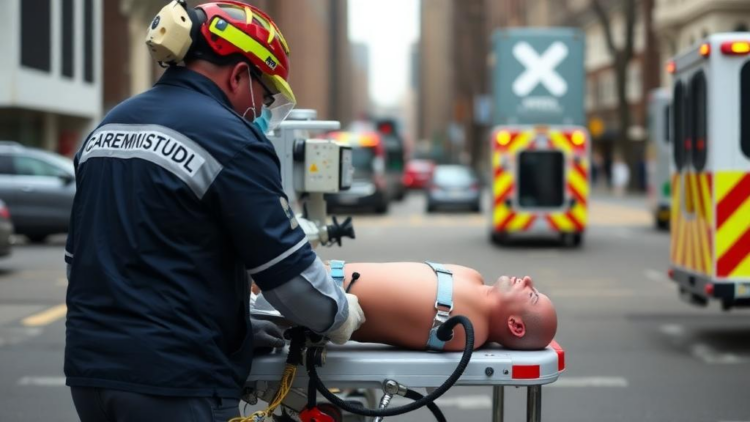
When someone collapses in cardiac arrest, every minute without circulation dramatically lowers their chances of survival and of walking out of the hospital with an intact brain. Conventional cardiopulmonary resuscitation, for all its life-saving value, is a blunt instrument: chest compressions generate only about 0.6 liters of blood flow per minute, a fraction of what a beating heart delivers. A new narrative review published in the Journal of Emergency and Disaster Medicine examines an audacious alternative—extracorporeal cardiopulmonary resuscitation, or ECPR, initiated not in the hospital but at the scene of the arrest itself. The review, led by Fatih Denizli of the Turkish Ministry of Health together with Zühal Kınış of Erciyes University and Etem Hızaler of Kayseri University, surveys global experience with prehospital ECPR and asks whether such a program could ever work in a resource-constrained health system like Turkey’s.
The technology behind ECPR is borrowed from extracorporeal membrane oxygenation, or ECMO, the machine that made headlines during the COVID-19 pandemic as a last-resort lung support. In venoarterial ECMO, blood is drained from large veins, passed through a membrane oxygenator that adds oxygen and removes carbon dioxide, and pumped back into the arterial system. Applied during cardiac arrest, this circuit can push roughly 2.0 liters per minute through the body—more than three times what compressions achieve—sustaining the brain, heart, and other organs while clinicians treat the underlying cause of the arrest. The catch is time. Studies reviewed by the authors show that for every ten-minute delay between collapse and the start of ECPR, the likelihood of favorable neurological recovery falls significantly, which is precisely why researchers have begun moving the machines out of the hospital and into ambulances.
The randomized trial evidence is striking but nuanced. In the American ARREST trial, patients with out-of-hospital cardiac arrest and refractory ventricular fibrillation who received early ECPR were discharged from the hospital at a rate of 43 percent, compared with just 7 percent among those receiving conventional resuscitation. Yet two European trials, INCEPTION in the Netherlands and PRAGUE-OHCA in the Czech Republic, found no such advantage—and the review’s authors point to a telling detail: in those studies, the average time to ECPR initiation stretched to roughly 61 to 74 minutes. The emerging consensus is that ECPR delivers meaningful benefit only when the so-called low-flow duration, the interval without effective circulation, stays under about 60 minutes, and only in carefully selected patients. Even then, the sub-60-minute mark is a benchmark rather than an absolute cutoff, since good outcomes have occasionally been achieved beyond it when compressions remain high quality.
Prehospital ECPR aims to attack the clock directly. Instead of resuscitating at the scene and then transporting, specialized teams reach the patient quickly and establish ECMO support either on-site or inside a mobile intensive care unit, working in parallel with compressions and airway management. Observational data suggest the approach is feasible: favorable neurological outcomes have been reported in roughly 20 to 25 percent of prehospital ECPR patients. A French analysis by Leroux and colleagues found no survival difference between prehospital and in-hospital initiation, but the low-flow duration was a full 30 minutes shorter when ECMO was started in the field. In Germany, Walter and colleagues achieved survival with good neurological function in 24.6 percent of 69 prehospital ECPR patients, while a French helicopter-borne team described by Hutin and colleagues still recorded 15 percent favorable survival despite low-flow times exceeding 110 minutes.
A handful of systems worldwide have made this a reality. Paris pioneered mobile ECPR in 2011, dispatching 24/7 teams—an anesthesiologist or emergency physician, an anesthesia nurse, and a paramedic—alongside standard mobile intensive care units, with a goal of establishing ECMO within 60 minutes of collapse. The first reported Paris case involved a marathon runner who received 4.5 liters per minute of extracorporeal flow about an hour after the emergency call and began recovering organ function within two days. In Albuquerque, New Mexico, the University of New Mexico partnered with the local fire department in 2019 to field a specially equipped ambulance crewed by an ECPR-trained intensivist and two paramedics, targeting witnessed arrests where hospital transport would exceed 35 minutes. The Netherlands equips all of its air ambulance units with ECPR capability, and in Regensburg, Germany, ambulance crews and the ECPR team are dispatched simultaneously, with exclusion criteria such as trauma, terminal illness, and unwitnessed arrest filtering candidates before cannulation begins.
The procedure itself relies on peripheral cannulation rather than open-chest surgery. Central access, which requires a sternotomy and placement of catheters in the right atrium and aorta, is considered infeasible in the field. Instead, teams use the percutaneous Seldinger or semi-Seldinger technique, typically accessing the femoral artery and vein, sometimes with ultrasound guidance. Recent studies support both approaches in prehospital protocols, and the review’s authors argue that restricting field programs to these percutaneous methods shortens intervention time and reduces complications. The technique is not without hazards: femoral cannulation carries a real risk of distal limb ischemia, particularly when a distal perfusion catheter cannot be placed, and achieving hemostasis in anticoagulated patients is difficult in uncontrolled environments. Maintaining aseptic technique at a roadside scene presents yet another challenge that early enthusiasm sometimes understates.
Training is the other formidable barrier. International teams typically comprise at least one physician, a nurse, a paramedic, and intensive care expertise, all credentialed in ECMO circuit setup, management, and troubleshooting. An Australian program described in the review trained 11 physicians and 6 critical care paramedics with no prior ECMO experience through a multiphase curriculum combining animal models, cadaver-based cannulation practice, simulation scenarios, and formal examinations; every participant ultimately met the learning objectives. The Extracorporeal Life Support Organization recommends certified basic and advanced ECMO training for anyone involved in ECPR. Patient selection is equally strict: candidates generally must have a witnessed arrest, immediate bystander CPR, a shockable initial rhythm such as ventricular fibrillation, and a low-flow duration under 60 minutes, while terminal illness, traumatic arrest, and advanced age—often capped at 65 to 70 years in French and Dutch protocols—exclude patients. Even so, only an estimated 2 to 10 percent of out-of-hospital cardiac arrest patients are potential candidates.
For Turkey, the review paints a sobering baseline. The national TROHCA study of 1,003 out-of-hospital arrests found that only 4.4 percent of patients reaching the hospital survived to discharge and just 2.7 percent achieved favorable neurological outcomes—figures below the global average, driven in part by bystander CPR rates of only about 2 to 5 percent. Turkish ECMO experience is limited to in-hospital cases: a Koşuyolu hospital series reported 36.4 percent neurologically intact survival among 22 in-hospital arrest patients, a Başkent University series weaned only 30.4 percent of 46 cardiac patients from VA-ECMO, and only a small number of Turkish centers are registered with ELSO. No prehospital ECPR case has ever been reported in the country, and no formal ECMO transport teams exist. The authors propose a phased pilot built on a centralized hub-and-spoke model with a Targeted-Dispatch strategy: local 112 teams begin high-quality resuscitation immediately, and if a witnessed arrest meets strict criteria without return of spontaneous circulation within ten minutes of advanced life support, a dedicated ECPR team deploys from a hub hospital to perform ultrasound-guided percutaneous cannulation in the field or a mobile intensive care unit.
Cost looms over any such plan. An Australian analysis by Zmudzki and colleagues estimated the average prehospital ECPR cost per patient at 12,741 Australian dollars, with a cost-effectiveness ratio near 44,000 dollars per quality-adjusted life year—falling to roughly 22,000 dollars when secondary benefits such as increased organ donation were included. The review’s authors stress that ECPR should be framed not as a replacement for basic life support but as an apex intervention layered on top of a strengthened chain of survival, and they call for ethical and legal governance covering clinical liability, consent, and withdrawal criteria, alongside formal cost-utility analysis before any rollout. Their proposed framework, they caution, is an expert-informed pilot concept rather than a validated protocol, limited initially to metropolitan regions with short transport distances and ECPR-capable referral hospitals. If prospective studies confirm feasibility, the idea of a heart-lung machine humming beside a roadside could move from medical science fiction to standard emergency care—one carefully selected patient at a time.
Subject of Research: Prehospital extracorporeal cardiopulmonary resuscitation for refractory out-of-hospital cardiac arrest
Article Title: Prehospital extracorporeal cardiopulmonary resuscitation: global trends and the Turkish perspective
Article References: Denizli, F., Kınış, Z., & Hızaler, E. (2026). Prehospital extracorporeal cardiopulmonary resuscitation: global trends and the Turkish perspective. Journal of Emergency and Disaster Medicine, 2(1), Article 20. https://doi.org/10.1007/s44467-026-00023-y
Image Credits: AI Generated
DOI: 10.1007/s44467-026-00023-y
Keywords: ECPR, ECMO, cardiac arrest, prehospital care, resuscitation, out-of-hospital cardiac arrest, emergency medicine, patient selection, cannulation, cost-effectiveness, Turkey, emergency medical services
Cite Scienmag News
APA MLA Chicago
Ophelia Keating. (September 30, 2026). Starting Heart-Lung Machines in the Street: The Race to Resuscitate Cardiac Arrest Victims. Scienmag. https://scienmag.com/starting-heart-lung-machines-in-the-street-the-race-to-resuscitate-cardiac-arrest-victims/
Ophelia Keating. “Starting Heart-Lung Machines in the Street: The Race to Resuscitate Cardiac Arrest Victims.” Scienmag, 30 September 2026, https://scienmag.com/starting-heart-lung-machines-in-the-street-the-race-to-resuscitate-cardiac-arrest-victims/. Accessed 30 September 2026.
Ophelia Keating. “Starting Heart-Lung Machines in the Street: The Race to Resuscitate Cardiac Arrest Victims.” Scienmag. September 30, 2026. https://scienmag.com/starting-heart-lung-machines-in-the-street-the-race-to-resuscitate-cardiac-arrest-victims/
Copy citation Download RIS
Tags: cannulationcardiac arrestchallenges of implementing ECPR in developing countriesCost-effectivenessECMOECPRECPR for cardiac arrestemergency medical servicesEmergency Medicineextracorporeal membrane oxygenation in emergency medicineglobal experiences with prehospital ECPRimpact of early extracorporeal support on survival ratesinnovations in out-of-hospital cardiac arrest treatmentlife-saving potential of mobile ECMO unitsout-of-hospital cardiac arrestpatient selectionprehospital careprehospital extracorporeal cardiopulmonary resuscitationresource-constrained healthcare systems and advanced resuscitationresuscitationstreet-level resuscitation techniquesTurkey