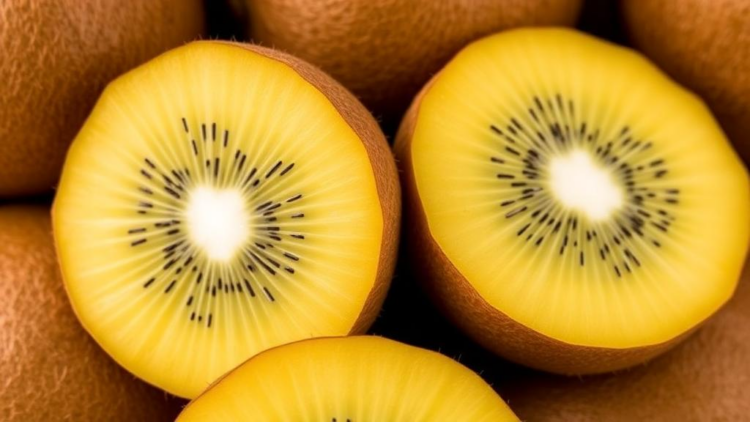
For growers of the red-hearted ‘Hongyang’ kiwifruit, one of China’s most prized commercial varieties, the blush of color on the fruit’s skin is more than decoration—it is a signal of quality that shapes market value. A new study published in BMC Genomics has now traced, at the level of individual genes and metabolites, exactly what happens inside the skin when growers wrap developing fruit in protective paper bags. The findings reveal that bagging drains the fruit of carotenoids, the yellow-orange pigments that dominate its exterior, while also quietly suppressing the machinery that builds anthocyanins, the red-purple compounds responsible for deeper coloration.
Bagging is a long-standing, pesticide-free technique used across fruit orchards in East Asia. By enclosing young fruit in paper covers, farmers shield them from insect damage, sunburn, and pesticide residue, often producing a more uniform and attractive appearance at harvest. Yet the practice has a well-known side effect: bagged fruit frequently emerges paler than its sun-exposed counterparts. For most crops this trade-off is acceptable, but the underlying biology has remained murky, particularly in kiwifruit, where the pigments involved and their regulatory networks had not been systematically dissected until now.
A team of researchers at Chongqing University of Arts and Sciences, led by corresponding author Xuelian Sang, set out to close that gap. They combined three complementary layers of analysis—physiological measurements of pigment content, untargeted metabolomic profiling of the fruit skin, and transcriptomic sequencing to capture which genes were switched on or off. This integrative approach, applied to ‘Hongyang’ kiwifruit (Actinidia chinensis), allowed them to connect the visible phenotype of pale skin to specific molecular events occurring along the flavonoid and carotenoid biosynthetic pathways.
The physiological measurements delivered the first surprise. When the researchers quantified pigment levels in bagged versus unbagged fruit, the dominant effect was a pronounced reduction in carotenoid accumulation—the pigments that give kiwifruit skin its characteristic yellowish-brown tone. Anthocyanins, by contrast, played only a minor role. Even in the control fruit, anthocyanin content was strikingly low, measuring just 11 micrograms per gram of skin at 130 days after pollination. This means that in ‘Hongyang’, the story of bagging-induced color loss is overwhelmingly a carotenoid story, with anthocyanins as a supporting character rather than the protagonist.
Metabolomic profiling sharpened the picture further. The team detected 33 differential metabolites between bagged and control fruit skins—15 that increased and 18 that decreased. Crucially, every one of the differential metabolites assigned to the flavonoid biosynthesis pathway, designated map00941 in the Kyoto Encyclopedia of Genes and Genomes, was present at significantly lower levels in the bagged fruit. This wholesale suppression of flavonoid pathway output suggested that bagging was not merely tweaking a single enzymatic step but dampening the entire metabolic pipeline that feeds pigment production.
To understand how that suppression was orchestrated, the researchers turned to their transcriptomic data. The decrease in anthocyanin accumulation in bagged fruit was accompanied by the downregulation of several structural genes that encode the enzymes of anthocyanin biosynthesis, including CHS (chalcone synthase), CYP73A (a cytochrome P450 enzyme), DFR (dihydroflavonol 4-reductase), and F3H (flavanone 3-hydroxylase). These enzymes sit at critical junctions of the pathway: CHS catalyzes the first committed step toward all flavonoids, while DFR channels intermediates toward the anthocyanin branch. When these genes fall silent, the flux of precursors into colored compounds slows to a trickle. The team also observed differential expression of MBW transcription factors—the protein complexes composed of MYB, bHLH, and WD40 subunits that act as master switches controlling anthocyanin gene expression—indicating that bagging exerts its influence at the regulatory level as well as the enzymatic one.
The metabolite data added an intriguing wrinkle. Among the 33 differential metabolites, one compound moved in the opposite direction from the anthocyanins: neohesperidin, a flavanone glycoside, increased in bagged fruit, while four other metabolites—butin, afzelechin, eriodictyol, and gallocatechin—all decreased alongside the anthocyanin decline. The authors are careful to frame these patterns as correlative rather than causative, but the inverse relationship between neohesperidin accumulation and anthocyanin reduction hints at a possible regulatory link. One speculative mechanism is metabolic competition: if pathway intermediates are diverted toward neohesperidin synthesis, fewer substrates remain available for the anthocyanin branch. Alternatively, neohesperidin accumulation could be a downstream consequence of the same transcriptional reprogramming. Distinguishing between these possibilities will require targeted experiments, but the correlation provides a concrete lead for future functional studies.
The carotenoid side of the story proved equally revealing. Bagging markedly altered the expression of two key genes in the carotenoid biosynthesis pathway. The gene crtZ, which encodes beta-carotene hydroxylase—an enzyme that converts beta-carotene into zeaxanthin—was downregulated by a staggering 95 percent. Meanwhile, LCY-epsilon, which encodes lycopene epsilon-cyclase, an enzyme that channels carotenoid precursors into the alpha-carotene and lutein branch, was upregulated 2.16-fold. The near-total shutdown of crtZ is particularly striking, as it effectively blocks the hydroxylation steps needed to produce the oxygenated xanthophylls that contribute significantly to skin color. Together, these transcriptional shifts plausibly account for the observed drop in total carotenoid content, though the authors note the association remains to be validated experimentally.
What makes this study methodologically notable is its integrative design. Rather than relying on a single omics layer, the researchers cross-referenced physiology, metabolomics, and transcriptomics to build a coherent causal chain: bagging alters light exposure, which reshapes transcription factor activity, which suppresses structural genes, which depletes pigment precursors, which lightens the skin. Each link in that chain is supported by data, even if the full regulatory logic—from photoreceptor signaling to MBW complex assembly—remains to be worked out. The approach also surfaced candidate genes and metabolites that breeders and growers can now target, whether through optimized bagging schedules, selective breeding for pigment stability, or post-harvest treatments designed to restore coloration.
The practical implications extend beyond kiwifruit. Bagging is used on apples, pears, grapes, mangoes, and many other crops worldwide, and the molecular principles uncovered here—light-dependent carotenoid accumulation, transcriptional control of flavonoid flux, and the interplay between competing branches of the phenylpropanoid pathway—are broadly conserved across plant species. For the ‘Hongyang’ industry specifically, the study suggests that growers who want the protective benefits of bagging without sacrificing skin color may need to time bag removal carefully, allowing a window of light exposure before harvest to rebuild carotenoid reserves. It also provides a reference framework for optimizing bagging practices to improve both the appearance and quality of kiwifruit, turning what was once an empirical art into a science guided by genes and metabolites. As consumer demand for visually flawless, residue-free fruit continues to grow, studies like this one demonstrate how genomics can illuminate the quiet chemistry unfolding beneath a paper bag.
Subject of Research: Molecular mechanisms by which bagging treatment inhibits skin coloration in ‘Hongyang’ kiwifruit through carotenoid and flavonoid pathway regulation
Article Title: Integrative transcriptomic and flavonoid metabolomic analysis reveals how bagging inhibits skin coloration in ‘Hongyang’ kiwifruit (Actinidia chinensis)
Article References: Jue, D., Liu, Y., Liu, Y., Zhang, Z., Ren, C., Chen, T., Zhang, Q., & Sang, X. (2026). Integrative transcriptomic and flavonoid metabolomic analysis reveals how bagging inhibits skin coloration in ‘Hongyang’ kiwifruit (Actinidia chinensis). BMC Genomics. https://doi.org/10.1186/s12864-026-13413-3
Image Credits: AI Generated
DOI: 10.1186/s12864-026-13413-3
Keywords: kiwifruit, bagging treatment, skin coloration, carotenoid biosynthesis, anthocyanin, flavonoid metabolism, transcriptomics, metabolomics, Actinidia chinensis, gene expression, MBW transcription factors, fruit quality
Cite Scienmag News
APA MLA Chicago
Juliet Wilcox. (September 30, 2026). Why Bagged Kiwifruit Stay Pale: New Study Maps the Genes Behind Skin Color. Scienmag. https://scienmag.com/why-bagged-kiwifruit-stay-pale-new-study-maps-the-genes-behind-skin-color/
Juliet Wilcox. “Why Bagged Kiwifruit Stay Pale: New Study Maps the Genes Behind Skin Color.” Scienmag, 30 September 2026, https://scienmag.com/why-bagged-kiwifruit-stay-pale-new-study-maps-the-genes-behind-skin-color/. Accessed 30 September 2026.
Juliet Wilcox. “Why Bagged Kiwifruit Stay Pale: New Study Maps the Genes Behind Skin Color.” Scienmag. September 30, 2026. https://scienmag.com/why-bagged-kiwifruit-stay-pale-new-study-maps-the-genes-behind-skin-color/
Copy citation Download RIS
Tags: Actinidia chinensisanthocyaninanthocyanin regulation in kiwifruitbagging treatmentcarotenoid biosynthesiscarotenoid suppression in bagged kiwifruiteffects of fruit bagging on pigment biosynthesisflavonoid metabolismfruit qualitygene expressiongenetic basis of color changes in ‘Hongyang’ kiwifruitimpact of protective bagging on fruit colorationinfluence of bagging on fruit market qualitykiwifruitKiwifruit skin color geneticsMBW transcription factorsMetabolomicsmolecular mechanisms behind kiwifruit skin colorpigment pathway disruption due to baggingrole of genes and metabolites in fruit pigmentationskin colorationTranscriptomics