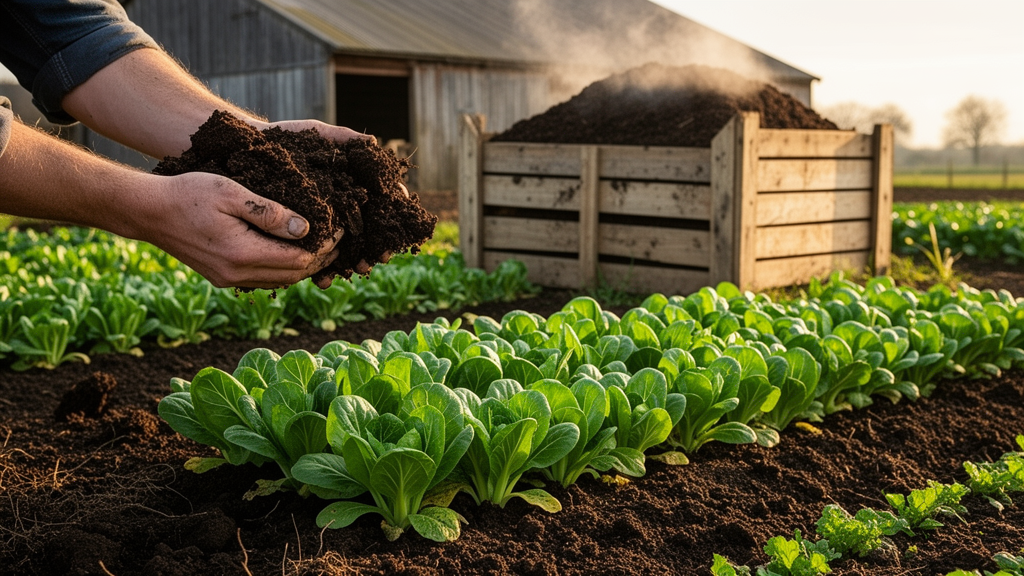
Composting cow manure has always been a race against time. The organic waste is rich in nitrogen and phosphorus, but turning it into stable, mature humus can take weeks, and slow humification often leaves farmers with a product that is either immature or of mediocre quality. Now a team at Central South University in Changsha, working with colleagues at Hunan Tevos Ecological Technology, has shown that the timing of microbial additions matters just as much as the microbes themselves. By inoculating compost piles with phase-specific microbial consortia at four distinct stages, the researchers produced compost with record humus content, superior nitrogen retention, and an organic fertilizer that dramatically outperformed both untreated compost and commercial inoculant products in pot-grown pakchoi.
The study, published in Frontiers in Microbiomes, addressed a pressing waste problem. China generates roughly 4 billion tons of poultry and livestock manure annually, alongside about 870 million tons of crop straw. Improper disposal, such as piling straw in fields or burning it, pollutes air and soil and squanders valuable organic matter. Cattle manure in particular contains abundant nutrients but also harmful substances including antibiotics, parasite eggs, and pathogenic bacteria. Aerobic composting is a promising recycling route, but it is a complex, microbially driven process that unfolds in four temperature-defined phases: a mesophilic heating stage, a thermophilic stage above 50 degrees Celsius, a cooling stage, and a maturation stage. Each phase is dominated by different microbial communities with different metabolic specialties, which is precisely why a one-size-fits-all inoculant added at the start often falls short.
The research team, led by Huanyao Li with Weimin Zeng and Jin Huang as corresponding authors, took a different approach. They first ran a preliminary composting experiment using cow manure from a farm in Anhua County, Hunan Province, mixed with chopped rice straw in cylindrical 50-liter fermentation tanks equipped with temperature probes, sampling ports, mechanical stirrers, and forced aeration at 0.45 liters per minute per kilogram. From samples collected on days 0, 2, 7, 14, 21, and 30, they isolated and purified 44 pure-culture strains with decomposition activity, matching the dominant taxa identified at each composting phase. During the mesophilic phase, dominant bacteria included Providencia stuartii, Klebsiella, and Brevundimonas strains; the thermophilic phase yielded Halomonas and multiple Bacillus subtilis strains; the cooling phase produced Halomonas, Alcanivorax, Rhodococcus rhodochrous, and Bacillus velezensis; and the maturation phase was characterized by Luteibacter anthropi and Halomonas strains. Additional functionally important strains were obtained from the China General Microbiological Culture Collection Center and the China Center of Industrial Culture Collection, and strains were blended at a 1:1 ratio to build phase-specific consortia.
The main experiment compared four treatments over a 30-day composting period: an uninoculated control (W), a staged commercial effective microorganisms (EM) inoculant containing Bacillus, Saccharomyces, Rhodopseudomonas, Acetobacter, Lactobacillus, Streptomyces, and Trichoderma, a single-dose composite inoculant (TF) containing all the same strains pre-mixed and added only at the start, and the staged targeted consortia (YF) added on days 0, 5, 14, and 22 to match the mesophilic, thermophilic, cooling, and maturation phases. The EM inoculant was applied at 0.4 percent by weight according to the manufacturer’s instructions, while the phase-specific and composite inoculants were applied at 0.9 percent to achieve comparable viable cell loads. Corn-cob powder, rich in cellulose and hemicellulose with a particle size of 100 to 200 mesh, was added to the control at corresponding phases to equalize carrier inputs.
The results were striking. The YF treatment achieved the longest thermophilic phase at 11 days, with a peak temperature of 62.87 degrees Celsius, exceeding the 10 days in the EM group and 8 days in the TF group, and comfortably meeting the Chinese industry standard NY/T 3442-2019 for pathogen inactivation. All inoculated treatments reached above 50 degrees Celsius by day 3, while the control took 4 days. Moisture content dropped furthest in the YF group, ending at 46.21 percent, reflecting the higher and longer heat output. By day 30, pH values in all groups ranged between 8.1 and 8.5, meeting the Chinese sanitary treatment standard GB/T36195-2018, and electrical conductivity in all treatments remained below 4 millisiemens per centimeter, indicating low salt hazard risk.
Carbon and nitrogen dynamics told a similar story. Total organic carbon decreased most in the YF and EM groups, with YF showing a 24.10 percent reduction compared to 16.23 percent in the control, indicating that staged inoculation promoted organic matter mineralization. Total nitrogen at the end of composting was highest in the YF treatment at 19.20 grams per kilogram, suggesting that the staged strategy reduced nitrogen loss through volatilization as ammonia. Humic substances reached 122.02 grams per kilogram in YF, a significant 24.72 percent increase over the control, while humic acid climbed to 92.32 grams per kilogram, a 35.81 percent increase. Fulvic acid, which is more active but less stable, was progressively converted into humic acid as composting proceeded, and the YF group showed the strongest fluorescence intensity for the humic acid-associated peak in three-dimensional excitation-emission matrix spectra of dissolved organic matter. Humification parameters including the humification ratio, humification index, and degree of polymerization were all significantly elevated in YF, and the seed germination index reached 90.63 percent, well above the 80 percent threshold generally considered to indicate harmless maturity. The control group, at 76.03 percent, failed to meet the standard.
High-throughput sequencing of the 16S rRNA gene V3-V4 region and the fungal ITS region revealed how the staged inoculation reshaped community succession. Bacterial Shannon diversity in the YF treatment decreased over time, which the authors attribute to targeted interventions producing a more specialized community rather than a diverse generalist one. Non-metric multidimensional scaling based on Bray-Curtis dissimilarity showed that bacterial community structures in the W, TF, and EM treatments followed similar trajectories, clustering together after the thermophilic phase, whereas the YF treatment exhibited significant shifts across time points with samples from different phases dispersed across the ordination space. At the phylum level, Firmicutes and Proteobacteria dominated, with Firmicutes enrichment in the inoculated treatments reflecting their thermotolerance and organic matter degradation capacity. At the genus level, the YF treatment showed distinct dominant taxa at each phase: Bacillus, Luteimonas, Cronobacter, and Providencia in the mesophilic phase; Bacillus, Planctomicrobium, Thermobacillus, and Vulgatibacter in the thermophilic phase; Bacillus, Planctomicrobium, Thermobacillus, and Paenibacillus in the cooling phase; and Flavobacterium and Luteimonas in the maturation phase, closely matching the taxa targeted for addition at those stages. Bacillus and Thermobacillus are renowned for thermotolerance and enzymatic machinery for degrading cellulose and hemicellulose, which contributed to the prolonged thermophilic phase, while Pseudomonas and Flavobacterium provided metabolic versatility for decomposing proteins, lipids, and simple sugars, generating precursors for humus synthesis.
Fungal communities were equally responsive. Ascomycota and Basidiomycota collectively accounted for more than 90 percent of relative abundance, with Basidiomycota more prominent in the early days and Ascomycota increasing in the middle and late stages. In the control group, the fungal community was relatively simple, dominated by Wallemia and Chaetomium, whereas no single genus exceeded 80 percent relative abundance in the TF and YF treatments, indicating a more complex fungal structure. In the YF treatment, Wallemia and Chaetomium were enriched initially, alongside the appearance of Thermomyces and Saccharomyces corresponding to the fungi added at that stage. Saccharomyces became dominant during the cooling and maturation phases, likely promoting stable microbial coexistence through metabolic exchange relationships. Redundancy analysis showed that pH was the primary explanatory factor for both bacterial and fungal community variance, followed by moisture content, humic substances, total organic carbon, electrical conductivity, temperature, and total nitrogen in descending order of influence for bacteria, and by total organic carbon, moisture content, total nitrogen, electrical conductivity, temperature, and humic substances for fungi.
The real test came in pot experiments. Four organic fertilizers derived from the respective compost treatments were applied at 3 percent by weight to 2.5 kilograms of soil per pot, with pakchoi grown under controlled conditions of 4000 lux light intensity, a 12-hour photoperiod, 60 to 80 percent relative humidity, and 20 to 30 degrees Celsius. On day 45, the YF-derived fertilizer treatment (YFP) achieved available nitrogen of 161.29 milligrams per kilogram, 98.3 percent higher than the unfertilized control and 19.8 percent higher than the EM-derived fertilizer. Available phosphorus reached 254.97 milligrams per kilogram, 118.2 percent above the control, and available potassium reached 184.40 milligrams per kilogram, 190.2 percent above the control. Plant height in YFP reached 20.83 centimeters, 261.1 percent higher than the control, and root length matched this figure exactly. Chlorophyll content climbed to 1.54 milligrams per gram, 126.5 percent above the control, while superoxide dismutase activity dropped to 305.17 units per gram, 30.2 percent below the control, indicating reduced oxidative stress and healthier plant growth. Electrical conductivity in the YFP soil decreased continuously over the 45-day period, reaching 272.19 microsiemens per centimeter, well below the 1000 microsiemens per centimeter threshold generally associated with salinization risk.
The authors conclude that phase-synchronized microbial management using autochthonous consortia represents a novel and practical framework for improving composting efficiency and product quality. While single-dose inoculation accelerated temperature rise, the high-temperature period was shorter than with staged addition, and the commercial EM inoculant had a weaker promoting effect on humification. By matching dominant microorganisms to each composting stage, the staged strategy enhanced cellulose and lignin degradation, drove the conversion of organic matter into stable humus, and reduced nitrogen loss. The study provides what the authors describe as the first empirical framework for phase-synchronized microbial management via indigenous consortia, revealing that temporal precision in community augmentation is critical for maximizing composting performance. For a livestock sector drowning in manure and a straw surplus that is too often burned, the message is clear: the right microbes at the right time can turn an environmental liability into a genuine agronomic asset.
Subject of Research: Environmental microbiology
Article Title: Enhancing cow manure composting via staged inoculation of functional microbial consortia
Article References: Li, H., Zeng, W., Huang, J., & Tan, S. (2026). Enhancing cow manure composting via staged inoculation of functional microbial consortia. Frontiers in Microbiomes, 5, Article 1855343. https://doi.org/10.3389/frmbi.2026.1855343
Image Credits: AI Generated
DOI: 10.3389/frmbi.2026.1855343
Keywords: aerobic composting, cow manure, microbial consortia, humification, staged inoculation, organic fertilizer, pakchoi, soil nutrients, Enhancing, manure, composting, staged
News Source: Morgan Morrow. (October 17, 2026). Staged Microbial Consortia Supercharge Cow Manure Composting and Boost Pakchoi Growth. Scienmag.