A three-year survey of rivers and streams across northeastern Algeria has uncovered a mayfly fauna far richer than anyone expected, including ten species that appear to be entirely new to science. The findings, published in Alpine Entomology, update the regional checklist of Ephemeroptera, the order of aquatic insects whose short-lived adults are among the most familiar sights above healthy freshwaters. Between 2018 and 2022, researchers documented 36 species across the region, with 15 recorded during a dedicated monthly sampling campaign across four hydrological regions. Nine of the ten new species are still awaiting formal description, making this one of the most significant contributions to North African mayfly taxonomy in decades.
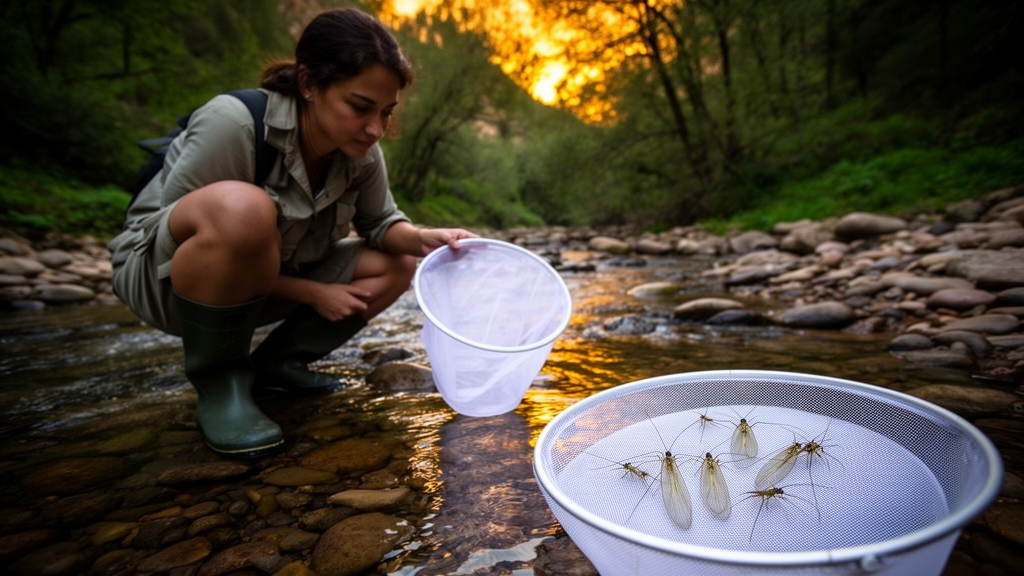
The survey spanned a remarkable environmental gradient, from the humid Mediterranean coast of the Collo region to the semi-arid steppe of Oum El Bouaghi and the high peaks of the Aurès Massif in Batna and Khenchela. Rainfall drops from roughly 800 millimetres per year in the north to about 350 millimetres in the south, while elevations range from below sea level at Chott Melghir to 2,328 metres at Djebel Chelia. This diversity of climates and altitudes creates a mosaic of ecological conditions that proved ideal for assessing mayfly diversity across the region. The team sampled 75 sites monthly from June 2019 to May 2022, using a dip net with a 500-micrometre mesh to collect larvae across different microhabitats, then preserved specimens in 80% ethanol for laboratory identification.
The most striking result concerns the genus Habrophlebia, which has undergone what the researchers describe as an explosive radiation in the Maghreb. No fewer than seven putative new Habrophlebia species were recorded in northeastern Algeria alone, all restricted to hilly or mountainous habitats but distributed across an extensive area stretching from the Tunisian border to the Djurdjura Mountains. These discoveries reinforce an emerging pattern of Maghrebian endemism, exemplified by already-described species such as Habrophlebia djurdjurensis from Algeria and H. vaillantorum and H. dakkii from Morocco. The findings also call into question previous records of European species in the region, with reports of H. fusca and H. consiglioi likely representing misidentifications that now require taxonomic reassessment.
Several factors may explain this remarkable diversity. Habrophlebia species occupy specialised ecological niches, have limited dispersal ability, and the Maghreb served as a refugium during glacial periods. Parts of the region likely functioned as biogeographical islands during marine transgressions, further promoting speciation. Alternatively, the genus may have originated in the Maghreb itself, with the region acting as a centre of radiation before spreading across the Mediterranean basin. This high endemism is not confined to mayflies: similar patterns have been documented in Maghrebian dragonflies, stoneflies, and caddisflies, suggesting the region’s freshwater ecosystems have fostered evolutionary diversification across multiple insect orders.
Beyond the new Habrophlebia species, the survey recorded a putative new baetid species (Procloeon sp. A) and two new heptageniid species (Ecdyonurus sp. Co and Rhithrogena sp. EK). The heptageniids are particularly interesting from a biogeographical perspective. Rhithrogena sp. EK appears to have a broad distribution similar to that of R. sartorii, which is endemic to Tunisia and Algeria, while five other Rhithrogena species in the Maghreb are all Moroccan endemics restricted to mountain streams. The two Ecdyonurus species are allotopic, meaning they inhabit distinct streams within the same river system, with preliminary data suggesting E. sp. Co may be confined to hilly and mountainous waters while E. rothschildi tolerates a wider range of conditions.
The survey also documented two rarely recorded burrowing mayfly species in North Africa: Ephemera glaucops (family Ephemeridae) and Ephoron virgo (family Polymitarcyidae). These species are adapted to soft substrates, where their larvae excavate burrows in sediment. Alongside them, the team recorded an interstitial species, Potamanthus luteus (family Potamanthidae), which does not burrow but instead inhabits the gaps between sand and sediment particles for shelter and foraging. All three species appear to be univoltine, completing one generation per year, and their presence seems to depend on particular hydrological regimes and the physical characteristics of the substratum.
Burrowing mayflies are among the most ecologically significant freshwater insects. They play a crucial role in nutrient cycling and are famous for their synchronised, seasonal mass emergences, which, despite often being considered a nuisance due to their sheer abundance, signify functional and productive hydrosystems. These emergences contribute significantly to the transfer of nutrients and biomass across ecotones, influencing both aquatic and terrestrial ecosystems. Burrowing mayflies also include species that are particularly sensitive to pesticides, as they are exposed to contaminants through direct contact with dissolved pollutants in water and the accumulation of toxins stored in sediments. Monitoring their populations therefore provides valuable insights into the health and stability of freshwater ecosystems, making them effective bioindicators of contamination levels in fluvial systems.
The vulnerability of these insects is well documented. In Midwestern waterways of the United States, increased eutrophication from agricultural runoff, coupled with chronic hypoxia, led to the disappearance of Hexagenia species, triggering cascading effects on aerial insectivores that depended on them as prey. While conservation efforts have supported partial recovery, and recolonization has been observed following catastrophic events, recent studies reveal fluctuating population trends that highlight ongoing vulnerability. In Algeria, aquatic insect populations, including mayflies, are undergoing a steep decline, with noticeable shifts in freshwater community structures. Regional data on mayflies remain scarce, making it difficult to assess long-term trends, which is precisely the knowledge gap this study begins to address.
Northeastern Algeria stands out as a major hotspot of freshwater biodiversity in the Mediterranean region, hosting numerous Maghrebian endemics, many of which are micro-endemics confined to single watersheds. The survey revealed that several species have highly restricted distributions: Procloeon sp. A, Oligoneuriopsis skhounate, and the burrowing mayfly Ephoron virgo are all localised in the Seybouse River, while Choroterpes lindrothi and Similicloeon simile appear to be restricted to the Djurdjura Mountains, and Cheleocloeon dimorphicum has only been recorded in the El Kala region. The region also serves as a well-documented refugium for Afrotropical relict taxa, including copepods, dragonflies, aquatic bugs, and beetles, which likely migrated across the hyperarid Sahara during a humid Holocene period. Beyond invertebrates, northeastern Algeria is home to endemic amphibians and fish, such as the newts Pleurodeles poireti and P. nebulosus, the tree frog Hyla carthaginiensis, and the Maghreb bleak, Tropidophoxinellus callensis.
The conservation stakes are considerable. Over 47% of freshwater species in North Africa are threatened with extinction, and many belong to species complexes or have been misidentified, as was the case with the Habrophlebia taxa until recently. The region faces increasing anthropogenic pressures driven by population growth, compounded by global challenges such as climate change, while water quality across Algerian rivers continues to deteriorate. Addressing this biodiversity crisis requires urgent, integrative conservation strategies, including ecosystem-based management, habitat restoration, and policy interventions. Equally important is a deeper understanding of these species’ genetic diversity and ecology, which are critical for developing targeted conservation efforts. The close association of burrowing mayflies with sediment and hyporheic zones, combined with their high sensitivity to environmental stressors, makes them particularly valuable for cost-efficient, rapid assessments of contaminants in fluvial systems. As the researchers note, sustainable management approaches must balance conservation priorities with human needs to safeguard the persistence of freshwater biodiversity and the essential ecosystem services these habitats provide.
Subject of Research: Updated checklist of mayflies from northeastern Algeria with biogeographical and ecological insights (Insecta, Ephemeroptera)
Article Title: Updated checklist of mayflies from northeastern Algeria with biogeographical and ecological insights ( Insecta , Ephemeroptera )
Article References: Hezil, W., Samraoui, F., Satour, A., Taferghoust, M., Boucenna, H., Vuataz, L., Gattolliat, J.-L., Sartori, M., & Samraoui, B. (2025). Updated checklist of mayflies from northeastern Algeria with biogeographical and ecological insights (Insecta, Ephemeroptera). Alpine Entomology, 9, 37-49. https://doi.org/10.3897/alpento.9.156544
Image Credits: AI Generated
Keywords: Updated, checklist, mayflies, northeastern, Algeria, biogeographical, ecological, insights, Insecta, Ephemeroptera, scientific research
News Source: Gavin Prescott. (October 17, 2026). Mayfly survey in northeastern Algeria reveals ten species new to science. Scienmag.