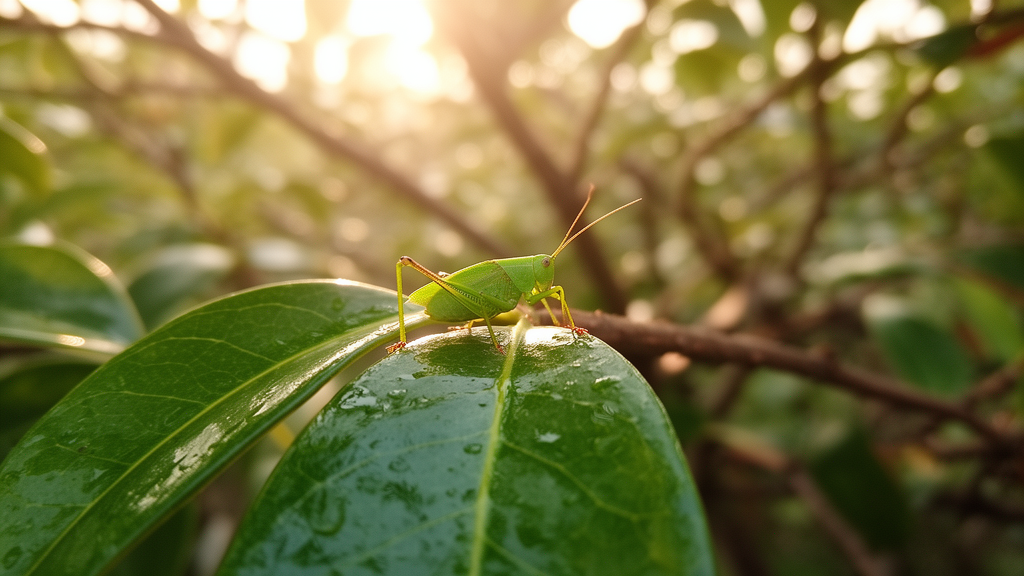
Deep in the subtropical orchards of southeastern China, a group of small insects has been hiding in plain sight. Scientists surveying the leafhoppers that feed on waxberry trees have uncovered something unexpected: an entirely new genus of idiocerine leafhoppers, never before recognized by science. The discovery, published in the Deutsche Entomologische Zeitschrift, includes not just one new species but two, both collected from the same economically important fruit crop. The finding reshapes what entomologists thought they knew about the leafhopper fauna of southern China and adds a fresh branch to the family tree of a subfamily better known for its mango pests.
Waxberry, Myrica rubra, is one of the most beloved fruit trees in southern China, cultivated for its sweet, juicy red fruits across vast orchards. Because the tree is perennial and widely grown, it supports a rich community of plant-eating insects. Previous surveys have documented at least 53 insect species associated with waxberry, including fruit-feeding beetles and foliage-dwelling moths. Among these, several leafhopper species had been recognized, but only a single idiocerine species, Idioscopus bimaculatus, had ever been recorded from the plant. Idiocerinae, the subfamily to which these insects belong, is predominantly associated with woody plants and often shows a high degree of host specificity. One genus in this group, Idioscopus, is economically important on mango in Asia, making any new idiocerine discovery on a fruit crop a matter of potential agricultural concern.
During recent surveys of leafhopper diversity in southeastern China, researchers collected idiocerine specimens feeding on waxberry from Fujian, Jiangxi and Zhejiang Provinces and the Guangxi Zhuang Autonomous Region. When the team examined the external morphology and male genital structures in detail, the specimens turned out to represent something previously unrecognized: a new genus of Idiocerinae, now named Chinaica. The genus is tentatively assigned to the tribe Idiocerini based on its overall morphology and male genital characters. Two new species are described within it: Chinaica myrica, the type species, and Chinaica viraktamathi, named in honor of Professor C.A. Viraktamath, a renowned hemipterist celebrated for his contributions to the taxonomy of Idiocerinae.
Chinaica leafhoppers are medium-sized insects, measuring between 5.1 and 5.9 millimeters long, with a yellowish brown ground color variably marked with fuscous markings on the back. The head features a crown of uniform length and a smooth surface, while the face is wider across the eyes than long. The ocelli, the small simple eyes characteristic of leafhoppers, sit above the ends of the frontal sutures, closer to the adjacent eyes than to each other. One of the most distinctive features of the new genus lies in the anteclypeus, a plate on the lower face: it is apically expanded laterally and distinctly projects beyond the genae, flat at the base but gradually raised toward the apex to form a median longitudinal ridge. This ridge is a key character separating Chinaica from its closest relatives, which have a flat anteclypeus.
The forewings of Chinaica carry four apical and three subapical cells, with the outer subapical cell smallest and closed, the central subapical cell closed, and the inner subapical cell longest and open basally. The hind femur bears macrosetae in a 2+1 formula, and the hind basitarsus carries three platellae on its distal transverse row, a number that distinguishes the genus from related groups with either four or two platellae. The abdominal apodemes, internal structures of the male abdomen, are robust and separated medially by a U-shaped notch, extending to the posterior margin of the fourth tergite. These anatomical details, invisible to the naked eye, form the backbone of modern leafhopper taxonomy, where genital structures and internal apodemes often provide the only reliable means of distinguishing closely related genera.
The male genitalia of Chinaica are particularly diagnostic. The pygofer, the lateral genital capsule, has a dorso-lateral fracture and a ventral process, while the anal collar, actually the modified tenth segment of the anal tube, is well developed and fused to a short pygofer dorsal bridge. The subgenital plates are elongate, slightly longer than the pygofer, and the style is elongate with an apophysis that curves slightly dorsally and carries a row of long stout setae near the subapex. The aedeagus, the intromittent organ, has a shaft that is dorsoventrally flattened and S-shaped, with the gonopore subapical on the ventral surface. The preatrium, an area of the aedeagus below the ventral rim of the atrium, is absent in Chinaica, a character the authors clarify has been frequently misidentified in descriptions of related genera.
Chinaica shares the S-shaped aedeagal shaft with two other genera, Amritodus and Paramritodus, but the three can be reliably separated by a suite of characters. Amritodus and Paramritodus both have finely rugose microsculpture on the crown, while Chinaica is smooth. The outer anteapical cell of the forewing is absent in both relatives but present in Chinaica. The number of platellae on the hind basitarsus is four in Amritodus, three in Chinaica, and two in Paramritodus. The subgenital plate length relative to the pygofer, the length of the pygofer caudal lobe, the setae of the style apophysis, and the length of the connective stem all provide additional separating characters. The authors also correct a long-standing confusion in the literature: the so-called male anal collar has been misinterpreted and is in fact the modified basal segment of the anal tube, variably fused to the dorsal bridge of the pygofer in Idiocerinae, accompanied by a very short pygofer dorsal bridge and the presence of a dorso-lateral fracture.
The two new species within Chinaica are distinguished from each other by subtle but consistent differences in the aedeagus and female abdomen. Chinaica myrica, the type species, has an aedeagal shaft that is less strongly sinuate with a non-bifurcate apex, and the hind margin of the female seventh sternite is slightly truncated. The species is known from Guangxi, where the holotype was collected on Mount Damingshan near Nanning at 1190 meters elevation in July 2021, along with dozens of paratypes from the same locality, some taken at light. Chinaica viraktamathi, by contrast, has a more strongly S-shaped aedeagal shaft with a bifurcated apex, and the hind margin of the female seventh sternite is deeply excavated, forming an inverted arc. This species has a much broader known distribution, with specimens from Jiangxi, Zhejiang, and Fujian Provinces, collected over more than a decade from 2008 to 2025, always by sweeping waxberry foliage.
The discovery of Chinaica underscores how much remains to be learned about the insect fauna of China’s orchards, even on crops as intensively studied as waxberry. Because idiocerine leafhoppers are predominantly associated with woody plants and often exhibit high host specificity, the fact that both new species were collected exclusively from waxberry suggests a close evolutionary relationship with this host. Whether these leafhoppers pose any threat to waxberry production remains to be seen, but their presence on an economically important fruit crop makes them a subject worth monitoring. The new genus also highlights the value of careful morphological study: features as small as the ridge on the anteclypeus, the number of platellae on a tarsus, and the shape of the aedeagal apex proved sufficient to reveal a lineage never before recognized, hidden among the leaves of one of China’s most familiar fruit trees.
Subject of Research: Taxonomy and morphology of a new genus of idiocerine leafhoppers from waxberry in China
Article Title: A new genus of idiocerine leafhoppers ( Hemiptera , Auchenorrhyncha , Cicadellidae ) from China on waxberry, with descriptions of two new species
Article References: Zhang, B., Fu, Z., & Webb, M. D. (2026). A new genus of idiocerine leafhoppers (Hemiptera, Auchenorrhyncha, Cicadellidae) from China on waxberry, with descriptions of two new species. Deutsche Entomologische Zeitschrift, 73(1), 105-113. https://doi.org/10.3897/dez.73.188389
Image Credits: AI Generated
Keywords: genus, idiocerine, leafhoppers, Hemiptera, Auchenorrhyncha, Cicadellidae, China, waxberry, descriptions, species, scientific research
News Source: Gavin Prescott. (October 17, 2026). New leafhopper genus Chinaica discovered on waxberry trees in China. Scienmag.