• HOME
  • NEWS
  • EXPLORE
    • CAREER
      • Companies
      • Jobs
    • EVENTS
    • iGEM
      • News
      • Team
    • PHOTOS
    • VIDEO
    • WIKI
  • BLOG
  • COMMUNITY
    • FACEBOOK
    • INSTAGRAM
    • TWITTER
Monday, June 29, 2026
BIOENGINEER.ORG
No Result
View All Result
  • Login
  • HOME
  • NEWS
  • EXPLORE
    • CAREER
      • Companies
      • Jobs
        • Lecturer
        • PhD Studentship
        • Postdoc
        • Research Assistant
    • EVENTS
    • iGEM
      • News
      • Team
    • PHOTOS
    • VIDEO
    • WIKI
  • BLOG
  • COMMUNITY
    • FACEBOOK
    • INSTAGRAM
    • TWITTER
  • HOME
  • NEWS
  • EXPLORE
    • CAREER
      • Companies
      • Jobs
        • Lecturer
        • PhD Studentship
        • Postdoc
        • Research Assistant
    • EVENTS
    • iGEM
      • News
      • Team
    • PHOTOS
    • VIDEO
    • WIKI
  • BLOG
  • COMMUNITY
    • FACEBOOK
    • INSTAGRAM
    • TWITTER
No Result
View All Result
Bioengineer.org
No Result
View All Result
Home NEWS Science News Chemistry

Stable radicals can solve unconventional problems in modern science and technology

Bioengineer by Bioengineer
October 10, 2019
in Chemistry
Reading Time: 3 mins read
0
IMAGE
Share on FacebookShare on TwitterShare on LinkedinShare on RedditShare on Telegram

Scientists of Tomsk Polytechnic University study reaction properties of verdazyl radicals, which can expand scientific knowledge into the field of organic chemistry and help to obtain new materials.
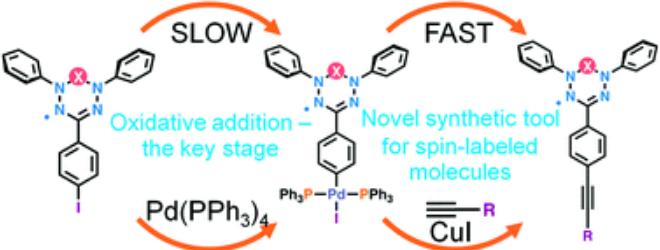
IMAGE

Credit: Tomsk Polytechnic University


Verdazyl radicals are stable molecules that are part of a variety of organic substances. You can literally sense, touch, and see them. More importantly, they can be applied for a variety of purposes since their properties differ from other classical organic molecules. Under certain conditions, these radicals have characteristics allowing them to solve unconventional problems in modern science and technology. For example, according to a concept, compounds based on stable radicals can be used for creating logical elements for a quantum computer.

The studies have demonstrated that we can combine radicals of various types in one molecule almost freely through a single reaction. In other words, they learned to control the structure of target compounds over a wide range. Combining the radical blocks like a puzzle, scientists found that these compounds acquire different properties. In the first instance, they combine the different properties of both radicals, in the second – they are complementary, and in the third – they are mutually exclusive.

Young scientists of the TPU Research School of Chemistry & Applied Biomedical Sciences Pavel Petunin and Daria Votkina research verdazyl radicals.

“The results that we obtain during our research often contradict the existing concepts of organic chemistry in this field. The obtained properties and reactions often challenge what we knew before. Thereby, we had to prove already existed knowledge in practice”, Pavel Petunin, an engineer at the TPU Research School of Chemistry & Applied Biomedical Sciences, says.

The results, obtained at the first stage of the studies, have already been transformed into independent projects. For instance, a project on energy storage is conducted jointly with the Catholic University of Louvain (Belgium), a project on the production of polymers using radicals jointly with the University of Aix-Marseille (France), and a project on the magnetic properties of radicals with the Max Planck Institute of Polymers (Germany). Scientists of Novosibirsk State University and the Novosibirsk Institute of Organic Chemistry SB RAS also participate in the studies. “For now we have developed several approaches for creating complex molecules based on stable radicals. We started putting forward our theories and preparing articles for publication in scientific journals” – Pavel Petunin says.

The study main goal is to accumulate knowledge about the chemical properties of stable radicals and to create unique matter, which will have practical applications in future.

###

The studies are conducted under the grants of the TPU Competitiveness Enhancement Program and the State Task “Science”.

Reference: Pavel Petunin was one of the first to defend his PhD thesis under a new system of state certification. Previously only the Ministry of Science and Higher Education of the Russian Federation could award doctor and candidate degrees. Later, this right was given to another 19 universities, including the Tomsk Polytechnic. Recently, TPU has awarded the first diplomas.

Media Contact
Vitalii Sdelnikov
[email protected]
7-382-260-6404

Original Source

https://news.tpu.ru/en/news/2019/10/10/35350/

Related Journal Article

http://dx.doi.org/10.1039/c9nj03361k

Tags: Chemistry/Physics/Materials SciencesIndustrial Engineering/Chemistry
Share12Tweet8Share2ShareShareShare2

Related Posts

AI and Physics Collaborate to Design Advanced Hydrogen Storage Materials

June 25, 2026

International Team Including Dresden Scientists Develops Novel Designer Proteins for Advanced Study of Living Tissue

June 25, 2026

New Study Uncovers Key Factors Driving Water Chemistry in Nanoscale Environments

June 25, 2026

Plasma Technology Extends Catalyst Lifespan in Hydrogen Production

June 24, 2026
Please login to join discussion

POPULAR NEWS

  • Saying Goodbye to PGY-6: Pediatric Fellowship Realities

    103 shares
    Share 41 Tweet 26
  • Multi-Hospital Study Reveals Long Covid Burden Is Twice as High as Current Estimates

    92 shares
    Share 36 Tweet 23
  • Detection of EDCs in Breast Milk and Infant Urine Up to Six Months Highlights Early Exposure Risks

    77 shares
    Share 31 Tweet 19
  • New Drug Candidate Developed at McMaster Shows Potential for Treating Brain Cancer

    58 shares
    Share 23 Tweet 15

About

We bring you the latest biotechnology news from best research centers and universities around the world. Check our website.

Follow us

Recent News

Tracking Lanthanide-Labeled Microplastics in Plants

POSTECH Researchers Slash Cost of Reconstituted Cell-Free Systems by 95%

AI and Physics Collaborate to Design Advanced Hydrogen Storage Materials

Subscribe to Blog via Email

Success! An email was just sent to confirm your subscription. Please find the email now and click 'Confirm' to start subscribing.

Join 82 other subscribers
  • Contact Us

Bioengineer.org © Copyright 2023 All Rights Reserved.

Welcome Back!

Login to your account below

Forgotten Password?

Retrieve your password

Please enter your username or email address to reset your password.

Log In
No Result
View All Result
  • Homepages
    • Home Page 1
    • Home Page 2
  • News
  • National
  • Business
  • Health
  • Lifestyle
  • Science

Bioengineer.org © Copyright 2023 All Rights Reserved.