


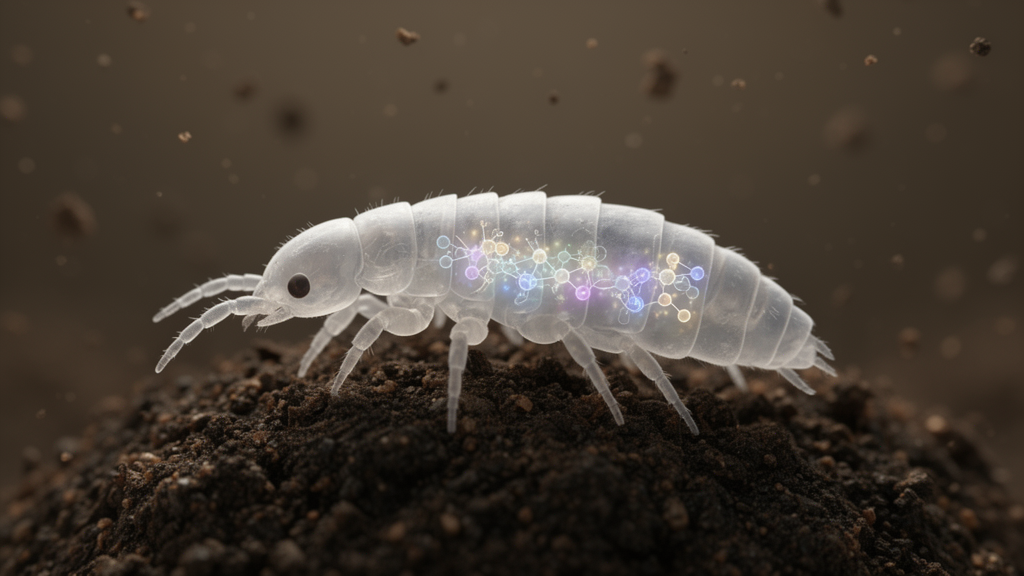
In the soil beneath our feet lives a tiny arthropod that has quietly preserved a body plan most insects abandoned long ago. The springtail Folsomia candida, a member of the basal hexapod group Collembola, carries three pairs of thoracic legs like any insect, but it also keeps a set of abdominal appendages that modern insects entirely lack: a ventral tube on the first abdominal segment used for osmoregulation, a retinaculum on the third segment that holds the springing organ in place, and the furca on the fourth segment, the robust jumping apparatus that gives springtails their name. A new study published in Development Genes and Evolution examines how the Hox gene Ultrabithorax, or Ubx, functions in this animal, and the results place collembolan Ubx in a striking evolutionary intermediate position between crustaceans, which retain abdominal limbs, and insects, which suppress them.
The research team, led by Yan Liang and Yun-Xia Luan, combined developmental transcriptome sequencing with functional assays in cell culture to dissect the regulatory relationship between Ubx and Distal-less, or Dll, the marker gene for appendage primordia across a wide range of animals. In Drosophila melanogaster, Ubx acts as a repressor of Dll in the abdominal segments, and this repression underlies the absence of abdominal limbs in adult insects. In the branchiopod crustacean Artemia franciscana, by contrast, Ubx cannot repress Dll, a functional shift attributed to phosphorylation sites in its C-terminus that impede limb suppression. Where collembolan Ubx falls on this spectrum has been an open question, particularly because previous work showed that collembolan Ubx, AbdA, and Dll are all expressed simultaneously in the developing abdomen, suggesting that repression fails in vivo despite the appendages that do form.
To build a foundation for functional analysis, the researchers synchronized three generations of F. candida from a Denmark strain and collected 51 samples spanning development from half a day after oviposition to day 50.5, sequencing transcriptomes from 15 of these stages, covering embryos, juveniles, and adults on the BGISEQ-500 platform. The embryonic timeline itself was carefully charted: embryos reach the gastrula stage by 1.5 days, appendage primordia begin forming at 2.5 days, the antenna and thoracic limbs start segmenting at 3.5 days, the furca appears by day 4, and appendages are fully formed by 8.5 days, with hatching around day 9.5 at 21 degrees Celsius. Principal component analysis, hierarchical clustering, and Pearson correlation of the transcriptomes recovered these morphological transitions, with post-hatching samples clustering together and embryonic stages grouping according to appendage phase.
Using the Short Time-series Expression Miner approach on four key embryonic time points, the team identified genes following trajectories consistent with appendage formation. Of the genes expressed at these stages, the analysis assigned them to 50 expression profiles, 12 of which were statistically significant, and cluster 42, showing a low-to-high developmental trend, contained 865 genes and 2,318 transcripts. Within this cluster sat a familiar cast of developmental regulators: the body patterning genes Notch and Engrailed, the proximal-distal limb axis genes Exd and Hth, the Hox selector genes Ubx, Antp, and Scr, plus genes tied to muscle and actin function such as the unconventional myosin MYO1E and Lim1, which regulates tarsal segments in flies. The authors caution, however, that these transcriptomes came from whole-mount animals, so the identified genes may also participate in organogenesis, neurogenesis, or other processes unrelated to limbs.
The expression dynamics of Ubx and Dll provided the study’s first key clue. In Drosophila embryos, Ubx expression exceeds that of Dll, consistent with its role as a Dll repressor in the abdomen. In F. candida, the relationship flips during early appendage formation: Dll dominates over Ubx at embryonic days 3.5 and 4.5, suggesting that FcUbx is deficient in suppressing Dll precisely when abdominal appendages emerge. From day 5.5 onward, however, Ubx expression surpasses Dll, hinting that repression might become possible during appendage maturation. Notably, the Hox cluster in F. candida lacks both spatial collinearity, because Scr, Antp, and Ubx are inserted into the anterior region of the complex, and temporal collinearity, since for example the pb gene is transcribed later than Dfd and Scr, and the most posterior gene AbdB peaks early at day 4.5.
To test binding directly, the researchers cloned two complete Ubx isoforms from F. candida, FcU1 with a short linker of five amino acids and FcU2 without a linker, produced the proteins in bacteria, and ran electrophoretic mobility shift assays. Both isoforms readily bound the DMXR element, the repression regulatory element within the Dll304 enhancer of Drosophila, and the dimer Exd/Hth stimulated binding to form trimeric Ubx/Exd/Hth complexes. The team also searched roughly 4,000 base pairs of intergenic sequence upstream of the collembolan Dll gene for Hox and Exd binding motifs, identifying a putative FcDll element on which the collembolan trimeric complex bound cooperatively. The conclusion was clear: the failure of collembolan Ubx to repress Dll in the embryo does not stem from any deficiency in DNA binding, pointing instead to other layers of regulation.
The surprise came from dual luciferase reporter assays in Drosophila S2 cells, where the firefly luciferase gene sat under control of the DMXR element. Despite previous reports that collembolan Ubx cannot repress Dll, both FcU1 and FcU2 significantly inhibited reporter expression, with activity comparable to that of DmUbx_Ib, the longest Drosophila isoform. The architecture of this repression, however, differed fundamentally from the insect version. In Drosophila, the long linker between the YPWM motif and homeodomain is indispensable, and replacing it with the short collembolan linker, or using the linker-less DmUbx_IVa isoform, abolished repression. For collembolan Ubx, the linker was simply not required. Deleting the C-terminus of either collembolan isoform significantly reduced repression, indicating a potential inhibitory domain there, while grafting the short collembolan C-terminus, ending in AKADCKSVY, onto the Drosophila protein caused a substantial loss of repression, suggesting the collembolan C-terminus carries regulatory or modification sites, likely a serine phosphorylation site, that modulate repressive function.
A cross-panarthropod sequence alignment sharpened the evolutionary picture. Crustacean Ubx proteins consistently maintain potential Ser/Thr phosphorylation sites in their C-termini, whereas insect Ubx proteins carry QAQA domains and poly-alanine stretches instead, structures crucial for Dll repression. The basal hexapods show a mosaic: proturan and dipluran Ubx contain QAQA domains, poly-alanine stretches, and phosphorylation sites, while collembolan Ubx lacks poly-alanine stretches but retains the QAQA domain plus a putative phosphorylated serine. Functionally, collembolan Ubx binds and represses like an insect protein, yet its C-terminal regulatory logic resembles the crustacean Artemia arrangement, supporting the authors’ model that its mechanism is genuinely intermediate between Crustacea and Insecta. A coexpression analysis across embryogenesis, using a Spearman correlation threshold above 0.95, identified 113 genes traveling with Ubx, including AbdA, the receptor tyrosine kinase ROR, and the phosphatases Ptp69D and Ptp99A, feeding the hypothesis that collembolan Ubx may be regulated by phosphorylation or dephosphorylation during embryogenesis.
From these threads the authors weave a context-specific model for how collembolan Ubx might sculpt the abdomen. In segments A1 and A3, where the ventral tube and retinaculum form, Ubx might be phosphorylated, possibly involving Ror, relieving repression of Dll and permitting appendage growth, with cofactors such as Lim1 and CG7526 shaping the distinct morphologies. In segment A2, which bears no appendage, two scenarios are proposed: either Ubx is dephosphorylated by Ptp69D or Ptp99A and represses Dll there, or the chromatin of the Dll regulatory region becomes inaccessible, blocking transcription. Both hypotheses remain untested, and the authors are explicit about the limitations: the putative FcDll element has not been validated as a genuine Dll regulatory region, because practical genetic tools for collembolans do not yet exist, and confirming the model will require approaches such as ChIP-seq or CUT&Tag to map Ubx-Dll interactions genome-wide, CRISPR editing of the candidate element, and spatial transcriptomic or ATAC-seq profiling of individual segments.
What the study delivers now is a reconstructed trajectory of functional domains in one of development’s most consequential transcription factors, tracing how DNA binding was retained across panarthropods while the capacity to repress Dll was gained, lost, and modulated. With only two complete collembolan Ubx sequences currently public, the authors note that the scarcity of basal hexapod sequences constrains firm conclusions about the ancestral hexapod state, and they anticipate that expanding genomic resources will consolidate the picture. For now, the springtail’s jumping organ and its humble ventral tube stand as living reminders that the loss of abdominal limbs in insects was not a single molecular switch but an incremental rewiring of Hox protein architecture, one phosphorylation site and one short linker at a time.
Subject of Research: Functional evolution of the Hox gene Ubx in regulating abdominal appendage formation in the springtail Folsomia candida
Article Title: The functional evolution of collembolan Ubx on the regulation of abdominal appendage formation
Article References: Liang, Y., & Luan, Y.-X. (2024). The functional evolution of collembolan Ubx on the regulation of abdominal appendage formation. Development Genes and Evolution, 234(2), 135-151. https://doi.org/10.1007/s00427-024-00718-0
Image Credits: AI Generated
DOI: 10.1007/s00427-024-00718-0
Keywords: Collembola, Ubx, Hox genes, Distal-less, abdominal appendages, Folsomia candida, evolutionary developmental biology, transcriptomics, phosphorylation, Drosophila melanogaster, Artemia franciscana, springtails
News Source: Gavin Prescott. (October 29, 2026). Springtail Hox Protein Reveals Evolutionary Middle Ground in Losing Abdominal Limbs. Scienmag.



