


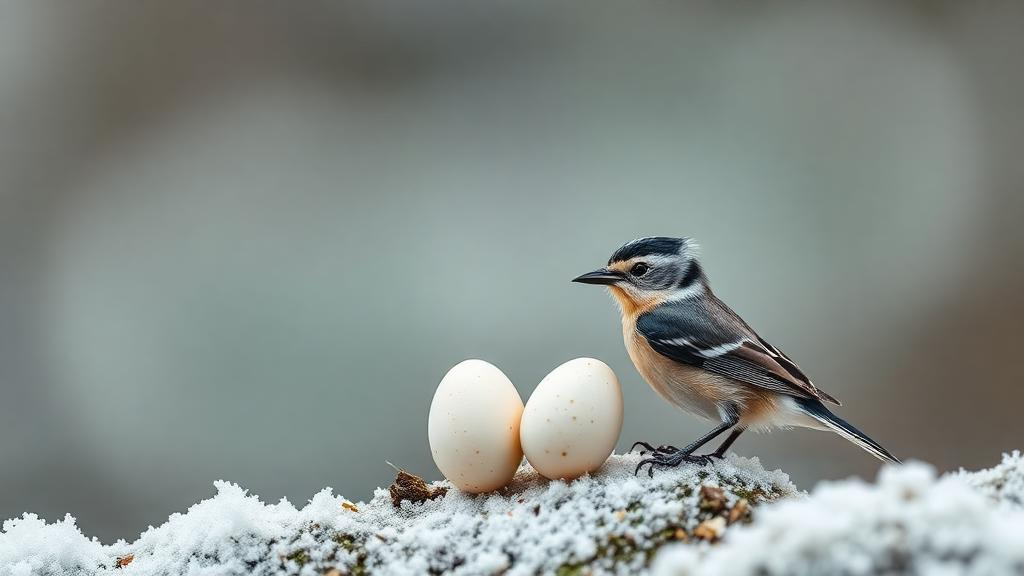
An abrupt spring frost that struck a montane population of Pied Flycatchers (Ficedula hypoleuca) in central Spain in 2024 led females to lay significantly smaller eggs, yet hatching success remained largely unaffected. That is the central finding of a new open-access study published in BMC Zoology, which used a natural experiment spanning three consecutive breeding seasons from 2023 to 2025 to ask how a single climatic extreme shapes maternal reproductive decisions in a wild bird population.
The research team combined standard reproductive monitoring of the breeding pairs with local temperature records and satellite-derived measurements of vegetation activity, known as the Normalized Difference Vegetation Index (NDVI). This combination allowed the researchers to link what females did at the nest with what happened to the landscape around them. Such late frosts following warm spells are expected to become a growing feature of a changing climate, which alters not only average temperatures but also the frequency and intensity of climatic extremes.
The biological mechanism the authors consider is trophic. Abrupt temperature fluctuations can damage newly emerged vegetation and reduce the availability of insect food for insectivorous birds precisely during reproduction, the period when females must gather the energy to produce eggs. Consistent with this, females in the frost year laid significantly smaller eggs than females in both the preceding breeding season of 2023 and the following season of 2025. By contrast, laying date and hatching success showed comparatively limited interannual differences across the three seasons.
The pattern leads the researchers to a specific interpretation: females reduced their reproductive investment when energetically constrained, but maintained overall reproductive performance. In other words, the birds appeared to trim the costliest component of reproduction, egg size, while protecting the outcome that matters most for producing offspring, successful hatching. The study suggests that short-lived climatic extremes may influence reproductive allocation even when downstream reproductive success remains relatively unaffected, a distinction that could matter for how scientists forecast the demographic consequences of extreme weather.
A further clue about how this flexibility works comes from within-individual variation. The researchers found low within-female repeatability of egg volume, meaning that the same female produced eggs of quite different sizes across years.
The authors emphasize that their findings highlight the importance of considering extreme weather events, alongside long-term warming trends, when evaluating how birds respond to climate change. This study adds a complementary dimension: a single pronounced frost event, compressed into a brief window after an unusually warm early spring, was enough to leave a measurable signature on egg investment in the same year it occurred.
Because the analysis rests on a natural experiment rather than a manipulated one, and covers a single montane population over three seasons, the results are an association observed in one population during one exceptional event rather than a demonstration of a universal rule. The authors frame their conclusions as consistent with the hypothesis of reduced investment under energetic constraint, and they note that the effects of such abrupt fluctuations on maternal reproductive investment remain poorly understood more broadly.
For the Pied Flycatchers of this central Spanish montane population, the 2024 frost left its mark not in failed nests or delayed laying, but in smaller eggs, a subtle shift in maternal allocation that hatching success did not reveal. As late-spring frosts following warm periods become more frequent under climate change, studies of this kind suggest that the first responses of breeding birds may show up in the resources they pack into their eggs, well before any change in the number of chicks they raise.
Subject of Research: How an abrupt spring frost influenced egg investment and hatching success in a montane Pied Flycatcher population
Article Title: Abrupt spring frost is associated with reduced egg investment but not hatching success in a montane Pied Flycatcher population
Article References: Barreda, I., Schaal, F., & Cantarero, A. (2026). Abrupt spring frost is associated with reduced egg investment but not hatching success in a montane Pied Flycatcher population. BMC Zoology. https://doi.org/10.1186/s40850-026-00286-y
Image Credits: AI Generated
DOI: 10.1186/s40850-026-00286-y
Keywords: Pied Flycatcher, spring frost, egg volume, hatching success, phenotypic plasticity, climate change, NDVI, reproductive investment, montane birds, central Spain, extreme weather, BMC Zoology
News Source: Drew Townsend. (October 29, 2026). Spring Frost Shrinks Eggs but Spares Hatching in Montane Flycatchers. Scienmag.



