• HOME
  • NEWS
  • EXPLORE
    • CAREER
      • Companies
      • Jobs
    • EVENTS
    • iGEM
      • News
      • Team
    • PHOTOS
    • VIDEO
    • WIKI
  • BLOG
  • COMMUNITY
    • FACEBOOK
    • INSTAGRAM
    • TWITTER
Tuesday, July 14, 2026
BIOENGINEER.ORG
No Result
View All Result
  • Login
  • HOME
  • NEWS
  • EXPLORE
    • CAREER
      • Companies
      • Jobs
        • Lecturer
        • PhD Studentship
        • Postdoc
        • Research Assistant
    • EVENTS
    • iGEM
      • News
      • Team
    • PHOTOS
    • VIDEO
    • WIKI
  • BLOG
  • COMMUNITY
    • FACEBOOK
    • INSTAGRAM
    • TWITTER
  • HOME
  • NEWS
  • EXPLORE
    • CAREER
      • Companies
      • Jobs
        • Lecturer
        • PhD Studentship
        • Postdoc
        • Research Assistant
    • EVENTS
    • iGEM
      • News
      • Team
    • PHOTOS
    • VIDEO
    • WIKI
  • BLOG
  • COMMUNITY
    • FACEBOOK
    • INSTAGRAM
    • TWITTER
No Result
View All Result
Bioengineer.org
No Result
View All Result
Home NEWS Science News

Spider silk can create lenses useful for biological imaging

Bioengineer by Bioengineer
June 30, 2020
in Science News
Reading Time: 3 mins read
0
IMAGE
Share on FacebookShare on TwitterShare on LinkedinShare on RedditShare on Telegram

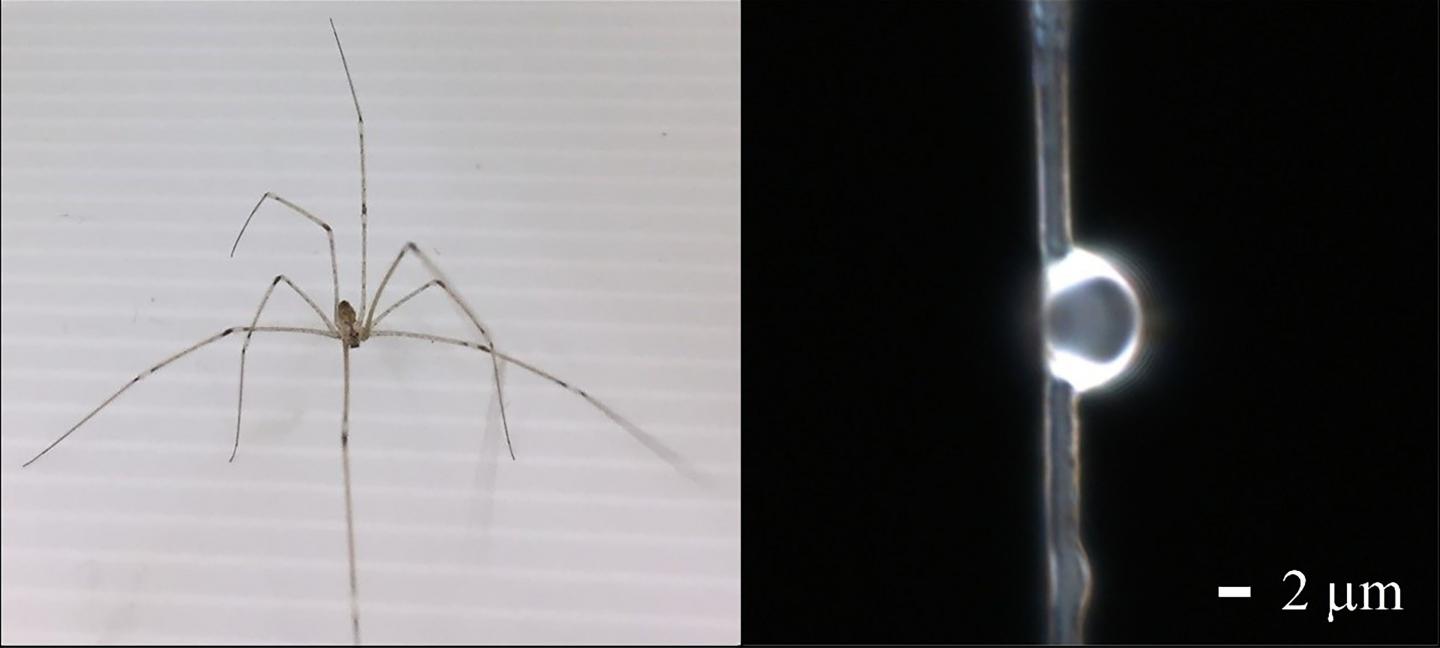
When properly cured, lenses built on dragline spider silk generate a special type of light jet that can image large biological areas with high resolution.
IMAGE

Credit: Cheng-Yang Liu

WASHINGTON, June 30, 2020 — Spiders — what are they good for? The answer, it turns out, is more than just insect control.

Spider silk is useful for a variety of biomedical applications. It exhibits mechanical properties superior to synthetic fibers for tissue engineering, and it is not toxic or harmful to living cells.

One unexpected application for spider silk is its use in the creation of biocompatible lenses for biological imaging applications. A team of researchers from Tamkang University and National Yang-Ming University in Taiwan describes the feasibility of creating lenses capitalizing on the properties of natural spider silk material in the Journal of Applied Physics, from AIP Publishing.

A spider can spin several different types of silks, each with different properties and functions. To create the spokes of their web, spiders use a type of silk known as dragline silk.

“Dragline silk is an interesting natural material because of its significant features, such as high elasticity, great toughness and large tensile strength,” said Cheng-Yang Liu, one of the authors on the study and a professor at National Yang-Ming University. Compared to its weight, the strength of dragline silk is greater than steel.

The authors collected smooth, uniform dragline silk from Pholcus phalangioides spiders, commonly known as daddy longlegs, and dripped a resin onto the silk fiber. As the resin condensed on the fiber, the wetting properties of the silk naturally formed it into a dome shape, which they found could be used as an optical lens. The mechanical and optical properties of the silk also make it ideal for supporting the lens.

When they shined a laser onto the lens, it generated a high-quality photonic nanojet — a type of beam that can provide large-area, super-resolution imaging for biomedical applications. By tuning the length of time the silk spends under the resin drip, the size of the dome lens can be changed, allowing the photonic nanojets to be optimized for the desired type of imaging.

“The dome lens with flexible photonic nanojets is suitable for imaging the nanoscale objectives in different depths within biological tissue,” Liu said.

After additional testing, the researchers hope this type of spider silk-based lens can be used to deliver light for biological imaging and operation.

###

The article, “Optimal photonic nanojet beam shaping by mesoscale dielectric dome lens,” is authored by C.B. Lin, Yi-Ting Lee and Cheng-Yang Liu. The article will appear in the Journal of Applied Physics on June 30, 2020 (DOI: 10.1063/5.0007611). After that date, it can be accessed at https://doi.org/10.1063/5.0007611.

ABOUT THE JOURNAL

The Journal of Applied Physics is an influential international journal publishing significant new experimental and theoretical results in all areas of applied physics. See https://aip.scitation.org/journal/jap.

Media Contact
Larry Frum
[email protected]

Related Journal Article

http://dx.doi.org/10.1063/5.0007611

Tags: BiologyBiomechanics/BiophysicsBiomedical/Environmental/Chemical EngineeringBiotechnologyChemistry/Physics/Materials SciencesMedicine/HealthOpticsTechnology/Engineering/Computer Science
Share12Tweet8Share2ShareShareShare2

Related Posts

Groundbreaking Surgery Completed on Western Lowland Gorilla at San Diego Zoo

July 14, 2026
UMA Scientists Enhance Morphine’s Pain-Relief Effectiveness

UMA Scientists Enhance Morphine’s Pain-Relief Effectiveness

July 14, 2026

New Method Enables Spinal Cord Recording in Freely Moving Rodents

July 14, 2026

Soil Nitrogen Controls Biochar’s Effect on Carbon Storage, Study Shows

July 13, 2026
Please login to join discussion

POPULAR NEWS

  • New Drug Candidate Developed at McMaster Shows Potential for Treating Brain Cancer

    58 shares
    Share 23 Tweet 15
  • Detection of EDCs in Breast Milk and Infant Urine Up to Six Months Highlights Early Exposure Risks

    77 shares
    Share 31 Tweet 19
  • Experimental Therapy Simultaneously Destroys Prostate Tumor Cells and Reactivates Antitumor Immunity

    46 shares
    Share 18 Tweet 12
  • 高齢者の骨粗鬆症治療の持続性比較

    51 shares
    Share 20 Tweet 13

About

We bring you the latest biotechnology news from best research centers and universities around the world. Check our website.

Follow us

Recent News

Groundbreaking Surgery Completed on Western Lowland Gorilla at San Diego Zoo

UMA Scientists Enhance Morphine’s Pain-Relief Effectiveness

New Method Enables Spinal Cord Recording in Freely Moving Rodents

Subscribe to Blog via Email

Enter your email address to subscribe to this blog and receive notifications of new posts by email.

Join 85 other subscribers
  • Contact Us

Bioengineer.org © Copyright 2023 All Rights Reserved.

Welcome Back!

Login to your account below

Forgotten Password?

Retrieve your password

Please enter your username or email address to reset your password.

Log In
No Result
View All Result
  • Homepages
    • Home Page 1
    • Home Page 2
  • News
  • National
  • Business
  • Health
  • Lifestyle
  • Science

Bioengineer.org © Copyright 2023 All Rights Reserved.