• HOME
  • NEWS
  • EXPLORE
    • CAREER
      • Companies
      • Jobs
    • EVENTS
    • iGEM
      • News
      • Team
    • PHOTOS
    • VIDEO
    • WIKI
  • BLOG
  • COMMUNITY
    • FACEBOOK
    • INSTAGRAM
    • TWITTER
Thursday, May 14, 2026
BIOENGINEER.ORG
No Result
View All Result
  • Login
  • HOME
  • NEWS
  • EXPLORE
    • CAREER
      • Companies
      • Jobs
        • Lecturer
        • PhD Studentship
        • Postdoc
        • Research Assistant
    • EVENTS
    • iGEM
      • News
      • Team
    • PHOTOS
    • VIDEO
    • WIKI
  • BLOG
  • COMMUNITY
    • FACEBOOK
    • INSTAGRAM
    • TWITTER
  • HOME
  • NEWS
  • EXPLORE
    • CAREER
      • Companies
      • Jobs
        • Lecturer
        • PhD Studentship
        • Postdoc
        • Research Assistant
    • EVENTS
    • iGEM
      • News
      • Team
    • PHOTOS
    • VIDEO
    • WIKI
  • BLOG
  • COMMUNITY
    • FACEBOOK
    • INSTAGRAM
    • TWITTER
No Result
View All Result
Bioengineer.org
No Result
View All Result
Home NEWS Science News

Solar perovskite production on a roll

Bioengineer by Bioengineer
November 10, 2020
in Science News
Reading Time: 2 mins read
0
IMAGE
Share on FacebookShare on TwitterShare on LinkedinShare on RedditShare on Telegram

IMAGE

Credit: © 2020 KAUST

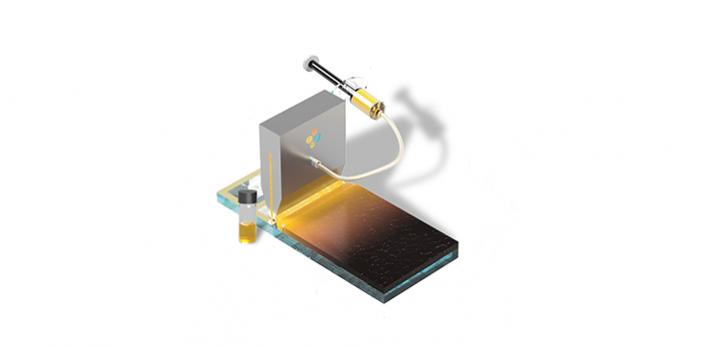
Advanced ink formulations could be the key to turning perovskite solar cells (PSCs) from heroes of academic labs into commercially successful products. Researchers at KAUST have developed a perovskite ink tailor-made for a mass manufacturing process called slot-die coating, producing PSCs that captured solar energy with high efficiency. The ink could also be coated onto silicon to create perovskite/silicon tandem solar cells that capture even more of the Sun’s energy.

“PSCs have shown a lot of promise in lab-scale work over the past decade,” says Anand Subbiah, a postdoc in Stefaan De Wolf’s lab. “As a community, we need to start looking at the stability and scalability of PSC technology,” he says.

PSCs made in research labs are typically made by spin-coating, which is unsuited to mass manufacture. Slot-die coating, in contrast, is a manufacturing technique used industrially for almost 70 years. “The process involves continuously and precisely forcing an ink through a narrow slit that is moved across the substrate to form a continuous film,” Subbiah says. “This high-throughput technique would allow for roll-to-roll fabrication, similar to printing newspapers.”

To produce high-efficiency slot-die coated PSCs, the team faced several challenges. Some of the best-performing spin-coated PSCs combine the perovskite with a poly(triarylamine) (PTAA) transport layer, but PTAA is hydrophobic and highly repellent to liquid perovskite ink. Adding a surfactant to the ink formulation overcame the repellence, resulting in better quality interface and films and better device performance, Subbiah says. The team also switched the ink to a lower-boiling solvent, reducing ink drying time without the need for further processing steps.

Overall, the team’s optimized slot-die coated PSCs captured solar energy with up to 21.8 percent efficiency, a significant improvement over the 18.3 percent previously recorded for PSCs made this way.

Even more significantly, from a commercial standpoint, was that the ink could readily be coated onto textured silicon to produce a perovskite/silicon tandem solar cell, Subbiah says. “We were also able to make the very first slot-die coated silicon-perovskite monolithic tandem solar cell, recording a 23.8 percent efficiency,” he says.

“The development of scalable deposition techniques for perovskite solar cells is essential to bring this technology from the research labs to the market,” De Wolf says. “Our next steps are making large-area devices and modules using our developed technology and testing their stability in the lab and the outdoors, while continuing to improve performance.”

###

Media Contact
Michael Cusack
[email protected]

Original Source

https://discovery.kaust.edu.sa/en/article/1042/solar-perovskite-production-on-a-roll

Related Journal Article

http://dx.doi.org/10.1021/acsenergylett.0c01297

Tags: Biomedical/Environmental/Chemical EngineeringChemistry/Physics/Materials SciencesIndustrial Engineering/ChemistryMaterials
Share12Tweet8Share2ShareShareShare2

Related Posts

Impact of Invitation Types on Breast Screening Attendance

May 14, 2026
SNOR Reactivates Translation After Dormancy — Medicine

SNOR Reactivates Translation After Dormancy

May 14, 2026

Triple-Negative Breast Cancer Ecotypes and Chemotherapy Response

May 14, 2026

Maveropepimut-S Combo Shows Promise in Ovarian Cancer

May 14, 2026
Please login to join discussion

POPULAR NEWS

  • Research Indicates Potential Connection Between Prenatal Medication Exposure and Elevated Autism Risk

    842 shares
    Share 337 Tweet 211
  • New Study Reveals Plants Can Detect the Sound of Rain

    729 shares
    Share 291 Tweet 182
  • Salmonella Haem Blocks Macrophages, Boosts Infection

    62 shares
    Share 25 Tweet 16
  • Breastmilk Balances E. coli and Beneficial Bacteria in Infant Gut Microbiomes

    57 shares
    Share 23 Tweet 14

About

We bring you the latest biotechnology news from best research centers and universities around the world. Check our website.

Follow us

Recent News

Impact of Invitation Types on Breast Screening Attendance

SNOR Reactivates Translation After Dormancy

Triple-Negative Breast Cancer Ecotypes and Chemotherapy Response

Subscribe to Blog via Email

Enter your email address to subscribe to this blog and receive notifications of new posts by email.

Join 82 other subscribers
  • Contact Us

Bioengineer.org © Copyright 2023 All Rights Reserved.

Welcome Back!

Login to your account below

Forgotten Password?

Retrieve your password

Please enter your username or email address to reset your password.

Log In
No Result
View All Result
  • Homepages
    • Home Page 1
    • Home Page 2
  • News
  • National
  • Business
  • Health
  • Lifestyle
  • Science

Bioengineer.org © Copyright 2023 All Rights Reserved.