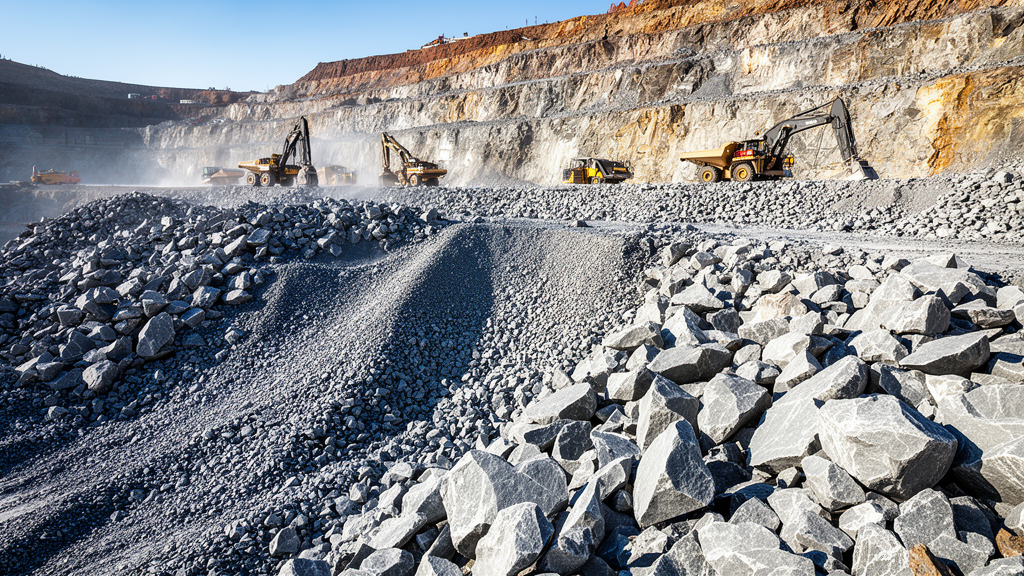
A hybrid artificial intelligence framework integrating the Crayfish Optimization Algorithm with Gaussian Process Regression has achieved superior predictive accuracy for blast-induced rock fragmentation in surface mining operations. Developed using an empirical dataset of 573 documented blasting records collected from a surface gold mine in Ghana, the optimized model recorded a mean squared error of 0.00581 and a correlation coefficient of 0.94370 when evaluated on an independent test dataset representing thirty percent of the observations. Non-parametric statistical validation through the Friedman test confirmed significant performance discrepancies across evaluated configurations, with the crayfish-tuned regression model securing the top mean rank of 1.00. The investigation demonstrates that coupling biologically inspired search algorithms with probabilistic machine learning architectures provides reliable, statistically rigorous predictions capable of informing downstream bench design without relying on trial-and-error blasting cycles.
Blasting serves as the principal mechanism for rock mass fragmentation and displacement across surface excavation, tunneling, and civil engineering projects, yet it remains characterized by notable thermodynamic and mechanical inefficiencies. Empirical mining assessments indicate that only twenty to thirty percent of commercial explosive energy is effectively channeled into fragmenting and displacing the targeted rock mass. The remaining seventy to eighty percent of detonation energy dissipates into the surrounding environment as airborne shock waves, seismic ground vibrations, overbreak, flyrock, and air overpressure. Inadequate fragmentation yields oversize boulders that demand secondary mechanical breaking or secondary blasting, driving up production expenditures. Conversely, excessive generation of fine particles diminishes processing plant throughput and accelerates abrasive wear on crushing and milling machinery, underscoring the necessity of accurate fragment size distribution control.
For decades, mining engineers have relied upon empirical formulas to project post-blast particle distributions from blast design parameters and rock mass properties. Foundational approaches such as the Rosin-Rammler distribution and the Kuz-Ram model pioneered the estimation of median fragment dimensions and uniformity indices from explosive quantities and rock structure. Advanced empirical iterations, including the Julius Kruttschnitt Mineral Research Centre crush zone and two-component models, integrated distinct mechanisms to account for fines produced in immediate borehole vicinities. Later adoptions of the Swebrec function produced the Kuznetsov-Cunningham-Ouchterlony model, offering improved distribution curve fits across extreme size fractions. Despite their widespread operational adoption, empirical formulations depend on rigid assumptions and site-specific calibration factors that struggle to accommodate the complex, highly non-linear geomechanical interactions governing explosive detonation within heterogeneous rock masses.
To overcome the limitations of classical empirical formulations, researchers have transitioned toward artificial intelligence architectures capable of mapping non-linear relationships across multi-dimensional geotechnical datasets. Within regression modeling for rock fragmentation, Gaussian Process Regression and Extreme Learning Machines offer complementary mathematical strengths. Gaussian Process Regression provides a non-parametric Bayesian learning framework that models output distributions through prior covariance kernels, delivering explicit quantification of predictive uncertainty vital for risk-sensitive mining decisions. Nevertheless, its performance depends strictly upon expert selection and numerical calibration of kernel hyperparameters. Conversely, the Extreme Learning Machine operates as a single-hidden-layer feed-forward neural network that computes output weights analytically via the Moore-Penrose generalized pseudoinverse, achieving rapid training. Despite this computational speed, the random initialization of input weights and hidden-layer biases induces parameter instability and inconsistent predictions across successive executions.
Although hybrid modeling has gained traction, prior studies predominantly examined single optimizer-algorithm pairings without investigating whether distinct algorithmic exploration mechanics align with specific predictive architectures. The present study addressed this research gap by establishing an optimizer-model compatibility framework comparing four modern nature-inspired metaheuristic algorithms across both Bayesian and neural paradigms. The evaluated optimizers comprised the Crayfish Optimization Algorithm, Greylag Goose Optimization, Puma Optimizer, and Hippopotamus Optimization Algorithm. The crayfish algorithm navigates continuous parameter spaces by alternating between exploration, competition, and foraging exploitation phases. Greylag Goose Optimization leverages coordinated flock dynamics and adaptive leadership to accelerate convergence while preserving population diversity. The Puma Optimizer incorporates predatory tracking, velocity adjustments, and escape mechanisms to traverse multimodal search terrains. Meanwhile, the Hippopotamus Optimization Algorithm balances global exploration and localized refinement by mimicking defensive positioning and evasive Gaussian perturbations.
The empirical foundation of the research was established at a large-scale surface gold mine operating within the Tarkwaian Group of the West African Craton in Ghana. Geologically situated approximately ten kilometers southwest of Tarkwa, the mining concession extracts ore from metavolcanic and metasedimentary lithologies of the Birimian Supergroup. Routine production involves standard open-pit drilling, blasting, loading, and hauling cycles supported by eighteen dedicated drill rigs, including Epiroc SmartROC T45, Epiroc DML, Sandvik DP1500i, and Rock Commander units. Drilling patterns across cutback zones maintain a staggered spacing of 4.4 meters by 4.8 meters, expanding to 5.0 meters by 5.5 meters within the main pit floor. The research team compiled 573 blasting events capturing operational variability under routine production conditions, with target mean fragment sizes determined through digital image processing of post-blast muck piles.
The modeling framework incorporated six input variables classified into explosive energy characteristics, rock mechanical resistance, and bench geometries. Geometric parameters were formulated as dimensionless ratios to minimize the distorting effects of absolute scale while preserving structural proportions, yielding spacing-to-burden, hole depth-to-burden, stemming-to-burden, and burden-to-hole diameter ratios. Explosive energy availability was quantified via the powder factor in kilograms per cubic meter, while rock mass resistance was represented by laboratory-measured uniaxial compressive strength in megapascals. Data integrity checks verified that all parameters exhibited variance inflation factor scores comfortably below the conservative multicollinearity threshold of 5.0. Extreme values flagged by interquartile range filtering were confirmed as legitimate production conditions and retained. The full dataset was partitioned into a seventy percent development subset and an isolated thirty percent testing subset using a fixed random seed of 2026 in MATLAB.
Prior to metaheuristic coupling, baseline configurations were determined using five-fold cross-validation restricted entirely to the model-development dataset. Predictor variables were normalized to a range between negative one and positive one, with scaling boundaries derived strictly from training folds to prevent data leakage. Among five candidate Gaussian process kernels, the Squared Exponential covariance function achieved the lowest cross-validation mean squared error of 0.05618 and the highest correlation coefficient of 0.77240. Among six candidate neural activation functions, an Extreme Learning Machine featuring a Radial Basis activation function and twenty-three hidden neurons demonstrated superior baseline performance, recording a validation mean squared error of 0.06376. These calibrated baselines ensured that subsequent accuracy gains could be credited directly to metaheuristic parameter tuning rather than baseline design defects.
During metaheuristic tuning, optimization routines calibrated length scale, signal variance, and noise variance for Gaussian processes, while optimizing input weights and biases for extreme learning networks. Across all evaluations, metaheuristic integration yielded substantial accuracy enhancements over unoptimized baselines. On the untouched thirty percent test partition, the Crayfish-optimized Gaussian Process Regression achieved the lowest mean squared error of 0.00581, a normalized mean squared error of 0.01620, a correlation coefficient of 0.94370, a Willmott Index of 0.93780, and a percentage bias of 6.02 percent. This performance marked an 89.66 percent reduction in mean squared error compared to the standalone Gaussian process model. Greylag Goose Optimization paired with Gaussian regression delivered the second-best test error at 0.00920, while Greylag Goose Optimization coupled with the Extreme Learning Machine led the neural network category with a test error of 0.01128.
Statistical evaluation confirmed that the observed performance variations among the ten investigated predictive models were statistically significant rather than artifacts of sampling variation. Conducting the Friedman test across the five validation folds yielded a test statistic of 44.83, exceeding critical thresholds at a significance level of p less than 0.001. The Crayfish-optimized Gaussian process attained the perfect mean rank of 1.00, followed by Greylag Goose Gaussian regression at 2.00 and Greylag Goose Extreme Learning Machine at 3.00. Unoptimized baseline models finished with the highest mean ranks, reflecting inferior predictive capability. Convergence curve tracking over one thousand iterations demonstrated that the crayfish algorithm systematically navigated the continuous kernel hyperparameter space of the Gaussian process, avoiding premature stagnation in local minima more effectively than competing optimizers.
Model interpretability was established through SHapley Additive exPlanations applied to the leading crayfish-optimized Gaussian process architecture. Uniaxial compressive strength emerged as the primary governing factor, exhibiting a dominant mean absolute SHAP value of 2.67. Beeswarm distribution plots revealed that elevated compressive strength produced consistently positive SHAP contributions, indicating that higher rock mass strength directly increases predicted mean fragment dimensions due to higher fracture resistance. Powder factor constituted the second most influential parameter with a mean absolute SHAP value of 0.96, displaying an inverse relationship where increased explosive concentration correlated with negative SHAP contributions and finer particle sizes.
To transition the empirical findings into practical engineering application, the authors constructed a standalone graphical user interface titled the Hybrid COA-GPR Rock Fragmentation Size Predictor using MATLAB App Designer. The software tool accepts the six primary blast parameters, validates entries against experimental calibration bounds, standardizes inputs, and executes the trained model to project fragment dimensions in centimeters within seconds. Despite its strong performance, the study authors emphasize that empirical calibration was conducted at a single Ghanaian gold extraction operation, leaving geological features such as joint spacing, joint condition factors, and initiation delay sequences outside the parameter matrix. Future research initiatives must focus on multi-site validation across variable lithologies, expanding structural joint inputs, and evaluating transfer-learning architectures to broaden operational deployment across global surface mines.
Subject of Research: Prediction of blast-induced rock fragmentation using hybrid metaheuristic machine learning models
Article Title: Explainable synergistic fusion of metaheuristic algorithms and machine learning models for rock fragmentation prediction in surface mine blasting
Article References: Ativor, G., Ziggah, Y. Y., & Temeng, V. A. (2026). Explainable synergistic fusion of metaheuristic algorithms and machine learning models for rock fragmentation prediction in surface mine blasting. Discover Civil Engineering, 3(1), Article 285. https://doi.org/10.1007/s44290-026-00682-w
Image Credits: AI Generated
DOI: 10.1007/s44290-026-00682-w
Keywords: Rock Fragmentation, Surface Mine Blasting, Gaussian Process Regression, Extreme Learning Machine, Crayfish Optimization Algorithm, Greylag Goose Optimization, Puma Optimizer, Hippopotamus Optimization Algorithm, SHAP Analysis, Uniaxial Compressive Strength, Powder Factor, Blast Design, Friedman Test, Digital Image Analysis, Mining Geomechanics, Decision Support Systems, Metaheuristic Algorithms
News Source: Denise Maddox. (November 22, 2026). Crayfish Optimization Paired with Gaussian Regression Accurately Predicts Mine Blasting Fragmentation. Scienmag.