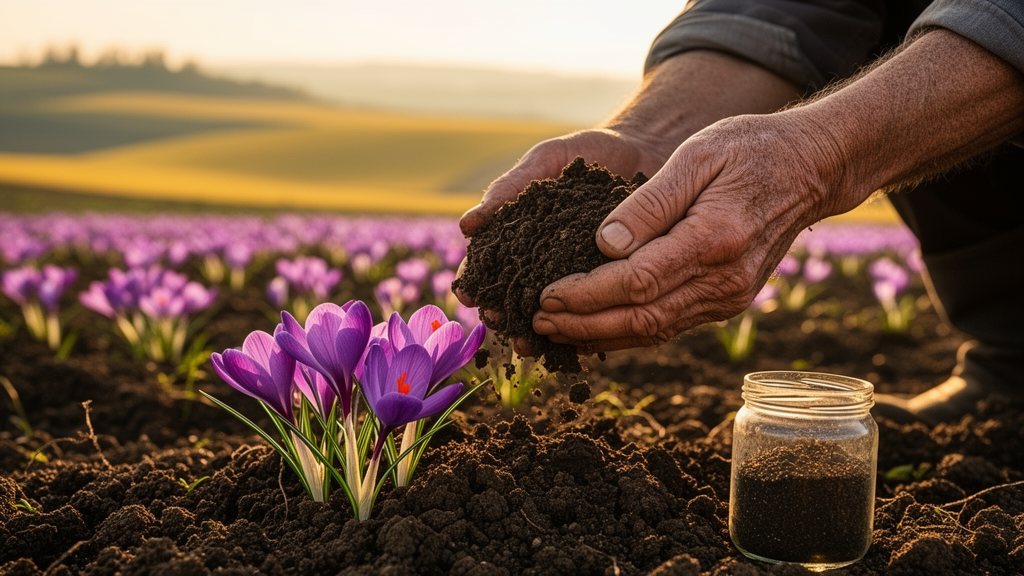
Saffron, the dried stigmas of Crocus sativus, is the most expensive spice in the world, and its production has been declining under pressure from soil degradation and other biotic and abiotic constraints. A three-year field study published in Discover Bacteria now reports that priming saffron corms with a bioformulation based on Bacillus sp. strain D5, a bacterium originally isolated from the corm sheath of saffron plants, significantly improved flowering, stigma biomass, stigma quality metabolites, vegetative growth and soil fertility at two cultivation sites in Jammu and Kashmir, India. Crucially, the study also shows that the size of these benefits was not uniform: it depended strongly on where the corms were grown and, to a lesser extent, on which of two saffron ecotypes was planted.
The research team, led by Tahir Ali, Nancy Bhagat, Nitika Sharma and Jyoti Vakhlu of the University of Jammu, describes the work as the first comprehensive multivariate analysis of a Bar D5-based bioformulation covering soil fertility and saffron growth performance across both a traditional and a non-traditional cultivation zone with two ecotypes. Corms of the Kashmir ecotype, obtained from farmers in Pampore, and the Kishtwar ecotype, from the Kishtwar district, were procured in mid-July 2020. Half of each ecotype’s corms were mock-primed with a sterile control formulation and half were primed with the Bar D5 bioformulation, a slurry of bacterial culture mixed with autoclaved calcium carbonate, producing four treatment sets.
The corms were planted in the first week of August 2020 at two contrasting sites: Pulwama in the Kashmir valley, the traditional saffron heartland, and Mandi in the Poonch district of the Pir Panjal range, where saffron cultivation had previously been extended but had produced corms and stigmas of lower quality than Pulwama. Field trials used a completely randomized block design with raised beds, roughly 33 to 34 corms per bed and three replicate beds per treatment at each location. No supplementary irrigation was applied, and data were collected during the flowering phase each November and the vegetative phase each March over three consecutive growing cycles, spanning the full three-year life cycle of the perennial crop.
The results showed that Bar D5 priming significantly increased flower number at both locations in all three years, and raised stigma fresh and dry weight across the study period. The three metabolites that determine saffron quality and market value under ISO 3632 standards, crocin, picrocrocin and safranal, were substantially increased in treated plants across all four location-ecotype combinations. Notably, by the third year the increase in crocin concentration was higher at the non-traditional Mandi site than at Pulwama, and the authors report that stigma quality from Bar D5-primed corms at Mandi became comparable to that from the traditional site, while quality at Pulwama was enhanced further beyond conventional levels.
The temporal patterns differed by compound and by trait. Crocin enhancement was greatest in the first year, dipped in the second and rose again in the third, while picrocrocin was lowest in the first year and peaked in the second. Safranal responses were ecotype-specific: the Kashmir ecotype mirrored the crocin pattern, whereas the Kishtwar ecotype showed progressive gains from the first to the third year. Among vegetative traits, shoot length, root length and number, leaf number and daughter corm weight all increased, but two parameters fell consistently: shoot number and daughter corm number declined in treated plants at every location-ecotype combination. Because daughter corm weight rose substantially and continued increasing through year three, the authors interpret this as a possible reallocation of resources toward fewer but larger corms, which is agronomically advantageous since corms above eight grams can produce more flowers with larger stigmas in subsequent cycles. The team notes this resource-allocation hypothesis needs further investigation.
Soil analysis, outsourced for comprehensive mineral testing, revealed significant differences between treated and control soils for five of fifteen measured parameters: organic carbon, nitrogen, phosphorus, potassium and calcium all improved at both locations. The response was stronger and more sustained at Mandi, particularly for organic carbon, nitrogen and calcium, whereas Pulwama showed a more moderate pattern. The authors suggest this may reflect Mandi soil’s comparatively lower exposure to chemical inputs, in contrast to Pulwama, where heavy fertilizer and pesticide use along with industrial dust deposition has degraded soil quality. Because soil samples were pooled per location, these comparisons reflect location-specific rather than ecotype-specific responses.
Microbial monitoring added an important caveat about durability. Total Bacillus load in the rhizosphere peaked in the first year and then declined sharply through years two and three at both sites, and the Bar D5 population itself followed the same downward trajectory, remaining far lower by year three than the initial priming load. Interestingly, the load of non-Bar D5 Bacillus was roughly one fold lower in treated soils, suggesting the introduced strain may inhibit some native relatives. Despite saffron’s rootless dormant phase, both the genus and the introduced strain persisted throughout the life cycle, leading the authors to speculate that the corm may act as a microbial reservoir that re-seeds the rhizosphere each season. Because the decline in Bar D5 load correlated with a weakening of its effects on plants and soil, the study concludes that annual reapplication of the bioformulation is likely required to sustain yield and quality benefits.
To integrate the full dataset, the researchers performed principal component analysis and Pearson correlation analysis on plant traits, yield attributes, soil nutrient changes and microbial parameters. The PCA explained 74.5 percent of total variance, with the first component, accounting for 43.5 percent, representing soil fertility and microbial abundance variables including organic carbon, nitrogen, phosphorus, potassium, calcium, total Bacillus load and stigma fresh weight, and the second, at 31.0 percent, capturing year-to-year temporal variation. At Pulwama, samples from both ecotypes clustered away from the fertility-associated axis in the second and third years, whereas at Mandi both ecotypes aligned with the fertility and microbial vectors in all three years. Location, the analysis indicated, influenced the bioformulation’s response more strongly than ecotype.
The correlation analysis also distinguished the two ecotypes. The Kashmir ecotype displayed compact, coherent correlation blocks with relatively uniform associations across traits, which the authors read as greater phenotypic stability, while the Kishtwar ecotype showed a more diffuse structure with greater variability among soil nutrients, microbial load and plant traits, indicating greater phenotypic plasticity and stronger environmental influence. At Mandi, the Kishtwar ecotype aligned more closely with fertility variables and higher stigma yield, while the Kashmir ecotype positioned nearer to daughter corm weight, suggesting divergent resource allocation between the ecotypes at that site. The consistent negative association between daughter corm number and daughter corm weight across all combinations pointed to a fundamental trade-off between corm proliferation and biomass accumulation.
The study’s practical implications are twofold. First, because the largest enhancement of stigma quality metabolites occurred in the first year after treatment while daughter corm benefits peaked in the third, harvest timing can be scheduled according to the grower’s goal, whether commercial spice production or corm propagation. Second, the findings position bioformulations as a feasible route for expanding saffron into non-traditional areas, an alternative to infrastructure-intensive controlled-environment systems that can be cost-prohibitive for small-scale farmers. The authors caution, however, that the magnitude of Bar D5’s effects is governed by a complex interplay of location, ecotype, soil health and the field persistence of the bacterium itself, and that application protocols will need standardization for optimal results.
Subject of Research: A three-year field study evaluating a Bacillus sp. strain D5 bioformulation for enhancing saffron yield, quality and soil fertility across two ecotypes and two cultivation locations in India.
Article Title: Corm ecotype and cultivation location modulate the magnitude of Bacillus sp. strain D5 mediated enhancement of saffron yield and quality
Article References: Ali, T., Bhagat, N., Sharma, N., & Vakhlu, J. (2026). Corm ecotype and cultivation location modulate the magnitude of Bacillus sp. strain D5 mediated enhancement of saffron yield and quality. Discover Bacteria, 3(1), Article 12. https://doi.org/10.1007/s44351-026-00050-0
Image Credits: AI Generated
DOI: 10.1007/s44351-026-00050-0
Keywords: saffron, Bacillus sp. strain D5, biofertilizer, plant growth-promoting bacteria, soil fertility, corm ecotype, Pulwama, Mandi, crocin, safranal, field trial, Crocus sativus
News Source: Morgan Morrow. (October 29, 2026). Soil Bacterium Boosts Saffron Yield and Quality, But Location and Ecotype Decide How Much. Scienmag.