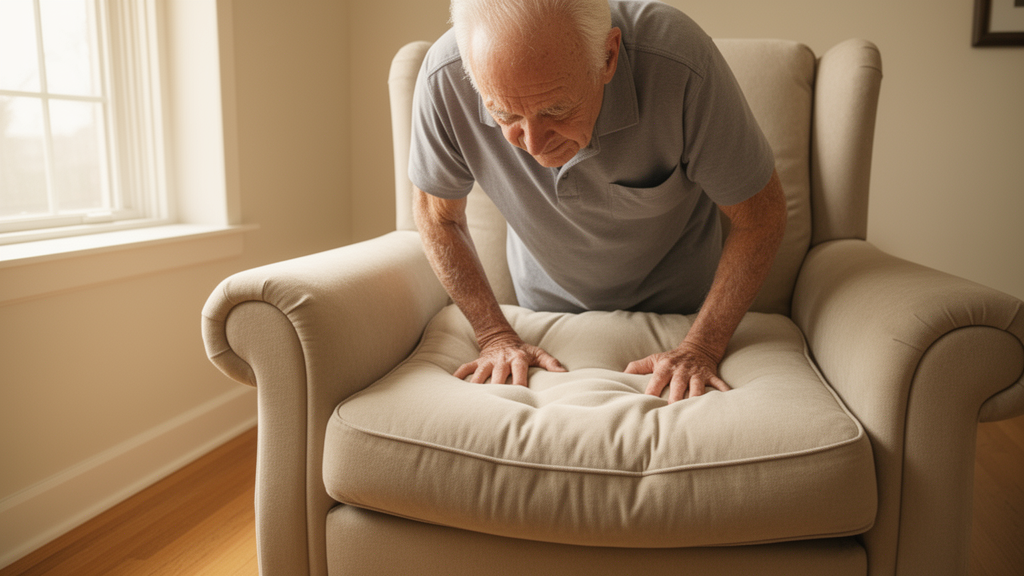
Standing up from a chair is such an ordinary act that most people never think about the physics involved, yet it is one of the most frequently performed movements in daily life and can be mechanically demanding, particularly for older adults. A new study in BMC Biomedical Engineering shows that two properties of the seat cushion beneath us — how bouncy the foam is and how hard it is — measurably change how hard the hips and knees must work to lift the body off the seat. The findings, based on laboratory experiments with fifteen healthy young adults, suggest that choosing a cushion with high resilience and sufficient firmness could reduce the load on the lower limbs, with potential value for chair design in clinical and caregiving settings.
The research team, led by Yusuke Onoda and Ami Ogawa, set out to isolate the effects of specific material properties that earlier studies had left unclear. Previous work had examined seat height, seat angle, armrests and cushion thickness, and had shown that these factors alter the mechanics of the sit-to-stand movement. But the mechanical consequences of the foam’s resilience — the proportion of energy the material returns after compression — and its hardness had not been systematically compared. The researchers hypothesized that a high-resilience seat would return elastic energy to the body and thereby reduce joint loading, and that a softer seat would force users to rely more on upper-body momentum to get moving.
To test these ideas, the team selected five commercially available polyurethane foam cushions, each 80 millimeters thick, spanning a practical range of seating materials. Their resilience values, measured according to a procedure based on the ISO 8307 ball-rebound test, ranged from 14 to 55 percent, and their 40 percent compression hardness, measured using a method based on ISO 2439, ranged from 66 to 336 newtons. The material ranges were chosen with reference to technical documents and a published patent specification so that all five cushions fell within the span commonly used in everyday seating products. Three of the cushions had nearly identical hardness but different resilience, allowing the effect of resilience to be examined alone, while the other three had nearly identical resilience but different hardness, isolating the hardness effect.
Fifteen healthy young adults — eleven men and four women, averaging 23 years of age — performed sit-to-stand movements from each cushion. The researchers deliberately recruited young adults rather than older participants, who show greater variability in physical and cognitive function, so that the fundamental mechanical effects could be established under controlled conditions as baseline data for future studies involving older or clinical populations. Handrails and arm movements were not permitted, and participants kept their arms alongside the trunk. Crucially, the seat height was adjusted in real time so that the height of a pelvic marker remained constant across all cushion conditions, ensuring that differences in buttock sinking did not confound the comparison of seat heights.
Motion capture with thirty-nine markers and ten cameras, synchronized with two force plates that recorded the forces at the feet and the buttocks, allowed the team to calculate net joint moments at the ankle, knee and hip using inverse dynamics. The researchers also tracked the seat reaction force — the force the cushion still exerted on the body — at the moments of peak hip and knee extensor moments, along with the timing of seat-off, the instant when the cushion’s force fell below three newtons. Statistical comparisons used repeated-measures ANOVA or the Friedman test with Bonferroni-adjusted pairwise comparisons.
The resilience results were striking. Seat resilience significantly affected the peak hip and knee extensor moments, with effect sizes ranging from 0.35 to 0.48. The peak hip joint moment was significantly greater on the lowest-resilience seat than on the two higher-resilience seats, and the same pattern held for the knee. The timing of seat-off was also significantly earlier on the low-resilience seat, occurring before the peak knee moment, whereas on the higher-resilience seats seat-off was delayed until after the peak knee moment. In other words, the bouncier cushions kept supporting the buttocks precisely during the phase when joint loading was at its greatest.
The force measurements explained why. The seat reaction force at both of these key time points was significantly higher for the high-resilience seat than for the low-resilience seat. The authors interpret this as the elastic energy stored in the compressed foam being released in synchrony with the upward motion of the buttocks, continuously supporting a small portion of body weight and smoothing the transition through the unstable seat-off phase, when the base of support shifts from the buttocks and feet to the feet alone.
Hardness told a different story. Among the three cushions with matched resilience, the softest seat produced a significantly higher peak horizontal velocity of the body’s center of mass and a significantly higher peak hip extensor moment, with effect sizes between 0.31 and 0.37, while the peak knee moment changed little. The peak trunk inclination angle also increased as seats got softer, although this difference did not reach statistical significance. The researchers attribute this pattern to buttock immersion: even with pelvic height standardized, softer foam allowed the thighs to adopt a more posteriorly inclined posture, a disadvantageous starting position for the movement. Participants appear to have compensated by generating greater forward momentum with the upper body, and since most of that momentum is transferred to the lower limbs after seat-off, the hip extensors had to work harder to decelerate it. The peak vertical ground reaction force was also significantly higher on the softest seat compared with the intermediate-hardness seat, consistent with greater momentum being passed to the legs.
Within the range of materials tested, the authors conclude that cushions with a resilience of 53 percent or higher and a 40 percent compression hardness of at least 180 newtons effectively reduced lower-limb joint loading. Because assistive seat cushions are easier to transport and install, require little maintenance and cost less than powered lift-assist chairs, the authors suggest these results could offer practical guidance for cushion selection in clinical and caregiving environments. The study’s authors emphasize that the findings provide fundamental insights rather than direct clinical recommendations, since the experiments involved only young adults standing without arm support from a standardized laboratory setup.
Several limitations frame the conclusions. The study did not measure muscle activation, so the mechanisms behind the increased hip moment on soft seats remain partly inferred from kinematics and forces; the authors note that future work should directly examine muscle activation patterns using electromyography. When changing seat materials, the team could not standardize both seat height and seat inclination simultaneously and chose to prioritize height, which may have affected initial posture. Upper-limb use was excluded, although many real-life situations involve occupied hands, and the authors acknowledge that arm involvement may modify joint loading and balance control. Future investigations involving elderly individuals are warranted to extend the applicability of the findings. Even so, the study makes clear that the cushion beneath us is not a passive comfort feature but an active mechanical partner in one of daily life’s most repeated and demanding movements.
Subject of Research: The effects of seat cushion resilience and hardness on lower-limb joint loading during sit-to-stand movements
Article Title: Effect of seat cushion resilience and hardness on lower-limb loading during sit-to-stand
Article References: Onoda, Y., & Ogawa, A. (2026). Effect of seat cushion resilience and hardness on lower-limb loading during sit-to-stand. BMC Biomedical Engineering, 8(1), Article 11. https://doi.org/10.1186/s42490-026-00115-w
Image Credits: AI Generated
DOI: 10.1186/s42490-026-00115-w
Keywords: sit-to-stand, seat cushion, polyurethane foam, resilience, hardness, hip extensor moment, knee extensor moment, biomechanics, joint loading, motion capture, chair design, force plates
News Source: Gregory Coleman. (October 28, 2026). Softer Is Not Always Easier: Cushion Resilience Shapes the Effort of Standing Up. Scienmag.