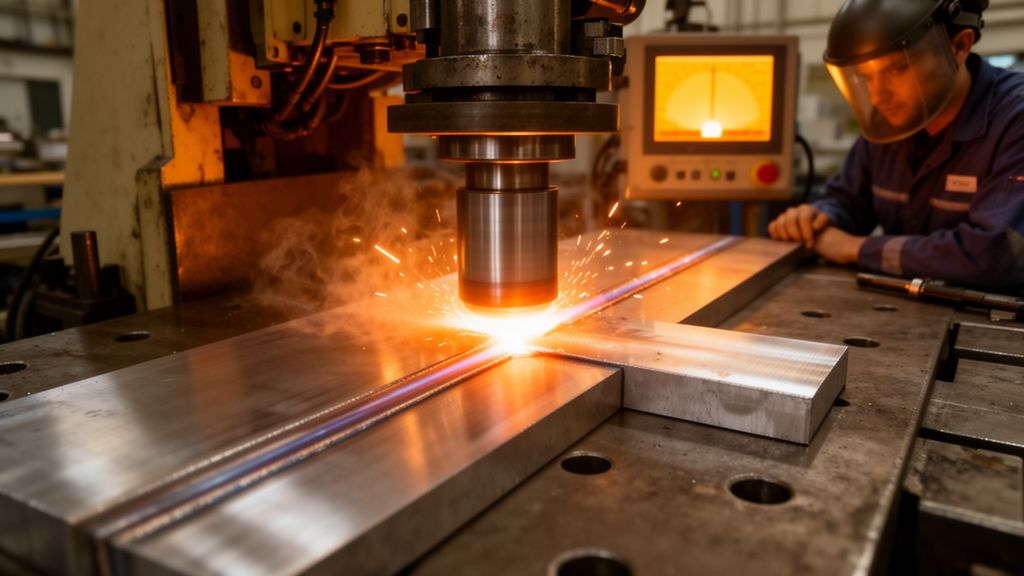
Friction stir welding has long been celebrated as a gentler alternative to fusion welding. Instead of melting metal with an electric arc or a laser beam, a rotating tool plunges into the seam between two plates and stirs them together in a hot, plasticized state. Because the material never melts, the finished joint avoids many of the defects that plague conventional welds: less distortion, finer grain structure, and superior strength and toughness. Yet for one of the most demanding materials in modern engineering, the nickel-based superalloy Inconel 718, the technique has remained stubbornly difficult to industrialize. A new study published in Frontiers in Control Engineering shows how a combination of high-fidelity simulation, statistical analysis, and modern control theory may finally change that.
Inconel 718 is prized for aerospace, energy, and automotive applications because it retains high strength, ductility, and corrosion resistance even at elevated temperatures. Those same properties, however, make it notoriously hard to weld. Previous successful friction stir welding trials on the alloy succeeded only under narrow conditions: low tool rotations between 100 and 500 revolutions per minute, slow welding speeds of 30 to 150 millimeters per minute, and very high axial loads of roughly 35 kilonewtons. While those parameters produced refined grains and improved microhardness, they limited throughput and raised questions about economic feasibility. The alloy is also acutely sensitive to temperature fluctuations during welding, so even small thermal excursions can degrade surface quality and mechanical performance.
A research team from the University of Strasbourg, Hamad Bin Khalifa University, and Texas A&M University at Qatar tackled the problem with an integrated strategy. First, they built a three-dimensional transient model of the friction stir welding process in COMSOL Multiphysics, capturing the frictional heat generated between a tungsten carbide tool and two Inconel 718 plates, each measuring 250 by 75 by 3 millimeters. The model incorporated temperature-dependent material properties and used the Johnson-Cook plasticity model to reproduce strain hardening and thermal softening. An Arbitrary Lagrangian-Eulerian formulation with adaptive meshing kept the mesh from distorting as the tool advanced, and a mesh convergence study settled on 108,000 elements with an average element quality of 0.81. Each simulation took roughly 6.2 hours on a standard desktop processor, a price worth paying for the fidelity the model delivered.
Validation was a critical step. The team compared their simulated temperatures against previously published experimental measurements on friction stir welded Inconel 718 plates. Where experiments recorded 577 degrees Celsius at a point 5 millimeters from the weld nugget, the model predicted 600 degrees Celsius, a discrepancy of only about 4 percent. With that confidence established, the researchers generated a comprehensive dataset by sweeping the key process variables: axial force from 5 to 50 kilonewtons, rotational speed from 100 to 600 RPM, welding speed from 50 to 150 millimeters per minute, shoulder diameter from 15 to 25 millimeters, and pin diameter from 4 to 8 millimeters.
Statistical analysis then revealed which of those variables actually matter. Using one-way analysis of variance with Tukey simultaneous 95 percent confidence intervals, the team found that welding speed, axial force, and rotational speed showed significant effects on workpiece temperature, while shoulder diameter and pin diameter produced no statistically significant differences across the tested range. A nonlinear regression analysis quantified the relationships, and the model-building sequence showed that axial force alone explained roughly 45 percent of the temperature variance, with rotational speed close behind. The final regression model achieved an adjusted R-squared value near 100 percent, and when the researchers used it to target a welding temperature of 700 degrees Celsius, the predicted settings landed within a 95 percent prediction interval of 675.16 to 724.84 degrees Celsius.
But a static regression equation cannot steer a dynamic process. Friction stir welding is riddled with nonlinearities, particularly during the plunge phase when the tool first enters the material and during the traverse ramp when it accelerates along the seam. Standard system identification tools in MATLAB produced transfer function and autoregressive models with fits between 99.21 and 99.95 percent, yet those linear approximations failed to capture the true system behavior. The researchers therefore embedded domain-specific physical insight into a nonlinear state-space model with six state variables, representing the instantaneous weld temperature, accumulated thermal energy, mechanical interactions tied to axial force, and the displacement dynamics of the tool along the weld line. Implemented in Simulink and validated against an independent dataset, including tests with step disturbances in axial force, the model faithfully reproduced the underlying physics.
With a trustworthy model in hand, the team designed and compared two families of controllers. The first was the workhorse of industrial automation, the proportional-integral-derivative, or PID, controller, tuned initially with the Ziegler-Nichols method, which yielded an ultimate gain of about 3.741 and an ultimate period of 1.516 seconds, then refined with MATLAB’s PID tuning app. The second was model predictive control, or MPC, a more sophisticated approach that uses the system model to forecast future behavior over a prediction horizon and solves an optimization problem at each step to choose the best control moves while respecting actuator limits. Both controller families were implemented in two configurations: a single-variable mode in which only rotational speed is manipulated while axial force and welding speed act as disturbances, and a multi-variable mode in which all three inputs are actively regulated.
The simulation results were striking. In single-variable mode, the PID controller stabilized the weld temperature at the 700 degree Celsius target across a wide range of welding speeds and axial forces, automatically adjusting rotational speed to compensate. In a head-to-head comparison featuring setpoint changes and injected disturbances, all four controllers kept temperature within acceptable limits, but their personalities differed. PID controllers responded faster to setpoint changes throughout the test. When the temperature setpoint dropped by 400 degrees Celsius at the 70-second mark, the multi-variable controllers experienced undershoots of roughly 30 degrees Celsius, while single-variable versions approached the new target more smoothly. When an axial force disturbance hit at 85 seconds, the single-variable controllers handled it with minimal overshoot, whereas the multi-variable controllers struggled with overshoots up to 150 degrees Celsius. Intriguingly, the ranking reversed for welding speed disturbances at 100 seconds, where the multi-variable controllers showed minimal undershoot while single-variable versions drifted by up to 20 degrees.
Why does this precision matter? In friction stir welding, workpiece temperature governs both surface finish and microstructure. Too little heat and the material cannot flow and consolidate properly, leaving voids and rough seams; too much heat and thermal degradation sets in. The team’s regression analyses quantified the stakes: a quadratic model relating average grain size to temperature explained 99.09 percent of the variance, and a similar model for microhardness explained 98.70 percent, both statistically significant with p-values below 0.001. In their baseline simulation at 600 RPM, 90 millimeters per minute, and 40 kilonewtons of axial force, the weld zone reached about 1,000 degrees Celsius, with refined grains of roughly 50 micrometers and hardness peaking at 410 HV near the nugget. By holding temperature at the optimal setpoint, the controllers directly safeguard those microstructural outcomes.
The authors argue their work is the first to implement effective thermal management for friction stir welding of nickel-based alloys by controlling the three dominant process variables simultaneously. High-strength alloys present challenges that aluminum and magnesium do not, including pronounced nonlinearity and strain hardening at elevated temperatures, so a control framework proven on Inconel 718 could transfer to a broad class of demanding materials. The practical implications extend from aerospace turbine components to automotive structures, wherever consistent, defect-free joints in superalloys are needed at scale. No single controller emerged as universally superior, and the researchers note that the choice between PID and MPC, and between single- and multi-variable modes, can be matched to operational priorities such as response speed, stability, energy consumption, or disturbance rejection. That flexibility, underpinned by a validated nonlinear model of one of industry’s toughest alloys, may be exactly what friction stir welding needs to move from laboratory promise to factory floor.
Subject of Research: Temperature control of friction stir welding of Inconel 718 using numerical simulation and process control
Article Title: Workpiece temperature control in friction stir welding of Inconel 718 through integrated numerical analysis and process control
Article References: Abotaleb, A., Al-Azba, M., Khraisheh, M., Remond, Y., & Ahzi, S. (2024). Workpiece temperature control in friction stir welding of Inconel 718 through integrated numerical analysis and process control. Frontiers in Control Engineering, 5, Article 1459399. https://doi.org/10.3389/fcteg.2024.1459399
Image Credits: AI Generated
DOI: 10.3389/fcteg.2024.1459399
Keywords: friction stir welding, Inconel 718, superalloys, temperature control, model predictive control, PID control, finite element simulation, ANOVA, system identification, weld quality, aerospace manufacturing, nonlinear state-space model
News Source: Denise Maddox. (October 16, 2026). Smart Temperature Control Brings Friction Stir Welding to Superalloy Inconel 718. Scienmag.