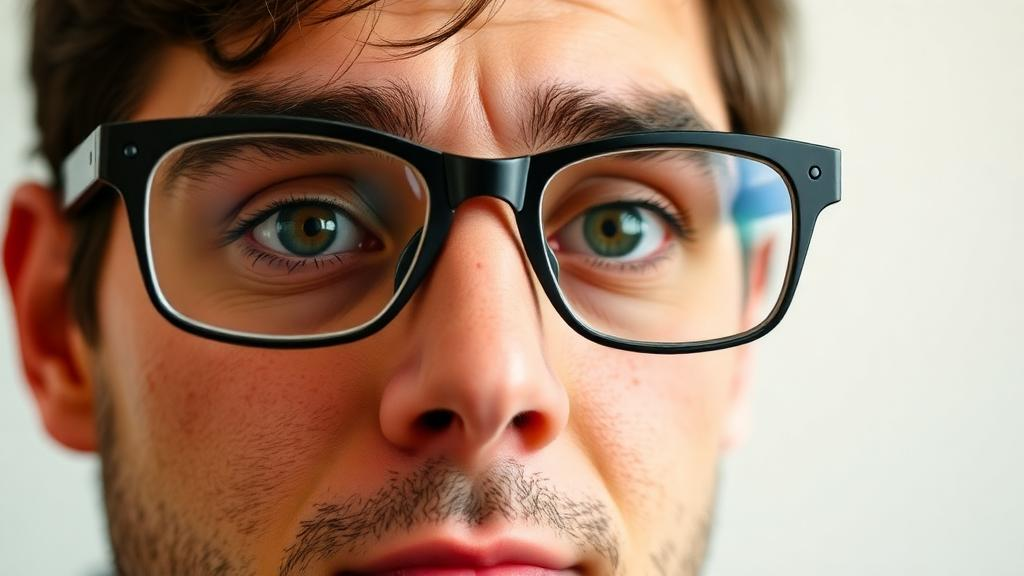
A conceptual foresight paper argues that smart glasses capable of inferring emotion, intention and vulnerability could provoke an adversarial cycle in which people hide the expressive signals computers analyze. The proposed conflict, termed “nuance warfare,” emerges when non-verbal signals are computationally inferred, those inferences are used for strategic advantage, and the person being analyzed responds by concealing, distorting or mediating communication. Rather than describing an observed historical event, the research assembles evidence about smart-glass prototypes, emotion recognition, surveillance-related self-censorship and reduced machine performance under facial occlusion, then uses those findings to develop a conditional future scenario. Its central warning is that people may eventually lose the capacity to interpret and express subtle meaning because everyday environments make unguarded expression too risky.
The technical pipeline begins with wearable sensing. Cameras, microphones and connected devices can capture facial movement, voice, gaze, posture, hesitation and physiological changes before software converts them into claims about emotion, attention, confidence or willingness to negotiate. Remote photoplethysmography offers another route, estimating heart rate from subtle changes in facial light reflection, although the technique remains sensitive to movement and illumination. Smart glasses are especially consequential because a single, hands-free device can combine outward sensing, private interpretation through a display, and partial protection of the wearer’s eyes. That configuration allows one person to analyze another while both remain in the same encounter, making defensive and offensive uses unusually easy to combine.
p>Existing prototypes show that smart glasses can already return real-time cues about facial expression, while research on camera glasses identifies a persistent gap between what wearers and bystanders expect about capture, consent and later use. Commercial components can also be combined into broader systems without a manufacturer openly advertising an espionage function. The study separates four stages in the resulting capability: sensing a person, identifying and tracking that person, inferring an internal state from observed signals, and using the inference strategically. Each stage is individually supported by research, but the article stresses that no cited case yet demonstrates the complete chain operating together in one high-stakes encounter. The escalation described below is therefore a theoretical prediction grounded in structural similarities among existing technologies.
p>Visibility alone, the paper argues, is not consent to computational interpretation. A face may be plainly visible while the person refuses to have it converted into a strategic claim about fear, deception, illness, preference or willingness to concede. The proposed “right to remain unread” would protect against machine-mediated extraction of actionable inferences from involuntary or contextually unavoidable signals. It would not prohibit ordinary human impression formation. The distinction is important because machine inference can be recorded, reused, aggregated across encounters, shared at a distance and applied simultaneously to many people, whereas an ordinary social impression is usually local, revisable and tied to the immediate exchange.
p>The conditions for escalation are deliberately narrow. Participants are more likely to enter nuance warfare when they must continue interacting, imperfect inferences are believed useful, observation is known or suspected, concealment costs less than exposure, opacity has value because penetrating it can provide an advantage, and reduced channels remain useful for exchange. Negotiations, adjudication and border control may satisfy many of these conditions. Some workplaces do so partially, especially where workers cannot simply leave an ongoing relationship with a supervisor. Informal contact among non-intimates satisfies fewer, while trusted family and close-community settings generally provide little strategic incentive for computational reading. The model therefore does not predict a universal retreat from expression, nor does it claim that all masking or device use represents adversarial behaviour.
p>Where those conditions coincide, the research anticipates a security dilemma. One participant acquires smart glasses for protection, but the other may interpret the device as an offensive intelligence tool. Defensive opacity then encourages better mask detection, which encourages stronger concealment, which in turn motivates efforts to penetrate or monopolize the defence. Physical adversarial research already shows that eyeglasses, masks, light and other accessories can be designed to defeat identity-oriented face recognition, although that work targets identity rather than emotion. Concealment could also become layered: glasses may obscure the eye region while masks, scarves, veils or hoods cover the lower face. Experimental work cited by the paper found lower human emotion-recognition accuracy under masks than under sunglasses or uncovered faces, with the mouth especially important for several emotions; some machine classifiers likewise lose accuracy when the upper face is covered by a headset.
p>Concealment may become technologically adaptive rather than ceremonial. Electrically adjustable and switchable optical materials could eventually allow eyewear to remain transparent in low-risk settings and become tinted, more opaque or reflective when computational observation is anticipated. Smartwatches create another possible leakage route because a visible heart-rate or workout display might be photographed by a nearby camera. In response, people might lower their gaze, flatten their expression, reduce speech, adopt written or coded channels, or route replies through AI-mediated agents. Emojis and messaging stickers offer precedents for channel switching because they provide a selected expression without exposing the uncontrolled bodily process behind it. The study also notes reported reductions in lexical and morphological diversity in machine-mediated writing, but it does not claim that those measurements already demonstrate a loss of embodied nuance.
p>The proposed endpoint is “mutual assured opacity,” an equilibrium in which both parties retain their sensing and concealment tools but withdraw the natural signals those tools would most usefully decode. Communication would continue through explicit propositions, predefined symbols, written conditions and machine-readable metadata, while facial expression, prosody, silence, hesitation and culturally situated ambiguity leave the shared terrain. An illustrative payoff sketch ranks concealment as the dominant choice when each side benefits from an open counterpart yet prefers to withhold its own signals. This is not a formal model of real encounters, and the paper states that its parameters cannot be fixed with current evidence. It is presented as a conceptual mechanism for examining how a security dilemma could transform ordinary communication.
p>Repeated withdrawal could have developmental consequences. The article proposes that nuance develops through repeated practice: people learn to attend to one another’s unspoken intentions, and repetition builds competence in expression, prosody, timing, silence and context. If defensive habits eliminate those opportunities, current users could lose skills through non-use, while later cohorts might lack the experiential foundation required to acquire them at all—a condition the author calls pre-skill deprivation. The study does not establish that this outcome has occurred, and it acknowledges that private relationships and small trusted communities may continue to provide places where nuance is practised. Evidence that stress and conflict can carry over between social domains supports the possibility of spillover, but whether defensive expression itself transfers in the same way remains an open empirical question.
p>As an alternative to mutual opacity, the paper proposes “mutual assured transparency,” in which participants surrender or seal computational devices at an agreed level of verification before entering a controlled “Safest Black Box.” A verifying party would need to be independent of the interests at stake, technically capable of detecting concealed inference and accepted by both sides. No existing institution is shown to meet all three conditions, and hidden augmentation would preserve the central trust problem. The comparison is therefore stark: opacity protects people from exploitative reading by reducing expressive depth, whereas transparency seeks to preserve that depth by suspending computational assistance. Both outcomes are conditional futures, not demonstrated solutions, and the article calls for empirical study of early warning signs such as consumer eyewear marketed for emotion inference, products designed to defeat it and exclusions imposed on people who refuse analysis.
Subject of Research: How smart-glass emotion inference may provoke concealment and erode human communicative nuance
Article Title: Nuance warfare and the right to remain unread in the age of smart glasses
Article References: Yamada, K. (2026). Nuance warfare and the right to remain unread in the age of smart glasses. Discover Informatics, 1(1), Article 30. https://doi.org/10.1007/s44564-026-00031-0
Image Credits: AI Generated
DOI: 10.1007/s44564-026-00031-0
Keywords: smart glasses, emotion recognition, human expression, privacy, surveillance, computational reading, non-verbal communication, AI ethics, Nuance, warfare, right, remain
News Source: Denise Maddox. (October 21, 2026). Smart Glasses Could Trigger a War on Human Expression. Scienmag.