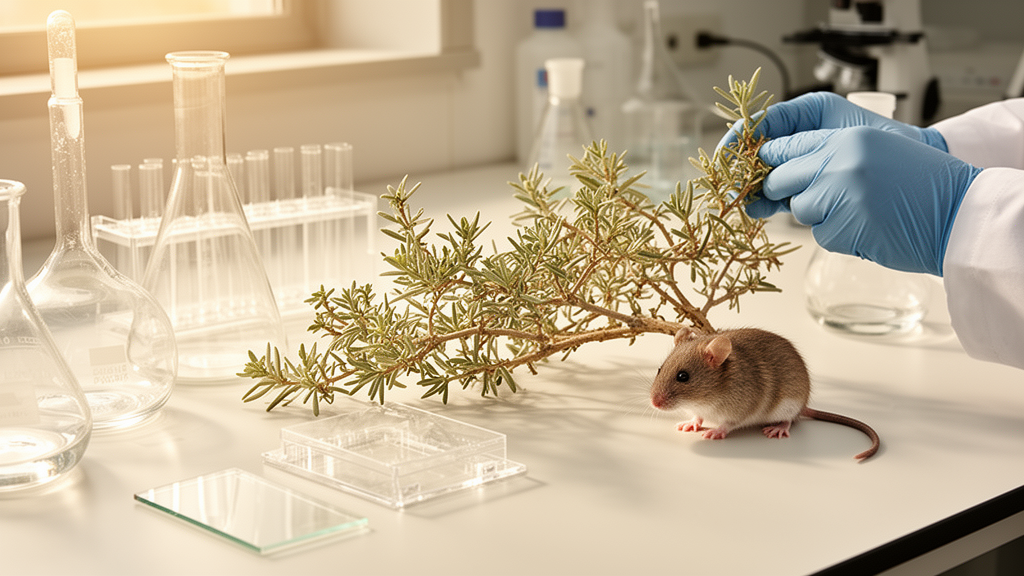
Extracts from the desert shrub Calligonum polygonoides reduced the viability of liver-cancer cells, inhibited two carbohydrate-processing enzymes and lowered blood glucose in diabetic rats, according to a preclinical study combining laboratory assays, liquid chromatography–mass spectrometry, molecular docking and pharmacokinetic prediction. The results identify chemically diverse materials with potential as leads for cancer and diabetes research, but they do not establish that the plant treats either disease in people. The work used cell cultures, a chemically induced rat model and computational analyses; no clinical trial was conducted.
The researchers collected roots, stems and flowers from the Cholistan Desert in Pakistan during June, a period associated in earlier work with high concentrations of phenolics, flavonoids and tannins in this species. Separate portions of each plant part were shade-dried for approximately 25 days, ground and extracted with absolute ethanol for seven days, with sonication used to enhance extraction. Liquid–liquid partition separated the crude material into n-hexane, dichloromethane and ethyl acetate fractions of differing polarity. The ethanolic stem extract was additionally separated by vacuum liquid chromatography into 13 fractions. This staged strategy was intended to connect particular chemical constituents with measured biological effects rather than treating the whole plant as an undifferentiated mixture.
In the anticancer arm of the study, the plant fractions were tested in HepG2 human liver-cancer cells and VERO cells, which served as a normal-cell comparator. An MTT assay measured metabolic cell viability, while phase-contrast microscopy examined changes in cell shape, density and organization. The ethyl acetate root fraction produced the strongest result among the tested root preparations, with 46% HepG2 cell viability and an IC₅₀ of 96.3 micrograms per millilitre. The other root fractions had similar half-maximal cytotoxic concentrations: 97 micrograms per millilitre for both dichloromethane and ethanol, and 98.78 micrograms per millilitre for n-hexane. Morphological observations included cell shrinkage, clumping, altered cell shape and disruption of the monolayer. By contrast, the tested extracts produced negligible cytotoxicity in the VERO cells under the reported conditions.
Stem fractions showed broadly similar activity, with approximately half of HepG2 cell viability remaining in the n-hexane, dichloromethane and ethyl acetate preparations. The crude ethanolic stem extract was less potent, leaving 55% viability and giving an IC₅₀ of 105.77 micrograms per millilitre. Flower fractions were less active against the cancer cells, with IC₅₀ values ranging from 122.88 to 181.26 micrograms per millilitre. These comparisons concern crude mixtures and in-vitro viability; they do not identify a single anticancer agent or demonstrate selective killing of liver-cancer cells in an animal or human setting. The researchers selected the ethyl acetate root fraction for chemical and computational examination because it had the lowest reported IC₅₀ among the root fractions and was supported by morphological changes.
LC-MS analysis tentatively identified a wide range of metabolites in the selected root fraction, including phenolic acids, flavan-3-ols, flavonol glycosides, triterpenoids, sterols and lignans. Prominent signals included catechin, epicatechin, galloylated quercetin derivatives, kaempferol glycosides, ursolic acid derivatives and alpha-viniferin. The presence of multiple glycosylated, galloylated and oligomeric forms indicated considerable structural diversity. Docking against the crystal structure of cyclin-dependent kinase 1 produced its most favourable predicted score for an ursolic-acid derivative, at −10.3 kcal/mol, followed by a prenylated isoflavanone and a complex glycoside at −9.0 and −8.7 kcal/mol. Catechin, epicatechin, quercetin galloylglucoside and isorhamnetin were also predicted to bind between −8.0 and −8.2 kcal/mol. These scores are computational estimates of pose and affinity, not measurements of enzyme inhibition, cellular penetration, selectivity or anticancer efficacy.
For the diabetes-related work, the ethanolic stem extract was the strongest crude preparation in the enzyme assays. Its IC₅₀ was 102.05 ± 0.65 micrograms per millilitre against alpha-amylase and 65.005 ± 1.555 micrograms per millilitre against alpha-glucosidase. Acarbose, the reference inhibitor, had an alpha-glucosidase IC₅₀ of 57.38 ± 0.95 micrograms per millilitre. The plant extract therefore approached the reference compound’s measured potency in this particular in-vitro test, although a lower IC₅₀ indicates greater inhibition. Non-polar stem and root fractions were less effective against alpha-amylase, with IC₅₀ values exceeding 600 micrograms per millilitre. Among the 13 chromatography fractions, V9 was the strongest alpha-glucosidase inhibitor, with an IC₅₀ of 47.97 micrograms per millilitre, while V13 was the strongest alpha-amylase inhibitor, with an IC₅₀ of 112.5 ± 0.6 micrograms per millilitre.
LC-MS profiling of V9 and V13 again revealed complex mixtures dominated by flavonoids, phenolic acids and glycosides. V9, obtained with 10% methanol in ethyl acetate, included 24 tentative assignments, among them procyanidin gallate, an epicatechin–epicatechin–catechin trimer, apigenin C-glycosides and a highly glycosylated isorhamnetin derivative. Docking against alpha-glucosidase ranked a quercetin–rhamnoside conjugate most favourably at −12.7 kcal/mol, followed by the epicatechin trimer at −12.5 and procyanidin B2 3′-O-gallate at −12.4 kcal/mol. For alpha-amylase, the V13 predictions were less extreme: a prenylated flavonoid scored −9.8 kcal/mol, while two tricin diglucuronoside entries and a diprenylisoflavanone scored −9.5 to −9.4 kcal/mol. Smaller acids, including isovaleric acid and 2-hydroxyisobutyrate, had much weaker scores of −4.1 and −4.3 kcal/mol. The calculations suggest that hydroxyl groups, sugar residues, aromatic systems and molecular bulk may favour predicted enzyme binding, but they cannot establish which compounds caused the experimental inhibition.
The study also evaluated the crude stem extract and the V9 and V13 fractions in an alloxan-induced diabetes experiment in male Wistar rats weighing 230–260 grams. After a single 120 mg/kg intraperitoneal dose of alloxan, diabetes was confirmed three days later by fasting blood glucose. Animals were assigned to untreated, diabetic-control, glibenclamide, crude-stem-extract, V9 and V13 groups, with four rats per group, and treatments were administered orally for seven days. The diabetic-control group remained near 239 milligrams per decilitre on day 7, while the glibenclamide group declined from 226 to 108.6 milligrams per decilitre. The crude stem extract fell from 243.6 to 141, V9 from 241.6 to 167 and V13 from 216 to 145.6 milligrams per decilitre. All treated diabetic groups differed significantly from the diabetic control on days 3, 5 and 7, according to the reported analysis with p < 0.001. The plant treatments produced smaller final reductions than glibenclamide, and the small groups, short duration and absence of reported dose details limit interpretation.
Computational pharmacokinetic analysis highlighted a major obstacle between promising fractions and a practical medicine. Smaller compounds such as 4-vinylphenol, isovaleric acid, kaempferide and several modest-sized flavonoids were predicted to have high gastrointestinal absorption. In contrast, many large glycosylated flavonoids and oligomeric polyphenols had low predicted absorption, low blood–brain-barrier permeability and, in several cases, possible P-glycoprotein substrate status. Large triterpenoids and stigmasterol were predicted to have poor oral absorption because of high lipophilicity. These are structure-based predictions rather than measurements of blood concentrations, metabolism, excretion or toxicity. Together, the findings support further investigation of selected constituents and bioassay-guided fractions, but not clinical use. The strongest supported conclusion is that C. polygonoides contains chemically diverse materials with measurable cytotoxic, enzyme-inhibitory and glucose-lowering activity in laboratory and rodent models; their safety, effective doses, mechanisms and human relevance remain unestablished.
Subject of Research: Preclinical anticancer and antidiabetic evaluation of Calligonum polygonoides extracts and fractions
Article Title: Phytochemical profiling, LC-MS characterization, anticancer and antidiabetic evaluation of calligonum polygonoides; in vitro , in vivo and in silico insights
Article References: Sadiq, F., Shahzad, M. I., Anjum, S., Rashid, S., Abass, K. S., Eman, K., Tahir, T., Hadi, F., & Rivera, G. (2026). Phytochemical profiling, LC-MS characterization, anticancer and antidiabetic evaluation of calligonum polygonoides; in vitro, in vivo and in silico insights. Results in Chemistry, 31, Article 103987. https://doi.org/10.1016/j.rechem.2026.103987
Image Credits: AI Generated
DOI: 10.1016/j.rechem.2026.103987
Keywords: Calligonum polygonoides, desert medicinal plants, LC-MS, HepG2 cells, alpha-glucosidase inhibition, alpha-amylase inhibition, alloxan-induced diabetes, molecular docking, pharmacokinetics, polyphenols, Phytochemical, profiling
News Source: Louis Brooks. (October 21, 2026). Desert shrub shows anticancer and glucose-lowering activity in preclinical tests. Scienmag.