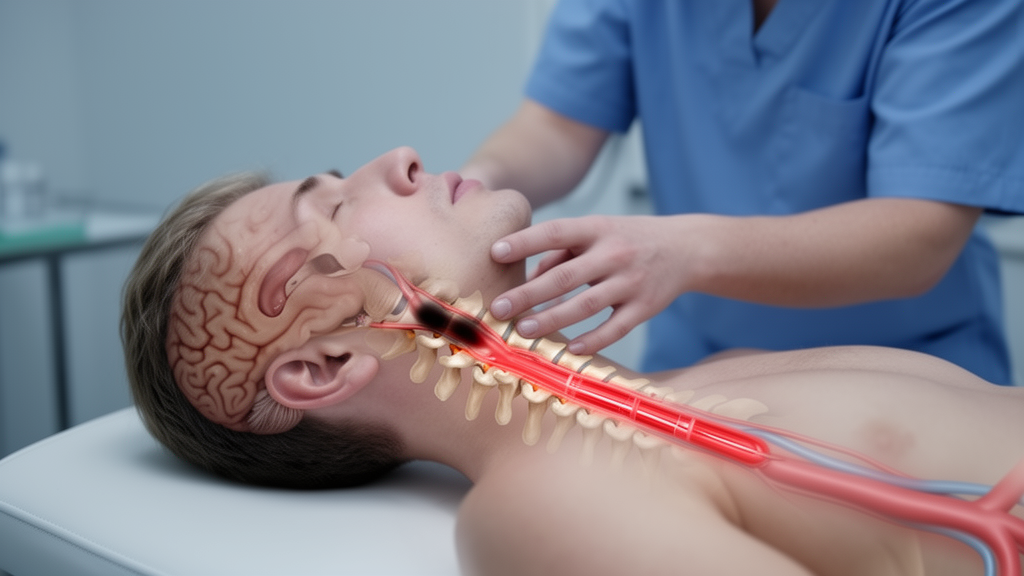
A 35-year-old woman developed a left pontine ischemic stroke and right vertebral artery occlusion immediately after a high-velocity cervical spine manipulation, according to a case report describing a close temporal association rather than proof that the procedure caused the event. The patient had no hypertension, diabetes or known hereditary thrombophilia, but her history included migraine and three years of oral contraceptive use. She also experienced six days of continuous, atypical headache before the procedure, raising the possibility that arterial pathology was already developing. The findings illustrate why clinicians may need to consider cervical artery dissection when acute neurological deficits emerge after neck manipulation, even in a young patient without conventional cardiovascular risk factors.
The woman first sought care at an informal community facility after an acute stressful life event was followed by a severe, new holocranial pressure-type headache on February 20, 2025. Unlike her previous episodic migraines, the pain was continuous and did not respond to non-steroidal anti-inflammatory drugs or a combination of acetaminophen, caffeine and dihydroergotamine. On February 26, an unregulated lay practitioner performed a cervical manipulation without a documented prior neurological examination. Seconds afterward, the patient lost consciousness for about three minutes and then recovered spontaneously. On awakening, she had right-sided hemiparesis, right central facial palsy and motor aphasia, with a recorded blood pressure of 140/100 mmHg.
She was transferred to a tertiary care center, where emergency non-contrast computed tomography showed neither acute hemorrhage nor an established territorial infarction. Magnetic resonance imaging performed two days later identified an acute ischemic lesion in the left pons. The lesion was hyperintense on T2-FLAIR and diffusion-weighted imaging, with corresponding attenuation on the apparent diffusion coefficient map, supporting an acute brainstem infarction. Because the initial scan did not show hemorrhage and the patient arrived beyond the therapeutic window for reperfusion, treating clinicians began aspirin at 81 mg daily and initiated neurological rehabilitation. Her aphasia resolved progressively and her hemiparesis improved partly, although a focal neurological deficit remained.
Contrast-enhanced CT angiography of the head and neck, performed on day nine, showed a complete filling defect through the V1 to V3 segments of the right vertebral artery and a thread-like distal V4 segment described as a “string sign.” The basilar artery was fully opacified, while the left vertebral artery remained patent with normal contrast filling. The images did not directly show classic pathognomonic features such as an intimal flap, double lumen or pseudoaneurysm. Nevertheless, the clinicians considered the segmental occlusion and distal string sign highly compatible with vertebral artery dissection in a young patient without atherosclerotic disease or identified thrombophilia. Primary thrombosis and arterial hypoplasia remained alternatives in the differential diagnosis.
Distinguishing dissection from other causes matters because a cervical artery dissection can create an intramural thrombus that embolizes into the posterior circulation, producing infarction. The report notes that thromboembolism is the most common pathophysiological mechanism in ischemic stroke caused by dissection and is associated with neuroimaging evidence of thrombus formation. Dissections may arise spontaneously, and reported associations include connective-tissue disorders such as fibromuscular dysplasia, Ehlers-Danlos syndrome, Marfan syndrome and Loeys-Dietz syndrome, as well as vascular anatomical variation, migraine, recent infection, hyperhomocysteinemia, oral contraceptive use and other conditions. The clinical literature does not establish many of those factors as independent risk factors, however.
The case is especially notable because the manipulation followed a prolonged, atypical headache. Severe localized or holocranial headache and neck pain can precede overt ischemic symptoms in cervical artery dissection, apparently reflecting nociceptive activation within the injured arterial wall. In this patient, dissection or subclinical thrombosis might therefore have been underway before the practitioner applied the high-velocity maneuver. The procedure could have aggravated an existing vascular tear or dislodged thrombus into the basilar circulation, but the case cannot distinguish these possibilities or establish a single mechanism.
Broader evidence also cautions against treating temporal sequence as definitive causation. A 2013 systematic review by Wynd and colleagues assessed cervical artery dissection associated with cervical manipulation therapy using Bradford Hill criteria. About 70% of the reported dissections involved the vertebral or carotid arteries. Among 707 cases that specified stroke type, 706 were ischemic, and the brainstem was the most common infarct location among the 32 cases reporting anatomical detail. A nationwide study of more than 5,000 cervical artery dissection cases examined by Whedon and colleagues in 2023 found that people evaluated for prodromal neck pain or headache were more likely subsequently to receive a dissection diagnosis than people receiving spinal manipulation. The authors interpreted much of the manipulation-dissection association as non-causal, attributing it to patients seeking treatment for symptoms of an impending or active dissection, and emphasized that the absolute risk of vertebral artery dissection after manipulation is extremely low.
Diagnostic assessment can be difficult because the sensitivity of imaging methods varies. Head and neck CT angiography or magnetic resonance angiography may be used alongside a neurological evaluation, and the report notes that CT angiography has shown superior diagnostic accuracy for vertebral artery dissection in particular. In this case, the initial CT and MRI sequence established the pontine infarct, while CTA nine days later documented the right vertebral artery occlusion. The delayed timing of vascular imaging reflects institutional logistics and the absence of baseline angiography, but it also means the report cannot directly show the artery’s condition before the event. The authors considered vertebral artery dissection the most compatible diagnosis while acknowledging that the defining structural signs were not visualized.
The report is a retrospective, single-case account with several important limitations. A close temporal relationship and compatible imaging findings do not establish that manipulation caused the occlusion or infarction. Oral contraceptive use, migraine and acute psychological stress could have contributed to the clinical setting, while the absence of pre-event vascular imaging prevents the investigators from definitively excluding arterial hypoplasia or vascular dysplasia. Moreover, much of the evidence linking cervical manipulation therapy to vertebrobasilar stroke consists of case reports, case series and expert opinion. The report therefore supports vigilance and careful documentation rather than a conclusion that manipulation routinely causes stroke. Its central message is that severe, atypical or refractory headache preceding manual neck treatment may warrant a different diagnostic approach, particularly when sudden neurological symptoms emerge during or immediately afterward.
Subject of Research: A case report linking cervical manipulation with vertebral artery occlusion and pontine ischemic stroke
Article Title: Ischemic Stroke Associated With Vertebral Artery Occlusion Following Cervical Spine Manipulation in a Young Woman With Underlying Vascular Risk Factors: A Case Report
Article References: González‐Delatorre, A., Alvarado‐Velásquez, J., Ruiz‐Alayón, B., López‐Sánchez, C., & Ayala‐Hernández, J. (2026). Ischemic Stroke Associated With Vertebral Artery Occlusion Following Cervical Spine Manipulation in a Young Woman With Underlying Vascular Risk Factors: A Case Report. Clinical Case Reports, 14(10), Article e73772. https://doi.org/10.1002/ccr3.73772
Image Credits: AI Generated
DOI: 10.1002/ccr3.73772
Keywords: cervical manipulation, vertebral artery occlusion, pontine stroke, arterial dissection, case report, oral contraceptives, migraine, head and neck CTA, cerebrovascular disease, Ischemic, Stroke, Associated
News Source: Cassandra Pierce. (October 21, 2026). Cervical Manipulation Preceded Pontine Stroke and Vertebral Artery Occlusion. Scienmag.