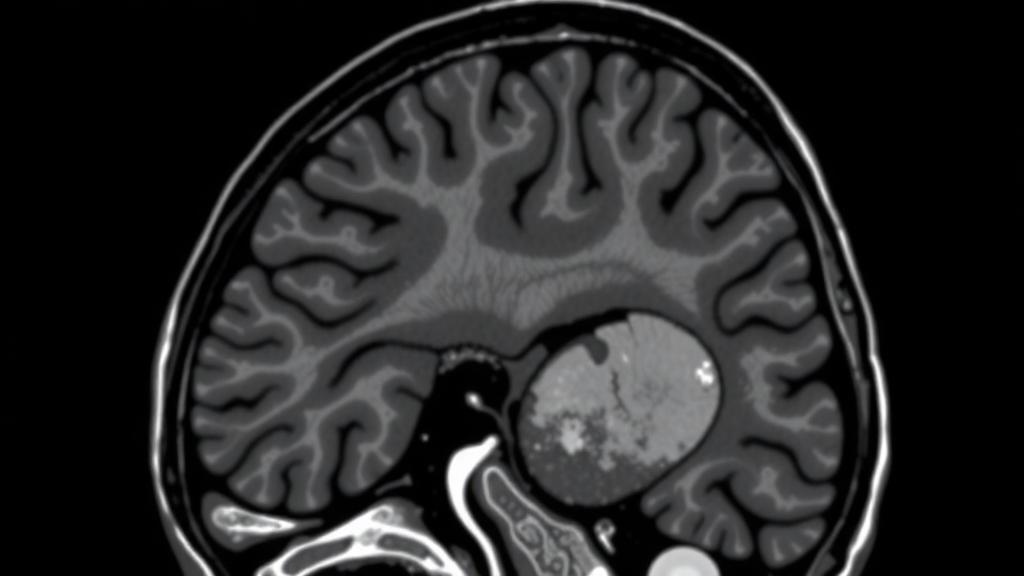
A retrospective proof-of-concept study from the Netherlands found that nnU-Net, a self-adapting biomedical image-segmentation framework, reached a median Dice score of 0.84 when trained from scratch on preoperative MRI scans from 10 pediatric patients with suspected Wilms tumor. In the fixed test set of 11 patients, performance varied substantially between individual cases, and the single-center results require independent validation before they can support clinical use.
The study included 56 children with renal tumors suspected to be Wilms tumor who were diagnosed and treated at the Princess Máxima Center for Pediatric Oncology in Utrecht between July 2018 and July 2024. The cohort contained 64 tumors, including unilateral disease in 49 children and bilateral disease in seven. The median age at imaging was 37.5 months, with a range of 8 to 110 months. Median tumor volume was 324 milliliters, ranging from 0.58 to 1,792 milliliters. Most children received preoperative chemotherapy, while six younger than six months did not.
Researchers divided the patients into 45 training cases and a fixed test set of 11, with bilateral cases distributed separately so that both groups contained comparable proportions. To measure the effect of training-set size, the investigators first selected five patients at random, trained a model from scratch and then added five patients at a time until all 45 were included. Each model was trained for 500 epochs, or training cycles, using nnU-Net version 2.0.1 and its default settings apart from the specified input data and training duration. The full incremental procedure was repeated five times with different random selections, producing 45 models that were all evaluated on the same 11 test patients.
The largest performance gain occurred between the smallest two training subsets. With five training patients, the median Dice score was 0.38, and the interquartile range across the five repetitions was 0.28 to 0.61. Adding five more patients raised the median to 0.84, while the interquartile range narrowed to 0.85 to 0.86. Models trained with all 45 patients produced the highest median score, 0.91, with an interquartile range of 0.91 to 0.92. Gains generally diminished as more cases were added, but the investigators did not observe a formal performance plateau before the full training set was reached.
The researchers used a Dice score above 0.80 as a pragmatic reference level, reflecting previously reported variation between human observers delineating Wilms tumors. They also treated a score of zero as complete segmentation failure. The maximum proportion of test patients exceeding the 0.80 reference level was nine of 11, or 81%, across the training repetitions. Reaching that maximum required between 30 and 45 training patients, depending on which patients had been selected. For the separate measure of any nonzero segmentation, the best repetition reached ten of 11 patients with 15 training patients, whereas another repetition required 35 patients to reach the same proportion.
Patient-level outcomes remained uneven even as the training set expanded. One test patient achieved a median Dice score of 0.98 with models trained on 35, 40 or 45 patients. The highest initial score among patients was 0.85, obtained with a model trained on five cases. One patient never received a nonzero automated segmentation, while the lowest median score among the other ten was 0.65 for a patient whose models did not exceed 0.80. Thus, the aggregate median improvement did not eliminate substantial variation among individual test cases.
Failure analysis identified small tumors with appearances similar to surrounding kidney tissue among the most difficult cases. The three poorest-performing test patients all had tumor volumes below 13 milliliters, compared with the cohort median of 324 milliliters. One had a 3.4-milliliter mixed-type tumor and reached a maximum Dice score of 0.68. Another had bilateral regressive lesions measuring 7.02 and 8.03 milliliters, both of which received a score of zero in the reported run. The third had a 12.06-milliliter completely necrotic, mid-polar tumor whose intensity was comparable with the surrounding renal parenchyma and reached 0.84. These associations within a small test set do not establish that size or MRI appearance alone caused the failures.
For the ground truth, three independent technical physicians delineated tumors on preoperative T2-weighted images in 3D Slicer under a standardized protocol. They could consult fat-suppressed T1-weighted images with or without intravenous contrast when needed to define boundaries, and an experienced pediatric radiologist reviewed the segmentations. The models received T2-weighted images and binary tumor masks and processed entire patient images rather than individual kidneys. Performance was measured with the Dice similarity coefficient on a per-patient basis. Bilateral lesions were consequently not evaluated separately, despite the importance of delineating both tumors in surgical-planning applications.
Several limitations constrain the interpretation and transferability of the findings. The study was retrospective, conducted at one center and evaluated on a specific 1.5-tesla MRI protocol. Its fixed test set contained only 11 patients, so the absence of statistically significant differences in measured characteristics between training and test groups does not establish that the test set represented the broader clinical population. Five included patients did not have Wilms tumor, including cases of nephroblastomatosis or another renal tumor type, consistent with the difficulty of definitive preoperative biopsy in pediatric oncology. The study also lacked formal statistical validation and used only the Dice score rather than additional boundary measures such as Hausdorff distance.
The model was trained only on T2-weighted imaging. nnU-Net automatically applies data augmentation, but the investigators did not separately evaluate additional augmentation, transfer learning, weak supervision, alternative architectures or other low-data strategies. A Dice score is a metric for model development and retrospective validation rather than direct evidence of clinical utility. The results show that automated MRI segmentation for pediatric Wilms tumor can be investigated with relatively small cohorts, even when the model trained on only five patients performed poorly and selection among cases had a substantial effect. The study also illustrates the limits of a median performance estimate: a model trained on 10 patients achieved a median Dice score of 0.84, yet difficult small tumors could still produce complete failures, and the full 45-patient training set did not yield a formally stable plateau.
Subject of Research: Feasibility of nnU-Net MRI segmentation for pediatric Wilms tumor using small patient cohorts
Article Title: The feasibility of training nnU-Net to segment pediatric Wilms tumor with small datasets
Article References: Buser, M. A. D., Meijer, R. F., van der Steeg, A. F. W., Wijnen, M. H. W. A., van den Heuvel-Eibrink, M. M., Littooij, A. S., De Donno, G., & De Luca, A. (2026). The feasibility of training nnU-Net to segment pediatric Wilms tumor with small datasets. Frontiers in Oncology, 16, Article 1841994. https://doi.org/10.3389/fonc.2026.1841994
Image Credits: AI Generated
DOI: 10.3389/fonc.2026.1841994
Keywords: Wilms tumor, pediatric oncology, MRI segmentation, nnU-Net, deep learning, small datasets, Dice score, retrospective study, surgical planning, feasibility, training, segment
News Source: Nathaniel Bowman. (October 22, 2026). Small-cohort nnU-Net study shows promise for pediatric Wilms tumor MRI segmentation. Scienmag.