Sodium-ion batteries have long promised a cheaper, more abundant alternative to lithium-based energy storage, but their cathode chemistries have struggled to deliver the reversible capacity needed for grid-scale deployment. Layered sodium manganese oxides, built from some of the most inexpensive and earth-abundant elements available, are among the leading candidates. Yet their practical energy density has remained capped by reversible capacities typically below 150 mAh per gram. The most promising route around this ceiling is oxygen redox, a process in which lattice oxygen atoms themselves participate in charge compensation alongside the manganese. Activating oxygen redox, however, is only half the battle: once oxidized, oxygen ions tend to reorganize, migrate, and in the worst case escape the crystal entirely as O2 gas, permanently degrading the cathode. A new study published in Advanced Science now shows that the fate of this fragile oxygen chemistry is decided not during the high-temperature synthesis itself, but in the way the material is cooled afterward.
The research team, led by Seungmin Lee and Hyung-Seok Kim, focused on a model compound known as mesh-type Na2Mn3O7, a layered sodium manganese oxide whose structure contains ordered manganese vacancies and intrinsic stacking faults. Both features have previously been linked to exceptionally reversible oxygen redox, with voltage hysteresis below 50 millivolts. What remained poorly understood was where these beneficial structural motifs actually come from during synthesis. Earlier work suggested that manganese vacancies form when the material absorbs oxygen from the surrounding atmosphere as it cools, a process that is thermodynamically favorable near or below 600 degrees Celsius. The excess oxygen oxidizes Mn3+ ions to Mn4+, and charge balance is maintained by removing manganese atoms from the layers. This view implies that vacancy ordering is not an intrinsic property of the hot parent phase at all, but the product of a cooling-driven, oxygen-mediated reconstruction, and that the cooling rate itself might be the decisive lever controlling the final defect architecture.
To test this hypothesis, the researchers prepared two batches of the cathode material from identical precursors of sodium nitrate and manganese carbonate, heated both to 600 degrees Celsius for four hours, and then diverged only in the cooling step. One sample was quenched in liquid nitrogen, freezing the high-temperature structure almost instantly; the other was cooled slowly at 1.8 degrees Celsius per minute. Synchrotron X-ray diffraction revealed that both materials were predominantly the target P’3-type phase, but the differences were telling. The slowly cooled sample contained 98.3 percent of the P’3 phase, while the quenched sample retained 9.9 percent of an unreconstructed P3-type impurity phase, a signature of incomplete structural transformation. Because both powders had comparable particle sizes of roughly 50 to 100 nanometers, the researchers could attribute the electrochemical consequences entirely to these cooling-dependent structural differences rather than to morphology.
The electrochemical consequences were dramatic. In full voltage windows spanning both cationic and oxygen redox processes, the slowly cooled material delivered a first discharge capacity of 198 mAh per gram, compared with just 127 mAh per gram for the quenched sample, and retained 64 percent of its capacity after 30 cycles versus only 37 percent for the quenched material. When the window was narrowed to isolate oxygen redox between 4.5 and 3.5 volts, the contrast sharpened further. The slowly cooled cathode showed voltage hysteresis of just 29 millivolts against 74 millivolts for the quenched sample, and a first-cycle Coulombic efficiency of 52.9 percent versus 34.3 percent. Most strikingly, in situ differential electrochemical mass spectrometry detected oxygen gas evolution from the quenched cathode during the first charge, while the slowly cooled material released no gas at all, a direct demonstration that its structure suppresses the irreversible oxygen loss that plagues oxygen-redox chemistry.
The durability gap widened with cycling. After 30 cycles in the oxygen-redox window, the slowly cooled cathode retained 87.2 percent of its oxygen-redox charge capacity, with hysteresis of only 45.2 millivolts, while the quenched sample retained 79.7 percent with hysteresis ballooning to 207 millivolts. Over 60 cycles in the wider window, the slowly cooled material held 68 percent of its capacity against 46 percent for the quenched one. Even rate performance favored the slow-cooled framework, which kept 71 percent of its discharge capacity when the current was raised from 7.5 to 150 mA per gram, compared with 54 percent for the quenched sample. Combined galvanostatic intermittent titration, impedance spectroscopy, and distribution of relaxation times analysis suggested the advantage stemmed mainly from reduced diffusion limitations at low states of charge, where the quenched material’s residual P3-derived framework appears prone to local rearrangement.
To find out exactly when the beneficial structure forms, the team turned to time-resolved X-ray diffraction inside a real-time analytical micro-furnace, tracking the synthesis live while thermogravimetric analysis recorded weight changes. During heating and the four-hour hold at 600 degrees Celsius, a layered P3-type sodium manganese oxide emerged around 350 degrees Celsius through topotactic sodiation, complete with a superstructure reflection indicating coupled cation ordering, likely periodic Mn3+/Mn4+ ordering. Crucially, however, the superstructure reflections associated with the characteristic in-plane vacancy ordering of the final P’3 phase never appeared during heating or the isothermal hold. The high-temperature parent framework, in other words, was still missing the very defects that make the cathode work. The target oxygen-redox-active structure was established only afterward, during cooling.
The cooling stage told the real story. As the temperature fell from 600 to 520 degrees Celsius, the P3 reflections shifted to higher angles, signaling contraction of the lattice as Mn3+ was oxidized to Mn4+, and the thermogravimetric data recorded a substantial weight gain of 5.05 percent from oxygen uptake above 500 degrees Celsius. Below 520 degrees, the P3 reflections broadened and split, the high-temperature superstructure peak faded, and new reflections marking in-plane manganese vacancy ordering emerged, all hallmarks of the monoclinically distorted P’3 phase. X-ray absorption spectroscopy confirmed the picture: the slowly cooled sample showed a higher average manganese oxidation state of 3.89, with a Mn4+/Mn3+ ratio of 8.10 versus 3.35 for the quenched material, and reduced manganese-manganese correlation in the extended fine structure, indicating a higher vacancy concentration. An intermediate cooling rate of 9 degrees per minute produced intermediate oxygen uptake of 2.72 percent and compromised reversibility, confirming that the degree of reconstruction scales directly with cooling rate.
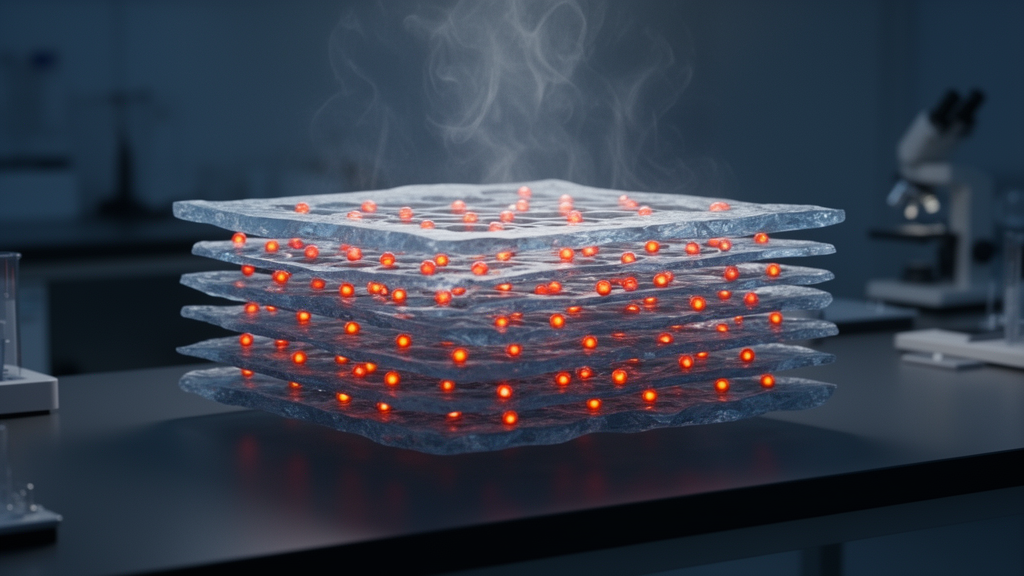
High-resolution transmission electron microscopy provided real-space confirmation. The quenched sample contained only locally confined stacking faults within otherwise well-ordered layers, with sharp diffraction spots and faint streaking in its Fourier transforms. The slowly cooled sample, by contrast, displayed a uniformly stacking-fault-rich framework throughout each particle, with pronounced streaks parallel to the stacking direction. Density functional theory calculations then explained why this matters: climbing-image nudged elastic band calculations showed that manganese ions hopping between octahedral sites face a barrier of 2.49 electron volts in bulk-like regions but 3.84 electron volts near stacking faults, an increase of roughly 1.35 electron volts. Since in-plane manganese migration drives vacancy clustering and brings oxidized oxygen ions close enough to form irreversible O-O dimers, stacking faults act as kinetic roadblocks against the very degradation pathway that kills oxygen redox. Soft X-ray O K-edge spectra and in situ diffraction during cycling both showed that the slowly cooled material’s oxygen electronic structure and lattice recover far more completely after discharge.
From these findings the authors distill a coherent mechanism and a practical design principle. Oxygen uptake during cooling above roughly 500 degrees Celsius oxidizes manganese and contracts the MnO6 framework, generating compressive stress that, together with reduced manganese-oxygen connectivity from vacancy formation, promotes layer gliding and stacking-fault development during slow cooling. Rapid cooling arrests this process, freezing an incomplete, fault-poor structure vulnerable to migration and oxygen loss. Remarkably, although the difference in P’3 phase fraction between the two samples was only about 8.2 percent, the improvement in oxygen-redox stability was substantial, underscoring the disproportionate stabilizing power of the fault-rich framework. The principle even carried over into full cells with pre-sodiated hard carbon anodes, where the slowly cooled cathode delivered 188 mAh per gram in the first cycle versus 148 for the quenched one. As sodium-ion batteries push toward commercial deployment, the message is clear: the recipe for a stable high-capacity cathode may be written as much in the cooling ramp as in the chemistry itself.
Subject of Research: Cooling-rate-controlled defect engineering for stable oxygen-redox sodium manganese oxide battery cathodes
Article Title: Regulating Oxygen‐Mediated Reconstruction during Cooling: A New Design Principle for High‐Capacity Sodium Manganese Oxide Cathodes
Article References: Lee, S., Han, D., Park, J.-H., Kwon, E., Barruna, E., Gong, S. H., Kim, M., Yoo, Y., Yu, S., Chung, K. Y., Nam, K.-W., Kim, S. Y., & Kim, H.-S. (2026). Regulating Oxygen‐Mediated Reconstruction during Cooling: A New Design Principle for High‐Capacity Sodium Manganese Oxide Cathodes. Advanced Science, Article e78064. https://doi.org/10.1002/advs.78064
Image Credits: AI Generated
DOI: 10.1002/advs.78064
Keywords: sodium-ion batteries, oxygen redox, cathode materials, manganese oxide, stacking faults, cooling rate, solid-state synthesis, manganese vacancies, energy storage, DFT calculations, voltage hysteresis, defect engineering
News Source: Faith Mcneil. (October 9, 2026). Slow Cooling Unlocks Stable Oxygen Redox in Sodium Battery Cathodes. Scienmag.