


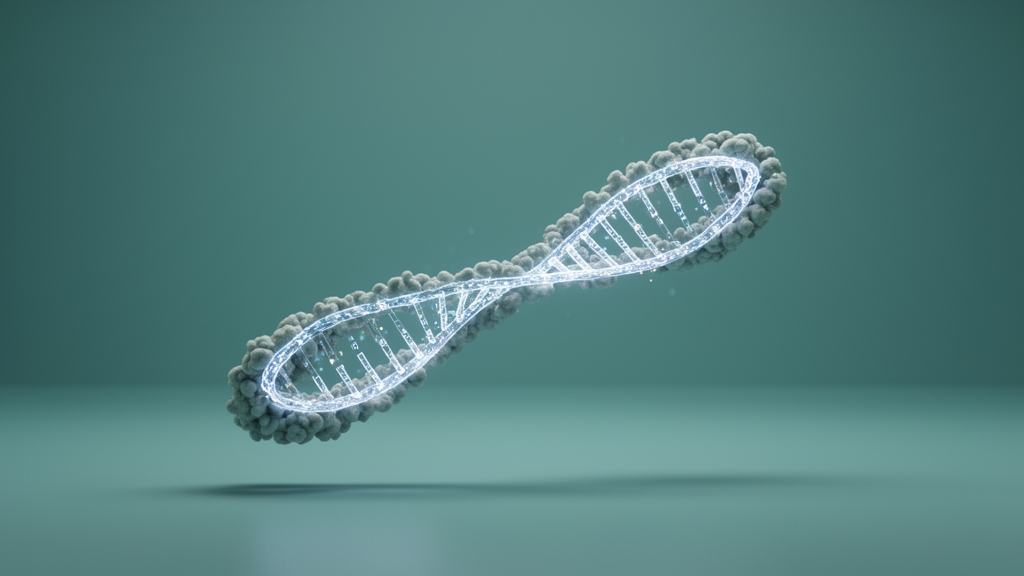
Scientists have sequenced, for the first time from one telomere to the other, the complete ribosomal DNA chromosome of the myxomycete Didymium iridis, a plasmodial slime mold whose ribosomal genes live on a peculiar non-Mendelian chromosome rather than on the standard chromosomes inherited in regular Mendelian fashion. The achievement, reported in BMC Molecular and Cell Biology, was made possible by ultra-deep long-read sequencing that finally resolved the dense tangle of repeats that had defeated earlier short-read attempts.
The chromosome is a linear molecule of about 20.3 kilobases, present at roughly 132 copies per haploid genome, and it is capped at both ends by regular TTAGGG telomeric repeats. It carries a single ribosomal RNA transcription unit of 11.3 kilobases that codes for the small and large subunit rRNAs. That transcription unit accounts for close to 60 percent of the chromosome. The remaining sequence is a non-transcribed region loaded with direct and inverted repeat motifs that the team labeled A through N, along with transcribed spacer regions studded with further repeats.
The key technical breakthrough was high-coverage Oxford Nanopore Technology sequencing. The researchers generated around 22 gigabases of sequence from haploid amoebae of the Pan 2 isolate, achieving a median read depth of 11,588-fold across the rDNA portion of their assembly, compared with 87-fold for ordinary chromosomal contigs. Because individual copies within each repeat array turned out to be highly similar but not identical, only reads long enough to span entire repeat blocks could distinguish true variation from sequencing error. Short-read technologies had repeatedly stalled in these highly repetitive regions.
Adjacent to the upstream telomere, the chromosome contains a 4.2-kilobase palindromic region whose forward and reverse halves are 99 percent identical in sequence. Within this palindrome the team identified two regions, designated PRO1 and PRO2, that contain 15-base-pair sequences identical to the experimentally proven replication origins of the related slime mold Physarum polycephalum, whose rDNA replication origins were mapped more than four decades ago using electron microscopy, Maxam-Gilbert sequencing, and biochemical approaches. The authors therefore designate the Didymium sites as putative replication origins and propose that the palindrome may switch between an open inter-strand configuration and a cruciform structure, potentially generating four different origin constellations.
The non-transcribed region also harbors a complex upstream promoter region organized as a direct repeat array of 260-base-pair D-type motifs. Each copy contains a 140-base-pair palindrome and an arrangement of inverted repeats built from one common 5-prime segment and three alternative 3-prime segments. Counterparts of these inverted repeat structures exist in Physarum rDNA, suggesting that this nested repeat architecture is a conserved feature between the two organisms. The researchers hypothesize that strand-specific DNA methylation, combined with reversible cruciform formation, may regulate replication of the rDNA chromosome, although this remains a model rather than a demonstrated mechanism in Didymium.
The ribosomal RNA genes themselves are interrupted by group I introns, autocatalytic RNA elements that splice themselves out of the precursor transcript. The small subunit gene carries a 1,436-nucleotide mobile intron named S956-1, which is optional and present only in the Pan 2 isolate. This intron is remarkable because it houses two ribozymes with different jobs: a group I splicing ribozyme and a lariat-capping ribozyme that adds an unusual three-nucleotide lariat cap, structurally distinct from the standard m7G cap of most eukaryotic messenger RNAs. The intron also encodes a homing endonuclease gene, itself interrupted by a tiny 51-nucleotide spliceosomal intron. The large subunit gene is split by two mandatory introns, L1949 and L2449, found in all isolates examined.
To see which parts of the chromosome are actually transcribed, the team sequenced polyadenylated RNA from four life stages: haploid amoebae, dormant microcysts, bi-flagellate swarm cells, and the multi-nucleate diploid plasmodium. The Illumina 3-prime-tag libraries yielded 86.3 million quality-filtered reads. Reads piled up across the pre-rRNA transcription unit, while no reads mapped to the rest of the chromosome. The rRNA exons showed high coverage, the external transcribed spacer reads began exactly at the predicted transcription initiation site, and all three group I introns were spliced out with flanking exon sequences perfectly ligated in both haploid and diploid stages.
Most strikingly, a sub-region of the S956-1 intron corresponding to the homing endonuclease gene was enriched at every stage. Two polyadenylated intron-derived RNA species were detected, one representing the unprocessed intron transcript and the other the mature homing endonuclease mRNA with the 51-nucleotide spliceosomal intron precisely removed. The mature message was polyadenylated at the same site previously mapped by RT-PCR and Sanger sequencing. Because the mRNA undergoes capping, polyadenylation, spliceosomal intron removal, and cytoplasmic translation, its detection in amoebae, flagellates, and plasmodia implies that this complex mobile element is active throughout the vegetative life cycle, in both haploid and diploid cells.
The study also revealed strain-specific variation in the internal transcribed spacer 1, where the number of J-type repeat copies differs among isolates: the Pan 2, Pan 3, and CR 8 isolates carry three copies, while Hon 1 and Gua 1 carry four. Such fine-scale differences, invisible to earlier partial sequencing efforts, illustrate how complete telomere-to-telomere assemblies can expose polymorphisms that serve as markers of evolutionary divergence among strains of the same species.
By delivering a gapless sequence of a non-Mendelian rDNA chromosome, the work provides new insight into how nuclear ribosomal DNA is organized in eukaryotic microorganisms, where extrachromosomal rDNA is widespread. It confirms that intron activities previously demonstrated only in vitro also occur in living haploid and diploid stages, strengthening the case that these mobile genetic elements are functionally important, and it sets a benchmark for resolving repetitive loci that conventional sequencing approaches cannot finish.
Subject of Research: Telomere-to-telomere sequencing of the non-Mendelian ribosomal DNA chromosome in the slime mold Didymium iridis
Article Title: Telomere-to-telomere characterization of rDNA chromosome in the myxomycete Didymium iridis
Article References: Khan, A., Jørgensen, T. E., Jakt, L. M., Karlsen, B. O., Hedberg, A., & Johansen, S. D. (2026). Telomere-to-telomere characterization of rDNA chromosome in the myxomycete Didymium iridis. BMC Molecular and Cell Biology, 27(1), Article 30. https://doi.org/10.1186/s12860-026-00587-7
Image Credits: AI Generated
DOI: 10.1186/s12860-026-00587-7
Keywords: ribosomal DNA, Didymium iridis, myxomycete, telomere-to-telomere sequencing, Oxford Nanopore, group I introns, homing endonuclease, replication origins, non-Mendelian inheritance, Physarum polycephalum, transcriptomics, palindromic repeats
News Source: Juliet Wilcox. (October 30, 2026). Slime mold ribosomal DNA chromosome mapped from end to end. Scienmag.



