Previously poorly characterized gene proved to be an important regulator with potential for the development of new metabolic therapies against ageing and cancer
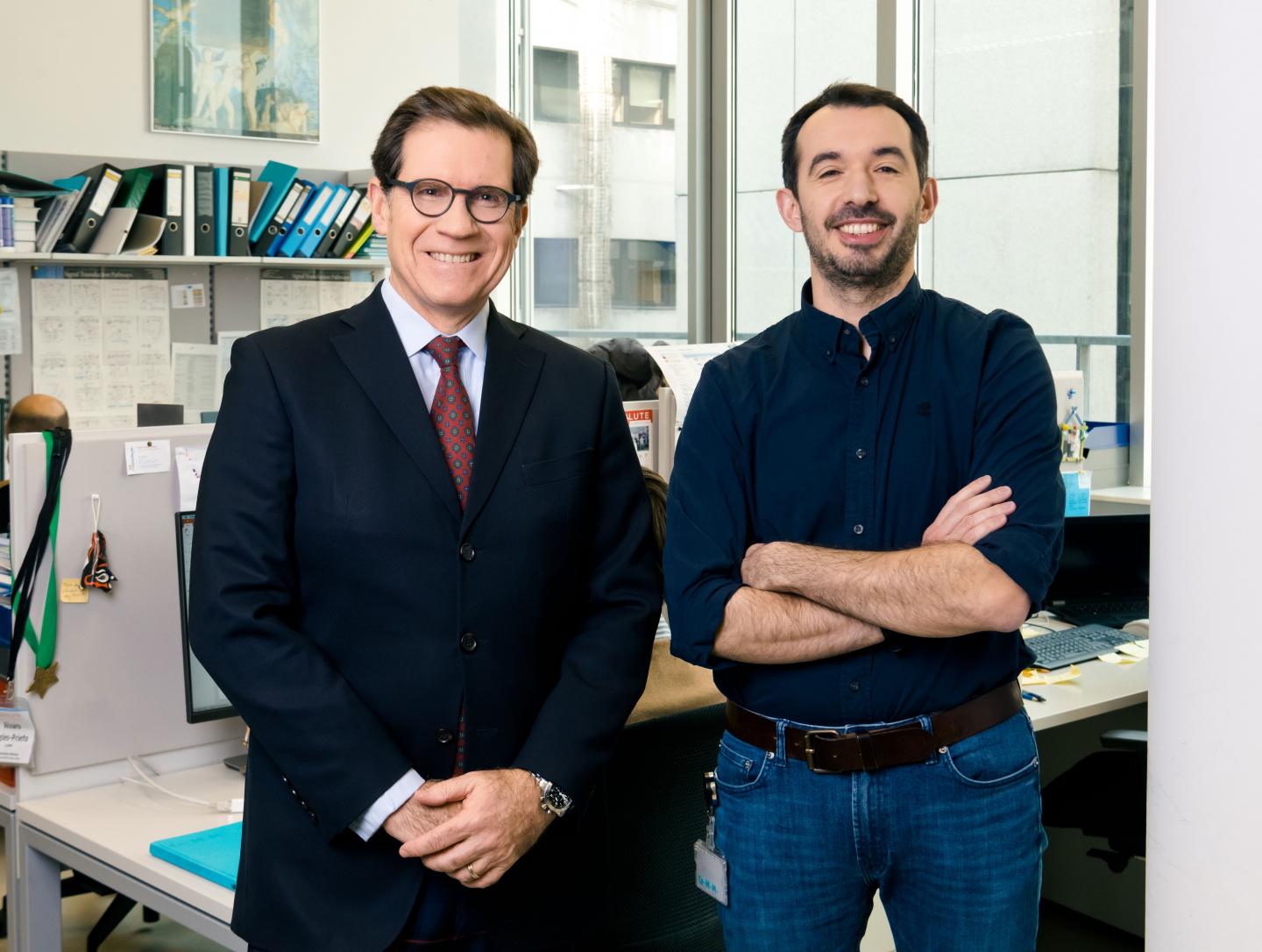
Credit: Klaus Pichler/CeMM
For their growth, cells need various nutrients and vitamins. So-called solute carriers (SLC), proteins that can transport such substances across the boundaries of cellular membranes, play a central role in metabolism. Scientists in Giulio Superti-Furga’s research group at the CeMM Research Center for Molecular Medicine of the Austrian Academy of Sciences have now discovered that the previously uncharacterised protein SLC25A51 acts as a transporter into the mitochondria for the coenzyme NAD. This molecule has already been associated with numerous physiological and pathological processes such as ageing, neurological diseases and the metabolism of cancer cells. Therefore, the results of this study not only open up new possibilities to study the biological role of NAD but also potentially provide the basis for new therapeutic approaches. The work has now been published in the journal Nature Communications.
Solute carriers (SLC) are proteins that act as transporters and enable the entry and exit of nutrients and waste products into and from the cell and its organelles. Many of these transporter proteins are still relatively poorly studied and the question of how some nutrients enter and leave cells often remains unanswered. So far, it has not yet been clarified how mitochondria gain access to an important cofactor of our metabolism, the so-called NAD (nicotinamide adenine dinucleotide). In scientific literature, there were only references to mitochondrial NAD transporters in plants and yeast. Lead author Enrico Girardi and the research group of CeMM Scientific Director Giulio Superti-Furga, in cooperation with scientists from the University of Bari (Italy), have now identified the protein responsible for the important transport of NAD into mitochondria: SLC25A51.
Measurement of nutrient pathways provided evidence
For their studies, the scientists used a specially created cell line library, which allows investigating pairwise genetic interactions of two SLCs. Their genes are deactivated both individually and in pairs; the effects of these interventions on cell growth can then be measured. Among the combination-related large number of interactions measured, some around the previously uncharacterised gene SLC25A51 stood out. The other interacting SLCs transport various nutrients, but all of them could be associated with NAD via known metabolic processes. “By accurately quantitatively measuring certain nutrients in the cells, we found that the presence of SLC25A51 correlated with the amount of NAD and that cells lacking SLC25A51 had extremely low levels of this molecule in their mitochondria,” explains senior author Giulio Superti-Furga. “In our study, we also show that the already known NAD transporter in yeast and SLC25A51 play a similar role in the human cell.”
Important part of the scientific puzzle
The question of the existence of a mitochondrial NAD transporter in humans has been discussed for some time. Giulio Superti-Furga also explains: “The results of our research, which have also been confirmed in two other independent studies by US laboratories, provide an important answer to this question and open up the opportunity of influencing the NAD content in this key organelle. NAD is associated with many physiological and pathological processes such as ageing, neurological diseases and the metabolism of cancer cells. Our study, therefore, represents an important contribution to understanding the biological role of this molecule. At the same time, we also see the enormous therapeutic potential arising from the possibility of a possible modulation of the NAD content in mitochondria by the transporter SLC25A51.”
###
Media Contact
Anna Maria Schwendinger
[email protected]
Original Source
http://cemm.
Related Journal Article
http://dx.