• HOME
  • NEWS
  • EXPLORE
    • CAREER
      • Companies
      • Jobs
    • EVENTS
    • iGEM
      • News
      • Team
    • PHOTOS
    • VIDEO
    • WIKI
  • BLOG
  • COMMUNITY
    • FACEBOOK
    • INSTAGRAM
    • TWITTER
Tuesday, August 18, 2026
BIOENGINEER.ORG
No Result
View All Result
  • Login
  • HOME
  • NEWS
  • EXPLORE
    • CAREER
      • Companies
      • Jobs
        • Lecturer
        • PhD Studentship
        • Postdoc
        • Research Assistant
    • EVENTS
    • iGEM
      • News
      • Team
    • PHOTOS
    • VIDEO
    • WIKI
  • BLOG
  • COMMUNITY
    • FACEBOOK
    • INSTAGRAM
    • TWITTER
  • HOME
  • NEWS
  • EXPLORE
    • CAREER
      • Companies
      • Jobs
        • Lecturer
        • PhD Studentship
        • Postdoc
        • Research Assistant
    • EVENTS
    • iGEM
      • News
      • Team
    • PHOTOS
    • VIDEO
    • WIKI
  • BLOG
  • COMMUNITY
    • FACEBOOK
    • INSTAGRAM
    • TWITTER
No Result
View All Result
Bioengineer.org
No Result
View All Result
Home NEWS Science News Chemistry

Skoltech researchers proposed an attractive cheap organic material for batteries

Bioengineer by Bioengineer
May 25, 2021
in Chemistry
Reading Time: 3 mins read
0
IMAGE
Share on FacebookShare on TwitterShare on LinkedinShare on RedditShare on Telegram

IMAGE

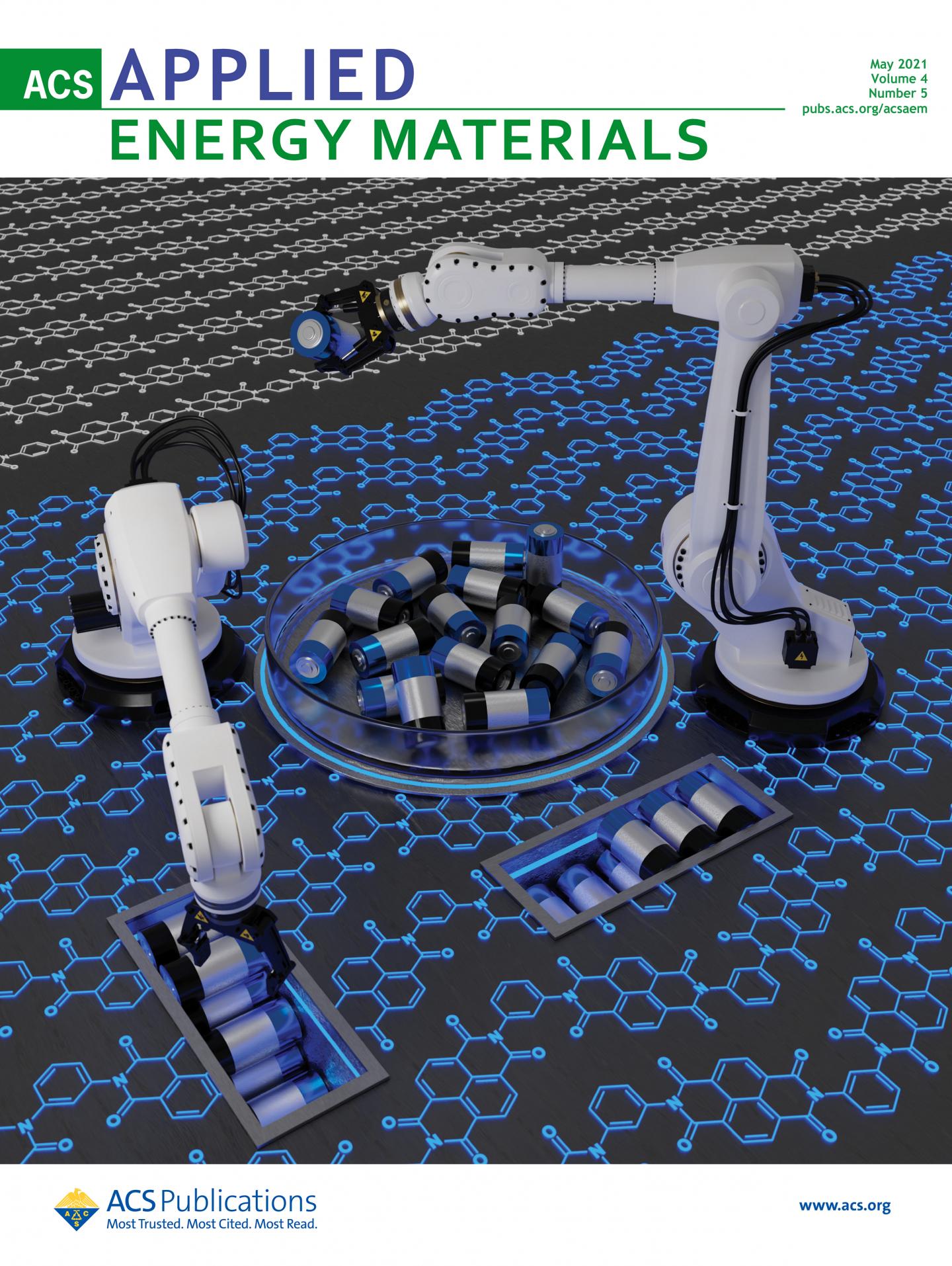
Credit: ACS Applied Energy Materials

A new report by Skoltech scientists and their colleagues describes an organic material for the new generation of energy storage devices, which structure follows an elegant molecular design principle. It has recently been published in ACS Applied Energy Materials and made the cover of the journal.

While the modern world relies on energy storage devices more and more heavily, it is becoming increasingly important to implement sustainable battery technologies that are friendlier to the environment, are easy to dispose, rely on abundant elements only, and are cheap. Organic batteries are desirable candidates for such purposes. However, organic cathode materials that store a lot of energy per mass unit can be charged quickly, are durable and can be easily produced on a large scale at the same time, remain underdeveloped.

To address this problem, researchers from Skoltech proposed a simple redox-active polyimide. It was synthesized by heating a mixture of an aromatic dianhydride and meta-phenylenediamine, both easily accessible reagents. The material showed promising features in various types of energy storage devices, such as lithium-, sodium- and potassium-based batteries. It had high specific capacities (up to ~140 mAh/g), relatively high redox potentials, as well as decent cycling stability (up to 1000 cycles), and abilities to charge quickly (

The new material’s energy and power outputs were superior compared to its previously known isomer, which is derived from para-phenylenediamine. With the help of collaborators from the Institute of Problems of Chemical Physics of the Russian Academy of Sciences, it was shown that there were two reasons for the better performance of the new polyimide. Firstly, it had smaller particles and a much higher specific surface area, which enabled easier diffusion of the charge carriers. Secondly, the spatial arrangement of the neighbor imide units in the polymer allowed a more energetically favorable binding of metal ions, which increased the redox potentials.

“This work is interesting not just because another organic cathode material was researched”, – says Roman Kapaev, a Skoltech PhD student who designed this study, – “What we propose is a new molecular design principle for battery polyimides, which is using aromatic molecules with amino groups in meta positions as building blocks. For a long time, scientists have paid little attention to this structural motif, and used para-phenylenediamine or similar structures instead. Our results are a good hint for understanding how the battery polyimides should be designed on a molecular level, and it might lead to cathode materials with even better characteristics”.

###

Skoltech is a private international university located in Russia. Established in 2011 in collaboration with Massachusetts Institute of Technology (MIT), Skoltech is cultivating a new generation of leaders in the fields of science, technology, and business is conducting research in breakthrough fields, and is promoting technological innovation to solve critical problems that face Russia and the world. Skoltech is focusing on six priority areas: data science and artificial intelligence, life sciences, advanced materials and modern design methods, energy efficiency, photonics, and quantum technologies, and advanced research. Web: https://www.skoltech.ru/.

Media Contact
Ilyana Zolotareva
[email protected]

Original Source

https://www.skoltech.ru/en/2021/05/skoltech-researchers-proposed-an-attractive-cheap-organic-material-for-batteries/

Related Journal Article

http://dx.doi.org/10.1021/acsaem.1c00092

Tags: Biomedical/Environmental/Chemical EngineeringChemistry/Physics/Materials SciencesElectrical Engineering/ElectronicsEnergy/Fuel (non-petroleum)MaterialsResearch/Development
Share12Tweet8Share2ShareShareShare2

Related Posts

3D-Printed Cellulose Hydrogel Keeps Wearable Sensors Flexible Below Freezing

3D-Printed Cellulose Hydrogel Keeps Wearable Sensors Flexible Below Freezing

August 18, 2026
AI uncovers elemental clues behind persistent free radicals in biochar

AI uncovers elemental clues behind persistent free radicals in biochar

August 18, 2026

Natural leaf coatings could help hydrochar store carbon more effectively

August 18, 2026

Quantum Light Engines Could Power a New Generation of Microscopic Machines

August 18, 2026
Please login to join discussion

POPULAR NEWS

  • UL Research Institutes names Chao-Yang Wang electrochemical safety institute executive director

    29 shares
    Share 12 Tweet 7
  • Alliance reports first randomized trial results for radiopharmaceutical treatment in kidney cancer

    29 shares
    Share 12 Tweet 7
  • Real-world study confirms TB preventive treatment works for people with HIV

    29 shares
    Share 12 Tweet 7
  • 3D-Printed Cellulose Hydrogel Keeps Wearable Sensors Flexible Below Freezing

    29 shares
    Share 12 Tweet 7

About

We bring you the latest biotechnology news from best research centers and universities around the world. Check our website.

Follow us

Recent News

UL Research Institutes names Chao-Yang Wang electrochemical safety institute executive director

Alliance reports first randomized trial results for radiopharmaceutical treatment in kidney cancer

Real-world study confirms TB preventive treatment works for people with HIV

Subscribe to Blog via Email

Enter your email address to subscribe to this blog and receive notifications of new posts by email.

Join 85 other subscribers
  • Contact Us

Bioengineer.org © Copyright 2023 All Rights Reserved.

Welcome Back!

Login to your account below

Forgotten Password?

Retrieve your password

Please enter your username or email address to reset your password.

Log In
No Result
View All Result
  • Homepages
    • Home Page 1
    • Home Page 2
  • News
  • National
  • Business
  • Health
  • Lifestyle
  • Science

Bioengineer.org © Copyright 2023 All Rights Reserved.