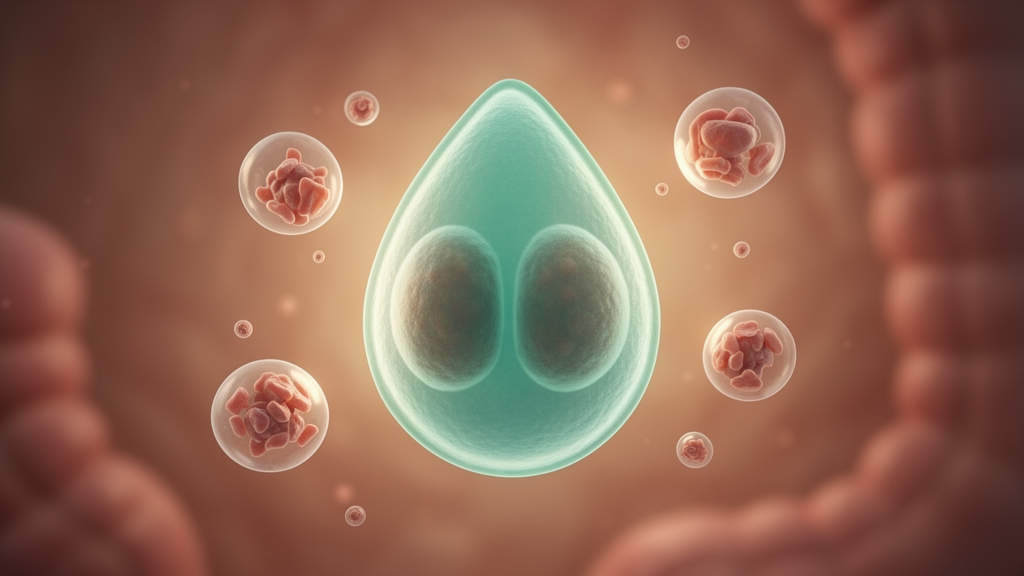
The intestinal parasite Giardia lamblia has long been one of the most puzzling organisms in cell biology. As one of the most deeply divergent eukaryotes known to science, it has shed many of the molecular systems that other cells consider essential, and among the casualties appeared to be autophagy, the cellular recycling process that nearly every eukaryote relies on to survive starvation and maintain internal order. A new study published in PLOS Pathogens now shows that Giardia has not abandoned autophagy after all. Instead, it runs a radically remodeled version of the pathway, one that operates without the canonical machinery that defines the process in yeast, plants, and animals, and that is controlled by a single, unexpected regulator: the parasite’s only Rho family GTPase, a protein the researchers call GlRac.
Autophagy, in its textbook form, is a beautifully choreographed process. When a cell is starved or stressed, a cascade of autophagy-related proteins, the ATG family, assembles a double-membraned vesicle called an autophagosome around cytoplasmic cargo. The hallmark protein ATG8, known as LC3 in mammals, decorates the growing membrane and helps tether and engulf the cargo. The completed vesicle then fuses with lysosomes, where acidic hydrolases dismantle the contents into raw materials the cell can reuse. Giardia, however, lacks most ATG genes, including ATG8 itself, which led many researchers to conclude that this parasite, with its famously simplified cellular architecture, simply does not perform autophagy. The new work, led by Angélica Hollunder Klippel and Alexander R. Paredez and their colleagues, overturns that assumption by revealing a degradative compartment system that behaves remarkably like autophagy despite lacking its familiar molecular cast.
The team’s central discovery is that GlRac marks and regulates a population of double-membraned compartments that arise under precisely the conditions that trigger autophagy in other organisms. When Giardia cells are deprived of nutrients or induced to encyst, the developmental program by which the parasite transforms into its hardy cyst form, GlRac-positive compartments accumulate in the cytoplasm. When amino acids are restored to the medium, these structures rapidly disappear. Notably, glucose replenishment has no such effect, indicating that the pathway is tuned specifically to amino acid availability rather than to general energy status. That kind of nutrient-specific regulation is a signature feature of canonical autophagy, and finding it in an organism without ATG8 suggests that the logic of the pathway has been conserved even as its molecular components have been replaced beyond recognition.
The regulatory circuitry extends one step further upstream to Giardia’s Target of Rapamycin, or GTOR, the parasite’s counterpart of the TOR kinase that serves as the master nutrient sensor in eukaryotes from yeast to humans. The researchers found that GTOR protein levels drop during nutrient depletion, mirroring the rise in GlRac-positive compartments. When they knocked down GTOR, compartment abundance increased, even in the absence of starvation. This positions GTOR as a negative regulator of the pathway: as long as nutrients are plentiful and GTOR is active, compartment formation is suppressed, but when GTOR signaling wanes, the degradative compartments bloom. The parallel with canonical autophagy is striking, because TOR inhibition is the canonical trigger for autophagy induction across the tree of life. Giardia appears to have preserved this regulatory architecture while swapping out the execution machinery downstream.
Live-cell time-lapse microscopy allowed the team to watch the compartments form in real time, and the footage revealed a morphological sequence familiar to anyone who has studied autophagosome biogenesis. The structures first appear as linear profiles, then curve into cup-shaped intermediates resembling the phagophores, or isolation membranes, of classical autophagy, before sealing into spheres. Upon nutrient replenishment, the mature compartments are cleared from the cell. This progression from flat membrane to curved cup to closed vesicle is precisely how autophagosomes are thought to grow and complete in ATG8-bearing organisms, making it all the more remarkable that Giardia accomplishes the same geometric feat without the membrane-deformation proteins usually credited with driving it.
To test whether any remnant of the canonical machinery might be involved, the researchers examined nine putative ATG orthologs encoded in the Giardia genome. None of them localized to the GlRac-positive compartments with anything approaching GlRac’s specificity, supporting the conclusion that the pathway is genuinely ATG8-independent and highly divergent. Yet the compartments themselves display a suite of features that are unmistakably autophagy-like. They are bounded by double membranes, the defining ultrastructural trait of autophagosomes. They recruit actin, they undergo acidification, and they harbor cysteine protease activity, the enzymatic workhorse of intracellular degradation. In other words, the output of the pathway looks like autophagy even though the input machinery does not.
Pharmacological experiments reinforced the idea that these compartments are sites of continuous degradative turnover rather than static storage structures. When the team blocked cysteine proteases with the inhibitor E-64d, or when they prevented vacuolar acidification by targeting the V-ATPase proton pump with concanamycin A, the compartments accumulated in the cells. Both outcomes are consistent with a system in which cargo is constantly being delivered, degraded, and cleared, and in which disrupting any stage of that pipeline causes intermediates to pile up. The same logic underlies classic autophagy assays in model organisms, where lysosomal inhibitors cause autophagosomes to accumulate because the downstream disposal step has been jammed.
GlRac itself proved to be a bidirectional control switch for the pathway. When the researchers engineered a constitutively active version of the GTPase, compartment abundance and size both increased, indicating that active GlRac drives biogenesis. Conversely, knocking down GlRac reduced the number of compartments, showing that the protein is required for their formation in the first place. This places GlRac, the sole Rho family GTPase in Giardia, in a role reminiscent of the small GTPases that regulate membrane trafficking and autophagy in other eukaryotes, but here concentrated into a single multifunctional protein in an organism with an unusually stripped-down signaling repertoire. The finding also hints that Rho GTPase involvement in autophagy-like membrane remodeling may be more ancient than the ATG8-centric version of the pathway familiar from model systems.
The work carries a potential translational payoff. Quinacrine, an FDA-approved drug long used against Giardia infections, accumulates in acidic organelles, and the researchers found that it perturbs the GlRac-positive compartments, consistent with reports that quinacrine disrupts autophagy in other eukaryotes. If the autophagy-like pathway contributes to parasite fitness, as the authors suggest, then the compartments may represent a previously unrecognized vulnerability that existing drugs already exploit, and one that new therapeutics could target more precisely. More broadly, the study is a reminder that evolutionary simplification can be deceptive. Giardia has not lost the function of autophagy; it has rebuilt it from unfamiliar parts, with a lone Rho GTPase standing in for an entire protein family. For evolutionary cell biologists, the parasite now offers a living experiment in how a fundamental eukaryotic process can be re-engineered, and for parasitologists, it opens a fresh front in the search for drugs against one of the world’s most common causes of diarrheal disease.
Subject of Research: An ATG8-independent autophagy-like pathway regulated by the Rho GTPase GlRac in the parasite Giardia lamblia
Article Title: Gl Rac regulates an ATG8-independent autophagy-like pathway in Giardia lamblia
Article References: Klippel, A. H., Newman-Boulle, C., Reed, G., Dule, D., Kedia, S., Kelty, M. T., Chan, W. P., Shih, H.-W., & Paredez, A. R. (2026). GlRac regulates an ATG8-independent autophagy-like pathway in Giardia lamblia. PLOS Pathogens, 22(10), e1014624. https://doi.org/10.1371/journal.ppat.1014624
Image Credits: AI Generated
DOI: 10.1371/journal.ppat.1014624
Keywords: Giardia lamblia, autophagy, ATG8-independent pathway, GlRac, Rho GTPase, GTOR, nutrient sensing, encystation, double-membrane compartments, cysteine proteases, quinacrine, PLOS Pathogens
News Source: Drew Townsend. (October 9, 2026). Single GTPase Governs a Strange Autophagy-Like Pathway in the Parasite Giardia. Scienmag.