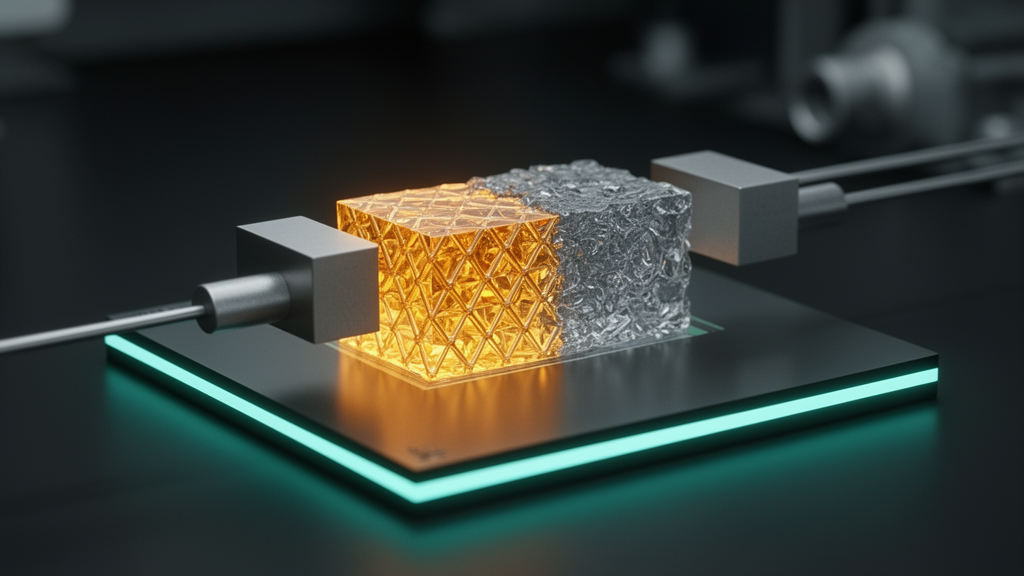
Engineers have long faced an awkward trade-off at the heart of high-density memory design: the memory cell that stores the bit and the selector that keeps stray currents away from neighboring cells are usually two different materials, each demanding its own deposition recipe, its own optimization, and its own lithographic attention. A team reporting in Applied Microscopy has now shown that a single binary material, germanium-telluride, can do both jobs, with the choice of function dictated simply by how much tellurium the film contains. By stacking a near-stoichiometric GeTe memory layer directly on top of a tellurium-rich GeTe6 selector layer, the researchers fabricated a monolithic one-selector one-resistor (1S1R) cross-point device that endured roughly eight million switching cycles while maintaining a stable memory window of about 0.2 volts.
The motivation comes from the relentless pressure on the memory hierarchy. Dynamic random-access memory serves as fast working memory and flash serves as storage, but both charge-based technologies face physical scaling limits and process difficulties. Storage-class memory, a concept IBM introduced in 2006, aims to fill the performance gap between the two, and resistive-type two-terminal devices such as phase-change memory and resistive random-access memory are leading candidates. To reach the densities that make such memory economical, the industry has converged on three-dimensional cross-point array architectures, in which memory cells sit at intersections of perpendicular wires. The catch is that without a nonlinear selector device in series with each cell, sneak currents flow through unselected cells and corrupt the readout.
Since 2009, the standard answer has been to pair phase-change memory with an Ovonic threshold switch, a volatile chalcogenide selector that stays insulating below a threshold voltage and snaps into a conductive state above it. But the two layers typically require different material systems and separately optimized manufacturing conditions, which drives up fabrication cost and complexity. The new work attacks that bottleneck directly: if one binary material can be coaxed into either memory switching or threshold switching by composition alone, both layers can be deposited in a single cluster system and patterned in one monolithic lithographic step.
The team deposited GexTe1-x thin films by radio-frequency magnetron co-sputtering from high-purity germanium and tellurium targets onto silicon dioxide substrates, holding the tellurium target power at 15 watts while varying the germanium power from 20 to 50 watts. This produced films spanning compositions from germanium-poor Ge0.11Te0.89 to germanium-rich Ge0.77Te0.23. Devices were built as hole-etched structures with 100-nanometer-thick tungsten electrodes above and below a 20-nanometer-thick functional layer, with hole sizes ranging from 34 by 34 nanometers up to 1921 by 1921 nanometers defined through an 18-size etched silicon dioxide array.
The chemical analysis explains why composition controls function. X-ray photoelectron spectroscopy showed that in tellurium-deficient compositions, tellurium atoms are almost entirely consumed in energetically favorable germanium-tellurium bonds; a tellurium-oxygen peak at 576.9 electron-volts stayed absent up to Ge0.56Te0.44 and only appeared once the composition reached Ge0.40Te0.60, growing steadily with further tellurium enrichment. Raman spectroscopy told a matching story: peaks associated with tellurium-tellurium chains and interconnected germanium-tellurium bonds dominated the tellurium-rich films, and peak broadening, a signature of structural disorder in the amorphous alloy, increased with tellurium content. Excess tellurium beyond the coordinative saturation point of germanium forms homopolar tellurium-tellurium bonds, which raise the density of localized trap states within the mobility gap, the mechanism widely associated with threshold switching in amorphous chalcogenides.
Electrically, the two regimes behaved exactly as the bonding picture predicted. The near-stoichiometric GeTe composition functioned as a phase-change memory cell, storing data in the resistance contrast between crystalline and amorphous phases. The RESET operation, which amorphizes the material by melting and rapidly quenching it, worked reliably across pulse widths from 70 to 300 nanoseconds with a resistance contrast of at least two orders of magnitude, and shorter pulses proved preferable for power efficiency. The SET operation, which crystallizes the material and needs longer pulses for atomic rearrangement, stabilized at 150 nanoseconds and above. Under these conditions the standalone GeTe cell survived roughly five million program-erase cycles without failure, holding a resistance contrast of about one order of magnitude.
The tellurium-rich GeTe6 composition, by contrast, acted as a bidirectional threshold switch. Below its threshold voltage the device sat in a high-resistance OFF state above one gigaohm, effectively suppressing leakage; above threshold it dropped several orders of magnitude into a low-resistance state below one kilohm at one volt, enough to supply the milliamp-level currents a neighboring memory cell needs for programming. The switching was volatile and abrupt, reverting to the OFF state whenever the applied voltage fell below the holding voltage. The selector showed a sharp switching slope, a delay time under 55 nanoseconds, selectivity exceeding ten thousand, and stable operation without breakdown for one hundred million cycles under 150-nanosecond pulses. In-situ X-ray diffraction confirmed the film remained amorphous, and functional, up to 225 degrees Celsius; above that temperature it crystallized and lost its threshold-switching behavior.
Stacking the two layers produced the integrated device that is the paper’s centerpiece. When the memory cell is in its low-resistance SET state, it acts as a negligible voltage divider, so the sharp current rise in the 1S1R stack occurs at essentially the same threshold voltage as the selector alone, near 0.4 volts. When the memory cell is in its high-resistance RESET state, both layers must turn on simultaneously, pushing the switching voltage up to roughly 0.6 volts. A read voltage placed between these two thresholds yields a current ratio of about 1.12 times ten to the second power, more than two orders of magnitude, allowing the stored state to be read unambiguously through the 0.2-volt memory window.
Perhaps the most striking result is that the integrated stack outlasted the memory cell it contains. The 1S1R device maintained uniform switching over approximately eight million cycles, exceeding the roughly five million cycles of the standalone PCM device. The authors attribute this to the intrinsic current-limiting, or self-compliance, behavior of the GeTe6 selector layer, which caps the current through the memory element and prevents the excessive Joule heating that degrades it during repeated cycling. The chalcogenide-on-chalcogenide interface may also improve thermal confinement and reduce atomic diffusion compared with conventional metal-electrode contacts. The authors are careful to note the limits of their evidence: they did not directly image the GeTe/GeTe6 interface microscopically, and interdiffusion between the two functional layers under repeated electrical stress cannot be ruled out, so engineering a stable interfacial barrier remains an open task.
The broader significance is architectural rather than a single device metric. Because both functional layers come from one binary material system tuned by sputtering power, the entire 1S1R stack can be deposited in one cluster tool and patterned monolithically, eliminating separate lithography steps and the multi-material process complexity that has kept cross-point memory expensive. The work also clarifies the mechanism: the functional identity of an amorphous germanium-telluride film, memory element or threshold selector, is set by whether its local bonding network is germanium-tellurium dominated or tellurium-tellurium rich. For storage-class memory and neuromorphic computing applications, where dense, reliable, and cheap cross-point arrays are the goal, a single material that plays both roles is a meaningful simplification, though scaling from laboratory hole-etched cells to production arrays will depend on solving the interface stability question the authors themselves flag.
Subject of Research: Composition-tuned germanium-telluride films enabling monolithic 1S1R cross-point memory devices
Article Title: Monolithic fabrication of 1S1R cross-point device using single GexTe1-x material by controlling composition between memory and threshold switching
Article References: Kim, Y.-M., Park, S.-H., Lee, J., Kim, S., Park, S., & Yeo, J.-S. (2026). Monolithic fabrication of 1S1R cross-point device using single GexTe1-x material by controlling composition between memory and threshold switching. Applied Microscopy, 56(1), Article 25. https://doi.org/10.1186/s42649-026-00145-7
Image Credits: AI Generated
DOI: 10.1186/s42649-026-00145-7
Keywords: phase-change memory, threshold switching, chalcogenide, 1S1R cross-point array, germanium telluride, selectors, storage-class memory, thin films, XPS, Raman spectroscopy, neuromorphic computing, endurance
News Source: Denise Maddox. (October 28, 2026). Single Germanium-Telluride Material Yields Both Memory Cell and Selector. Scienmag.