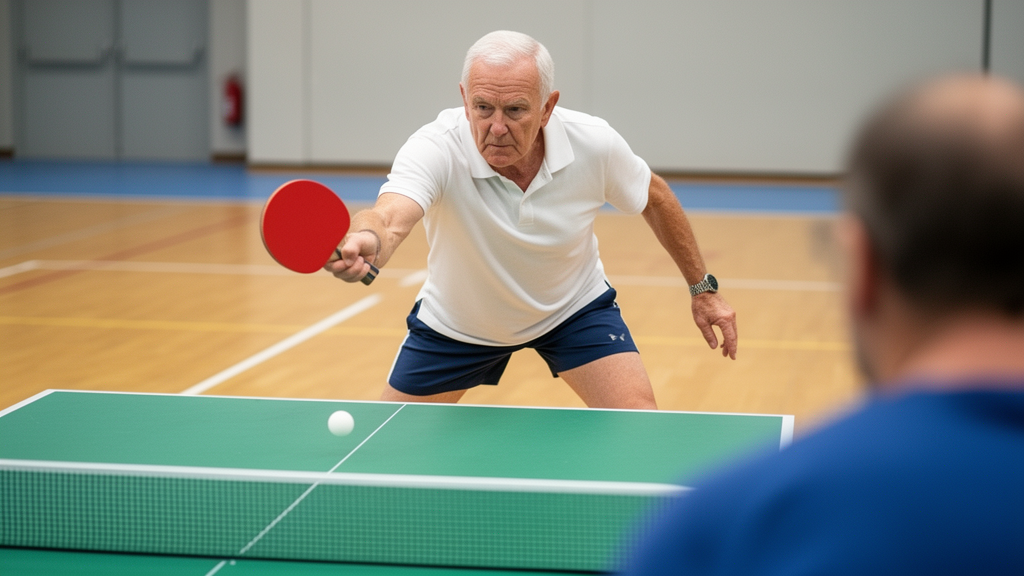
Table tennis, badminton and tennis are often lumped together as ‘racket sports’ in exercise recommendations for older adults, but a new systematic review and network meta-analysis suggests the evidence behind them is far from equal. The review, published in European Review of Aging and Physical Activity, compared the three sports across five functional domains in adults aged 60 and over: muscular strength, balance, cognitive function, aerobic capacity and flexibility. Its central finding is a stark imbalance. Table tennis was the only sport whose effects were informed by more than one trial, while tennis rested on a single study of 16 men with no non-exercise comparison group.
The researchers searched six databases from inception to December 2025, with an update in August 2026, and included randomized and quasi-experimental trials. Thirteen trials, reported across 14 papers, met the inclusion criteria. Ten randomized trials covering 469 participants formed the primary analysis, with quasi-experimental studies analyzed separately as secondary evidence. Muscular strength, balance and cognitive function were analyzed using random-effects network meta-analysis, a statistical approach that allows both direct comparisons within trials and indirect comparisons across trials to be combined. Aerobic capacity and flexibility lacked independent indirect evidence, so these outcomes were analyzed pairwise. Evidence certainty was graded using GRADE, with each comparison labeled as direct, indirect or combined.
For table tennis, the estimates favored the sport over non-exercise control in four of the five domains, with standardized mean differences ranging from 0.82 to 1.42 based on combined evidence, direct for aerobic capacity. Against active exercise comparators rather than inactive controls, table tennis showed advantages for muscular strength, with an SMD of 0.89 (95% CI 0.28 to 1.50), and for cognitive function, with an SMD of 1.16 (95% CI 0.69 to 1.64), both based on combined evidence. However, the certainty behind these numbers was limited. The network estimates for table tennis versus non-exercise control on strength, balance and cognition were rated as low certainty, though they were relatively stable across the sensitivity analyses that could be performed. Most other estimates in the network were rated as very low certainty.
The between-sport comparisons, the question the review was designed to answer, were even thinner. No trial in the review directly compared one racket sport against another. Badminton evidence was sparse. Tennis evidence came from that single trial of 16 men without a non-exercise arm, meaning every tennis estimate against control was indirect and, as the authors state, could not support firm conclusions. The only between-sport estimate that excluded the null was table tennis versus badminton for cognitive function, with an SMD of 0.83 (95% CI 0.24 to 1.43). That estimate was indirect, of very low certainty, and not robust across all sensitivity analyses.
The authors’ conclusion is carefully worded: racket-sport interventions were associated with favorable effects on several functional outcomes in older adults, but the evidence was concentrated in table tennis. Current evidence is insufficient to determine whether one racket sport is superior to another, a gap the authors attribute to sparse and imbalanced evidence rather than demonstrated equivalence between the sports. They call for adequately powered head-to-head randomized trials to settle the comparison. The review was registered prospectively on PROSPERO under registration number CRD420251148095, and the article is open access, published on 15 October 2026 as a peer-reviewed accepted manuscript carrying a permanent DOI.
Subject of Research: Comparative effects of table tennis, badminton and tennis on physical and cognitive function in adults aged 60 and over
Article Title: Comparative effects of racket sports on physical and cognitive function in older adults: a systematic review and network meta-analysis
Article References: He, Z., Li, X., Kim, G., Xing, K., Um, J., Lee, J.-S., Koo, D., & Panday, S. B. (2026). Comparative effects of racket sports on physical and cognitive function in older adults: a systematic review and network meta-analysis. European Review of Aging and Physical Activity. https://doi.org/10.1186/s11556-026-00440-y
Image Credits: AI Generated
DOI: 10.1186/s11556-026-00440-y
Keywords: table tennis, badminton, tennis, older adults, network meta-analysis, systematic review, cognitive function, muscular strength, balance, GRADE certainty, randomized trials, physical function
News Source: Ophelia Keating. (October 27, 2026). Table Tennis Leads Racket Sports Evidence in Older Adults, Review Finds. Scienmag.