
Hybrid Nanocomposite Thin Films Enable Low Temperature Nitrogen Dioxide Gas Sensing
Polyaniline and tungsten oxide hybrid nanocomposite thin films achieved an 87.71 percent sensing response to nitrogen dioxide gas at 90 ...
Polyaniline and tungsten oxide hybrid nanocomposite thin films achieved an 87.71 percent sensing response to nitrogen dioxide gas at 90 ...

Post-deposition sulfur vapor treatment reduces the optical bandgap of bismuth ferrite thin films from 2.68 to 1.72 electron volts while ...

A study identifies how substrate flexibility influences the structural architecture and anti-icing efficiency of transparent superhydrophobic coatings.

Researchers fabricated uniaxially oriented zinc phthalocyanine nanowire thin films on friction-transferred polytetrafluoroethylene templates, achieving a 3.8-fold electrical conductivity enhancement along ...
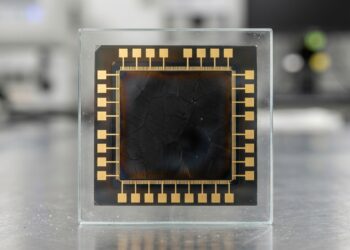
Researchers have developed high-quality perovskite thin films using a volatile eutectic mixture, enabling efficient solar cells and light-emitting diodes within ...

Tohoku University researchers achieved a 250-fold increase in thermoelectric power factor by adding titanium to room-temperature chromium nitride thin films.

Researchers at the University of Osaka developed an automated robotic platform combining high-speed imaging and machine learning to monitor perovskite ...

Researchers have experimentally demonstrated that a manganese-silicon altermagnet can electrically inject pure spin current into a non-magnetic material using lateral ...

Researchers demonstrated that refreshing chemical bath solutions during zinc oxide nanorod deposition decouples seed-layer thickness effects from precursor depletion, establishing ...

Post-deposition annealing and environmental exposure reveal phase-dependent defect dynamics and irreversible radiative shifts in magnetron-sputtered antimony selenide thin films.

A lithium-ion-embedded, quercetin-cross-linked polyvinyl alcohol film removed 96.3% of methylene blue from water and kept over 90% of its adsorption ...

Researchers demonstrated that tungsten trioxide thin films synthesized using an argon-oxygen sputtering plasma achieved 86.18 percent sensitivity toward 100 parts ...

Researchers found that incorporating bismuth oxide into polyvinylpyrrolidone thin films reduced the optical band gap, achieved a 75.60 percent degradation ...
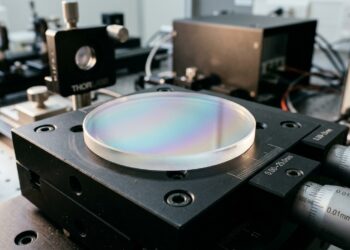
A study of sputtered doped zinc oxide thin films found that variational quantum regression predicted near-band-edge emission energies with a ...

Researchers developed a negative-working near-infrared lithographic imaging system based on non-aqueous polymer dispersions and a dual crosslinking strategy.

Researchers have shown that Raman-derived effective bond enthalpy can predict the relative nanoscale wear resistance of amorphous chalcogenide films, enabling ...

Ceramics underpin technologies ranging from electronics and solid-state batteries to aerospace components, but the researchers note that traditional sintering at ...

Using handed terahertz light on ultrathin iron-based superconducting films, Rutgers and Estonian researchers separated two groups of quantum particles trapped ...

A systematic study of 10-nanometer Hf0.5Zr0.5O2 films finds that rapid thermal annealing near 600 degrees Celsius maximizes the ferroelectric orthorhombic ...

Researchers report the first room-temperature electrodeposition of aluminium-modified bismuth oxide thin films on FTO substrates, achieving 76 percent transmittance and ...