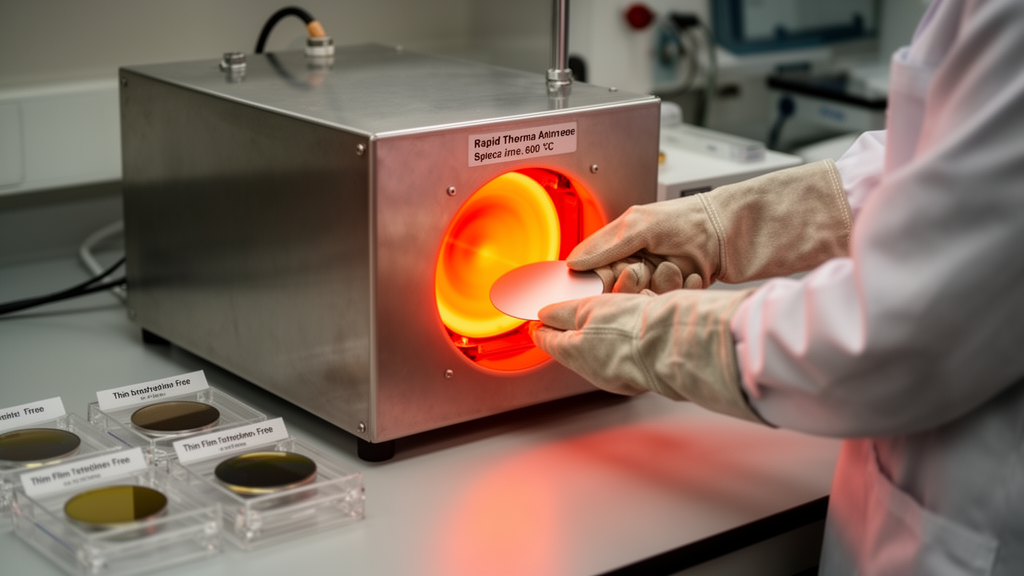
A thin film only ten nanometers thick may hold the key to faster, denser, and more energy-efficient memory devices, and a new study has now mapped, degree by degree, exactly how heat transforms this material from a disordered insulator into a working ferroelectric. Their central finding is strikingly clear: an annealing temperature near 600 degrees Celsius provides the optimum condition for stabilizing the ferroelectric orthorhombic phase and achieving enhanced ferroelectric performance in these films.
HZO has emerged as a leading ferroelectric material for CMOS-integrated nonvolatile memory, logic, and neuromorphic hardware, owing to its high permittivity, thermal stability, scalability to a few nanometers, and full process compatibility with advanced silicon platforms. Building on the industrial adoption of fluorite-structured HfO2 and ZrO2 as high-k gate dielectrics in MOSFETs and DRAM capacitor dielectrics, HZO uniquely exhibits robust room-temperature ferroelectric switching at thicknesses where conventional perovskite ferroelectrics struggle. That combination positions it as a practical pathway toward dense, low-power ferroelectric devices that can be fabricated directly on top of standard silicon circuitry without exotic processing steps.
The ferroelectric response in HZO originates from a metastable, non-centrosymmetric orthorhombic phase, which competes with the nonpolar tetragonal phase and the thermodynamically stable monoclinic phase. Maximizing the fraction, preferred orientation, and stability of the orthorhombic phase is therefore essential for achieving optimal ferroelectric device performance. But the phase stability of HZO is highly sensitive to processing conditions, including film thickness, composition, oxygen vacancy concentration, electrode material, mechanical boundary conditions, and, most critically, the post-deposition thermal treatment. Insufficient annealing can leave the film amorphous or poorly crystallized, suppressing polarization, whereas excessive annealing can relieve strain, alter defect distributions, and promote transformation to the monoclinic ground state, ultimately degrading ferroelectric properties. These effects become even more pronounced in ultrathin films of roughly ten nanometers, where interfacial energy and mechanical constraints can dominate over bulk thermodynamics.
In the new work, the team deposited ten-nanometer-thick HZO films by thermal atomic layer deposition on silicon substrates carrying a 100-nanometer silicon dioxide interfacial layer. HfO2 and ZrO2 were alternately deposited at a substrate temperature of 250 degrees Celsius using metal-amide precursors with ozone as the reactant and argon as the purge gas, with both oxides growing at approximately one angstrom per cycle in a one-to-one ratio over fifty cycles. The films were then crystallized by post-metal rapid thermal annealing in the range of 400 to 1000 degrees Celsius, using a ramp rate of 50 degrees per second and a dwell time of 30 seconds at each target temperature, all under a nitrogen atmosphere with no additional surface treatment before or after annealing.
Structural analysis began with grazing-incidence X-ray diffraction. The as-deposited film showed the typical spectrum of an amorphous material with no crystal peaks, and no significant peaks appeared in the sample annealed at 400 degrees Celsius. Crystalline peaks first emerged in the 600-degree sample, with the number of peaks increasing as the annealing temperature rose. Three prominent diffraction features appeared near 28.5, 30.5, and 35.5 degrees two-theta. The peak at 28.5 degrees was attributed to the (−111) reflection of the monoclinic phase, the dominant peak near 30.5 degrees arose from overlapping orthorhombic and tetragonal reflections, and a weaker peak at 35.5 degrees corresponded to the (200) reflection of the orthorhombic phase. Tracking the peak evolution with temperature revealed that the orthorhombic phase reached its maximum intensity at 600 degrees Celsius and subsequently decreased, while the monoclinic phase emerged at around 700 degrees and became more pronounced with further heating.
Cross-sectional transmission electron microscopy provided complementary real-space confirmation. The HZO layer maintained a uniform thickness of approximately ten nanometers with well-defined interfaces under all conditions. In the as-deposited state the film was homogeneous and featureless, with a diffuse halo in its FFT pattern. At 400 and 500 degrees Celsius the bulk of the film remained predominantly amorphous, but faint lattice fringes appeared locally at the HZO/SiO2 interface, showing that crystallization begins at the interface rather than in the bulk. Bulk crystallization became evident at 600 degrees, when lattice fringes extended from the interface into the film interior. After annealing at 700 and 800 degrees, continuous lattice fringes spread throughout the layer, and at 900 and 1000 degrees the images showed coarse, faceted grains with distinct boundaries extending through the full film thickness.
Atomic-resolution scanning transmission electron microscopy then pinned down the crystal structure directly. In films annealed at both 600 and 1000 degrees Celsius, the lattice fringes and discrete FFT spots could be indexed to the orthorhombic Pbc21 phase, with the projected two-dimensional unit cell overlaid against the experimental atomic columns for direct comparison. These observations indicated that the ferroelectric orthorhombic phase was stabilized and remained predominant after annealing above 600 degrees, in good agreement with the diffraction results.
The electrical measurements told a story with an important nuance. Electrostatic force microscopy, applied to films annealed between 600 and 900 degrees, showed a pronounced voltage contrast in the 600-degree sample, corresponding to a surface potential of 1.515 millivolts. As the annealing temperature increased, the contrast progressively diminished: the surface potential fell to 0.535 millivolts at 700 degrees, 0.029 millivolts at 800 degrees, and a nearly indistinguishable 0.004 millivolts at 900 degrees, indicating a systematic reduction in the local electrical response at higher annealing temperatures. Piezoresponse force microscopy, meanwhile, showed that the 600-degree film exhibited clear domain contrast between positively and negatively poled regions with sharp, well-developed hysteresis loops, demonstrating strong polarization switching and a robust electromechanical response, whereas the 700-degree film retained domain switching but with reduced amplitude and phase contrast and less distinct hysteresis.
Capacitance-voltage measurements on titanium nitride/HZO/titanium nitride capacitors added a macroscopic perspective. The as-deposited film and samples annealed at 400 and 500 degrees showed nearly constant capacitance of approximately 310 to 320 picofarads across the voltage range, behaving as linear dielectrics without ferroelectric switching. In contrast, films annealed at 600 and 700 degrees displayed pronounced butterfly-shaped curves with clear hysteresis, the hallmark of ferroelectric polarization reversal. Interestingly, the 700-degree sample showed the largest capacitance variation, with peak values approaching 840 picofarads, while the 600-degree sample showed a slightly lower maximum of approximately 720 picofarads but retained a well-defined butterfly loop. The authors caution that these results are not contradictory: because capacitance-voltage measurements can be influenced by domain-wall motion, charge trapping, leakage, and non-ferroelectric phases, the larger capacitance modulation at 700 degrees does not necessarily imply a larger remanent polarization, and the local and macroscopic techniques simply examine different aspects of the film’s electrical response.
Taken together, the study establishes a coherent multiscale structure-property relationship for ultrathin HZO films. The films remain amorphous up to 500 degrees, begin to crystallize near 600 degrees where the ferroelectric orthorhombic phase is most prominent, and develop an increasingly dominant non-ferroelectric monoclinic phase at higher temperatures. Electrical measurements track this evolution closely: the electrostatic response declines steadily with annealing temperature, the strongest domain contrast and switching occur at 600 degrees, and macroscopic ferroelectric hysteresis appears only in films annealed at 600 degrees and above. For engineers seeking to integrate ferroelectric hafnia-based films into next-generation memory and neuromorphic hardware, the message is that the annealing window is narrow, and precision around 600 degrees Celsius may make the difference between a robust ferroelectric device and a merely dielectric one.
Subject of Research: The effect of rapid thermal annealing temperature on the structural and ferroelectric properties of ultrathin hafnium zirconium oxide thin films.
Article Title: Structural and electrical characterization of Hf0.5Zr0.5O2 thin films crystallized by rapid thermal annealing
Article References: Park, J., Park, Y. G., Kang, M.-H., Lee, M.-K., & Hyun, M. S. (2026). Structural and electrical characterization of Hf0.5Zr0.5O2 thin films crystallized by rapid thermal annealing. Applied Microscopy, 56(1), Article 21. https://doi.org/10.1186/s42649-026-00141-x
Image Credits: AI Generated
DOI: 10.1186/s42649-026-00141-x
Keywords: ferroelectricity, hafnium zirconium oxide, rapid thermal annealing, thin films, orthorhombic phase, GI-XRD, transmission electron microscopy, piezoresponse force microscopy, capacitance-voltage, nonvolatile memory, atomic layer deposition, TiN electrodes
News Source: Denise Maddox. (October 28, 2026). Rapid Thermal Annealing at 600 Degrees Celsius Unlocks the Best Ferroelectric Performance in Ultrathin Hafnium Zirconium Oxide Films. Scienmag.