• HOME
  • NEWS
  • EXPLORE
    • CAREER
      • Companies
      • Jobs
    • EVENTS
    • iGEM
      • News
      • Team
    • PHOTOS
    • VIDEO
    • WIKI
  • BLOG
  • COMMUNITY
    • FACEBOOK
    • INSTAGRAM
    • TWITTER
Monday, November 16, 2026
BIOENGINEER.ORG
No Result
View All Result
  • Login
  • HOME
  • NEWS
  • EXPLORE
    • CAREER
      • Companies
      • Jobs
        • Lecturer
        • PhD Studentship
        • Postdoc
        • Research Assistant
    • EVENTS
    • iGEM
      • News
      • Team
    • PHOTOS
    • VIDEO
    • WIKI
  • BLOG
  • COMMUNITY
    • FACEBOOK
    • INSTAGRAM
    • TWITTER
No Result
View All Result
Bioengineer.org
No Result
View All Result
Home NEWS Science News Health

Simulations Show PEEK Cranial Implants Transfer More Bone Load Than Titanium

by
November 16, 2026
in Health
Reading Time: 2 mins read
0
Simulations Show PEEK Cranial Implants Transfer More Bone Load Than Titanium

Simulations Show PEEK Cranial Implants Transfer More Bone Load Than Titanium

Share on FacebookShare on TwitterShare on LinkedinShare on RedditShare on Telegram

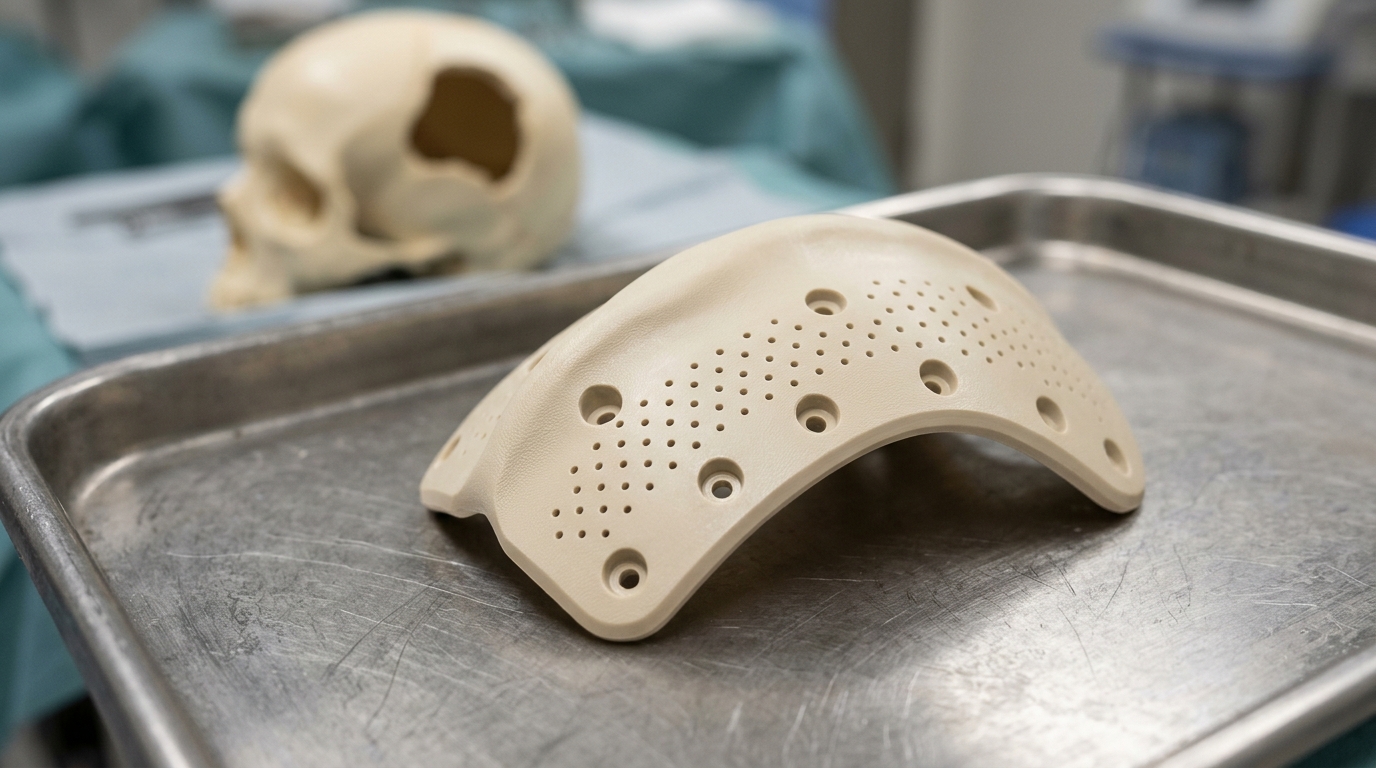
A finite element analysis comparing patient-specific cranial prostheses has demonstrated that implants constructed from polyether ether ketone (PEEK) transfer more mechanical load to surrounding bone than titanium implants, while titanium provides greater bone protection at the expense of stress shielding. According to the computational findings, PEEK prostheses sustained higher internal von Mises stresses than identical implants modeled from titanium alloy (Ti6Al4V), whereas titanium shielded the adjacent bone tissue by absorbing a larger share of the applied force.

The original research article, authored by Cyrus Ahmadi Toussi and Reza Ghasemi, was published in the Journal of Materials Science: Materials in Medicine under the section Clinical Applications of Biomaterials. The investigation evaluated the biomechanical performance of custom cranial prostheses used in cranioplasty, which is a surgical procedure for reconstructing cranial defects.

To perform the comparative biomechanical evaluation, the investigators reconstructed a three-dimensional model using computed tomography (CT) data from a 19-year-old male patient presenting with a right parietal skull defect. Using this patient-specific geometry, the research team modeled and compared custom-designed implants manufactured from either Ti6Al4V titanium alloy or PEEK using finite element analysis.

In the finite element simulations, the authors applied static loads ranging from 50 N to 400 N across three distinct anatomical regions of the cranial defect model. Evaluating this range of static loading across three separate regions allowed the researchers to examine how varying degrees of mechanical load influenced stress distribution across the prostheses and the surrounding skeletal structure.

The computational analysis revealed that PEEK implants exhibited higher von Mises stresses than titanium implants while simultaneously transferring more load to the surrounding bone. Under loads exceeding 200 N, the simulations detected marked stress concentration occurring specifically in Region 3 of the cranial structure.

These biomechanical outcomes demonstrate contrasting advantages and limitations for each biomaterial, with titanium providing greater protection to bone at the cost of stress shielding, whereas PEEK offers more physiological load sharing. The authors emphasized that these findings highlight the critical importance of material selection, concluding that the choice between titanium and PEEK must be made based on defect location and expected loading conditions.

Subject of Research: Biomechanical comparison of titanium and PEEK custom cranial prostheses

Article Title: Design and comparison of custom cranial prostheses made of titanium and polyether ether ketone using the finite element method

Article References: Toussi, C. A., & Ghasemi, R. (2026). Design and comparison of custom cranial prostheses made of titanium and polyether ether ketone using the finite element method. Journal of Materials Science: Materials in Medicine. https://doi.org/10.1007/s10856-026-07128-w

Image Credits: AI Generated

DOI: 10.1007/s10856-026-07128-w

Keywords: cranioplasty, cranial prostheses, titanium implants, Ti6Al4V, polyether ether ketone, PEEK, finite element analysis, biomechanical performance, stress shielding, von Mises stress, patient-specific implants, computed tomography, parietal defect, load sharing, cranial reconstruction, stress concentration, biomaterials

News Source: Ophelia Keating. (November 16, 2026). Simulations Show PEEK Cranial Implants Transfer More Bone Load Than Titanium. Scienmag.


Tags: biomaterialsbiomechanical performancecomputed tomographycranial prosthesescranial reconstructioncranioplastyfinite element analysisLoad-sharingparietal defectpatient-specific implants**PEEKpolyether ether ketonestress concentrationstress shieldingTi6Al4Vtitanium implantsvon Mises stress
Share12Tweet7Share2ShareShareShare1

Related Posts

National Survey Links Neuromuscular Disorders and Financial Toxicity to Reduced Health Utility

National Survey Links Neuromuscular Disorders and Financial Toxicity to Reduced Health Utility

November 16, 2026
Surgeon Operates California Robot From Remote Guyana Village Using Satellite Link

Surgeon Operates California Robot From Remote Guyana Village Using Satellite Link

November 16, 2026

Direct NLRP3 Inflammasome Quantification Reveals Non-Linear Sepsis Mortality Risk

November 16, 2026

Combined Laser and Needle Acupuncture Shows Glycemic Gains in Small Diabetes Series

November 16, 2026

POPULAR NEWS

  • Engineered Myeloid Progenitor Platform Overcomes Allogeneic Barriers in CNS Tumors

    Engineered Myeloid Progenitor Platform Overcomes Allogeneic Barriers in CNS Tumors

    29 shares
    Share 12 Tweet 7
  • Physician Specialty Distribution Lags Behind Global Demographic Aging Trends

    29 shares
    Share 12 Tweet 7
  • Rapid In Planta Citrus Transformation System Enables Efficient Genome Editing

    29 shares
    Share 12 Tweet 7
  • Simulated Reinforcement Learning Model Improves 4G LTE Handover Success and Reliability

    29 shares
    Share 12 Tweet 7

About

We bring you the latest biotechnology news from best research centers and universities around the world. Check our website.

Follow us

Recent News

Castor Oil Accelerates Propellant Curing While Palm Olein Widens Casting Window

Cervical Lesions Tied to Papillomavirus and HIV in Ethiopian Screening Study

National Survey Links Neuromuscular Disorders and Financial Toxicity to Reduced Health Utility

Subscribe to Blog via Email

Enter your email address to subscribe to this blog and receive notifications of new posts by email.

Join 88 other subscribers
  • Contact Us

Bioengineer.org © Copyright 2023 All Rights Reserved.

Welcome Back!

Login to your account below

Forgotten Password?

Retrieve your password

Please enter your username or email address to reset your password.

Log In
No Result
View All Result
  • Homepages
    • Home Page 1
    • Home Page 2
  • News
  • National
  • Business
  • Health
  • Lifestyle
  • Science

Bioengineer.org © Copyright 2023 All Rights Reserved.