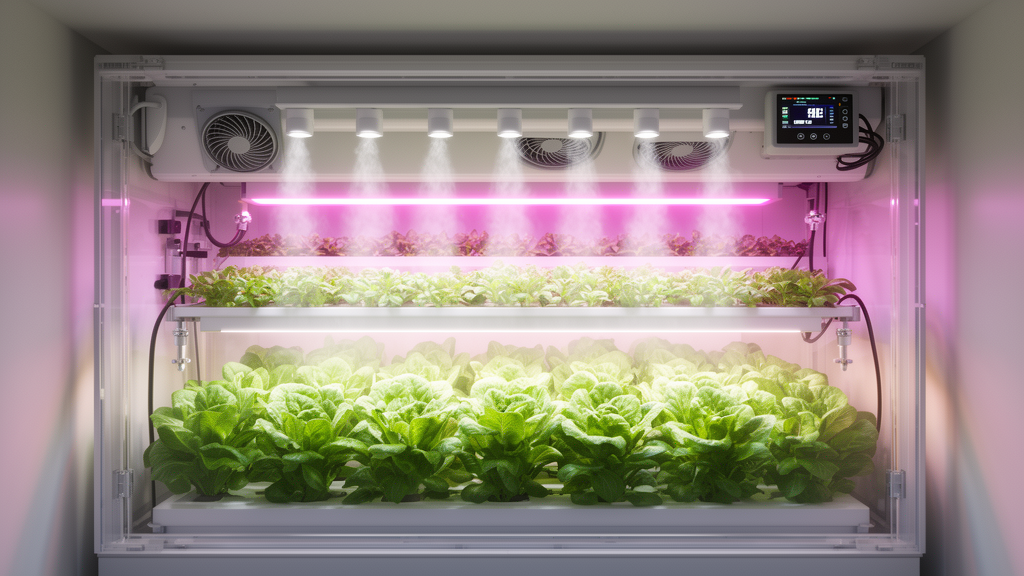
A simulated vertical farm that treated lettuce growth as a strict schedule could cut electricity costs by an average of 13.7% while still delivering the same 250-gram harvest, according to a new study. The system did more than move lighting away from expensive electricity hours: it jointly adjusted artificial light, temperature, humidity, heating, cooling and dehumidification so that changes in one system did not simply transfer energy costs to another. Across 36 combinations of three countries, four seasons and three production intensities, every optimized run was cheaper than a carefully tuned static baseline. These results are computational rather than a field trial, and the researchers emphasize that physical testing and reliable crop-mass sensing remain necessary before commercial deployment.
The proposed controller is designed for indoor vertical farms, where stacked crops are grown without sunlight under tightly controlled conditions. Such farms can produce food with little exposure to drought or extreme weather, but electricity-hungry lighting and climate equipment can undermine their efficiency. In the modeled container farm, LEDs and heating, ventilation, air-conditioning and dehumidification systems accounted for nearly all operational electricity, with lighting alone representing roughly 60–90% of consumption in the wider literature reviewed by the authors. Because LEDs both illuminate plants and add heat to the growing room, increasing illumination can also raise cooling and dehumidification demand. A controller that purchases cheap electricity without considering those consequences may therefore lower the lighting bill while increasing the total energy cost.
The team addressed that coupling with a three-level hierarchical controller operating at different time scales. The first, or strategic, layer plans the entire 14–25-day crop cycle. It searches possible harvest dates and produces a daily biomass trajectory while imposing the final harvest weight and date as hard constraints. It also varies the daily light integral, allowing more light as the leaf canopy expands and less during early growth, when much of the incident radiation would not be absorbed. Prices and outdoor temperatures are represented by 50 stochastic scenarios, generated around long-range forecasts with an autoregressive process, so the plan is not optimized for one perfect future. The controller then evaluates each candidate harvest date and selects the least costly feasible one.
The second layer uses published day-ahead electricity prices to revise the plan for the coming day. It can move projected biomass growth forward when the current day is inexpensive or defer it when prices are high, provided the crop can return to the strategic trajectory within a four-day calibration horizon. It also chooses a lighting window with a favorable price profile, but replaces the original photoperiod only when the predicted cost reduction exceeds 15%, a threshold intended to avoid acting on small differences that may reflect solver error rather than genuine market savings. The third layer operates every 15 minutes using a shrinking-horizon model predictive controller. At each step it re-solves the remainder of the day from the measured crop and climate state, allowing it to respond to updated intraday prices, changing weather forecasts and imperfect earlier decisions without losing sight of the day’s end-of-day biomass target.
The mechanistic model represents a four-level hydroponic farm inside an insulated shipping container, with 12 square metres of cultivation area on each level. It was configured for Batavia Othilie lettuce and tracked canopy temperature, air temperature, humidity, structural and non-structural plant biomass, photosynthesis, respiration and the electrical and thermal loads of the LEDs, heater, cooler and dehumidifier. The refrigeration equipment was modeled as vapor-compression devices whose coefficients of performance and sensible heat ratios varied with outdoor temperature and indoor dew point rather than as perfect machines. The crop model was calibrated for high-performance controlled environments at 1,200 parts per million carbon dioxide, and the simulations imposed light, temperature and humidity limits to prevent the optimizer from operating beyond that calibrated envelope. These safeguards also encoded a day-to-day limit on the light integral as a precaution against biological effects that the simplified growth model did not represent.
Against a static baseline operating at 24°C by day and 20°C at night, with a 20-hour photoperiod placed in the cheapest hourly window and light intensity adjusted to match the same harvest, the full controller saved 13.7% of energy cost and reduced electricity use by 8.4%. Individual savings ranged from about 7% to 20%, depending on the scenario. The same simulations produced a mean saving of 18.7% when evaluated using wholesale spot prices without levies, taxes and markups, illustrating how strongly reported savings depend on the price definition. Savings were 24.4% against a deliberately drier baseline because that baseline required more dehumidification and reheating. The reference was not intentionally weak: its humidity and temperature came from the crop experiments used for calibration, and its lighting was scheduled economically, making the comparison more demanding.
An ablation study showed that the largest contribution came from flexing the daily light total rather than holding it constant, which increased the saving by roughly five to seven percentage points across the three production tiers. Day-ahead optimization at 15-minute resolution added about 4.6 points, while intraday control added another 0.6 to 1.4 points. Adjusting the photoperiod produced a smaller benefit of 0.1 to 0.3 points, and recalibrating biomass against day-ahead prices did not consistently improve the final result when the strategic layer already had a useful long-term price forecast. About 97% of the full framework’s cost saving came from the climate system rather than the LEDs. By contrast, a controller optimizing lighting alone saved 5.0% and was about 10% more expensive than the joint controller because it concentrated light in cheap hours where photosynthesis was already saturating, requiring more light for the same crop.
The benefits increased with volatile prices. Across the 12 country-and-season trajectories, the mean saving ranged from 10.5% in relatively stable Norwegian summer conditions to 17.9% in German spring, when the daily day-ahead price range was much wider. The relationship between daily price spread and savings was strong, with a correlation of 0.88 and a permutation-test p-value below 0.001. Mean outdoor temperature, by contrast, had no detectable association with the size of the saving. Higher production intensity also reduced the percentage benefit: savings fell from 15.7% at a daily light integral of 17.30 mol m−2 d−1 to 11.3% at 28.80 mol m−2 d−1. Absolute energy cost per harvest was nearly identical across the three tiers, however, because the most intense production required fewer growing days.
Model sensitivity exposed a critical obstacle to deployment. When the researchers doubled the growth model’s reported calibration error and replayed the control trajectories without feedback, only 19.3% of simulated harvests remained fully marketable, and 43.4% would have been unsellable. Energy costs were still lower in most cases, but the static baseline was cheaper in 12.8% of the perturbed trials. Adding one biomass measurement per day and using it to correct the next day’s light level restored 98.2% of harvests to the fully marketable range and kept the modeled energy saving between 10.5% and 14.9% in every draw. The calculations assume exact measurements and do not include noise, delay, equipment cycling, defrost behavior, peak-power charges or the added wear associated with frequent load changes. Synthetic intraday prices, continuous lighting windows and a specific three-device climate configuration also limit direct transfer to other farms.
Even with those limitations, the study shows that a vertical farm can treat electricity markets and crop physiology as parts of one optimization problem rather than separate schedules. The strongest result is not a guaranteed benefit in a real farm, but a testable control architecture: preserve the harvest endpoint, use plant development to create shifting room for adjustment, and include the climate consequences of every lighting decision. Real-world testing would now need to combine in-situ crop-mass sensing with equipment-level power metering and closed temperature and humidity balances. Such a trial would determine whether the simulator’s promise survives contact with imperfect crops, imperfect forecasts and real machinery—and whether a vertical farm can become a flexible electricity user without compromising the harvest it exists to produce.
Subject of Research: Hierarchical co-optimization of lighting and climate control in indoor vertical farms under volatile electricity prices
Article Title: Beyond light scheduling: Harvest-constrained co-optimization of lighting and climate in vertical farms under volatile electricity prices
Article References: Sathyanarayanan, K. K., Raecke, J., & Streif, S. (2026). Beyond light scheduling: Harvest-constrained co-optimization of lighting and climate in vertical farms under volatile electricity prices. Smart Agricultural Technology, 15, Article 102636. https://doi.org/10.1016/j.atech.2026.102636
Image Credits: AI Generated
DOI: 10.1016/j.atech.2026.102636
Keywords: vertical farming, lettuce cultivation, demand response, lighting control, climate control, electricity prices, model predictive control, energy efficiency, controlled environment agriculture, crop growth models, Beyond, light
News Source: Alan Morgan. (October 20, 2026). Simulated vertical-farm controller cuts costs by co-optimizing light and climate. Scienmag.