• HOME
  • NEWS
  • EXPLORE
    • CAREER
      • Companies
      • Jobs
    • EVENTS
    • iGEM
      • News
      • Team
    • PHOTOS
    • VIDEO
    • WIKI
  • BLOG
  • COMMUNITY
    • FACEBOOK
    • INSTAGRAM
    • TWITTER
Tuesday, October 20, 2026
BIOENGINEER.ORG
No Result
View All Result
  • Login
  • HOME
  • NEWS
  • EXPLORE
    • CAREER
      • Companies
      • Jobs
        • Lecturer
        • PhD Studentship
        • Postdoc
        • Research Assistant
    • EVENTS
    • iGEM
      • News
      • Team
    • PHOTOS
    • VIDEO
    • WIKI
  • BLOG
  • COMMUNITY
    • FACEBOOK
    • INSTAGRAM
    • TWITTER
No Result
View All Result
Bioengineer.org
No Result
View All Result
Home NEWS Science News Agriculture

Arbuscular mycorrhizal fungi inoculation and deficit irrigation mediate phytochemical quality and antioxidant activity of cardoon (Cynara cardunculus var. altilis) leaves

by
October 20, 2026
in Agriculture
Reading Time: 2 mins read
0
Arbuscular mycorrhizal fungi inoculation and deficit irrigation mediate phytochemical quality and antioxidant activity of cardoon (Cynara cardunculus var. altilis) leaves

Fungi and Thirsty Times: How Mycorrhizal Partners and Deficit Irrigation Boost Cardoon's Antioxidant Power

Share on FacebookShare on TwitterShare on LinkedinShare on RedditShare on Telegram

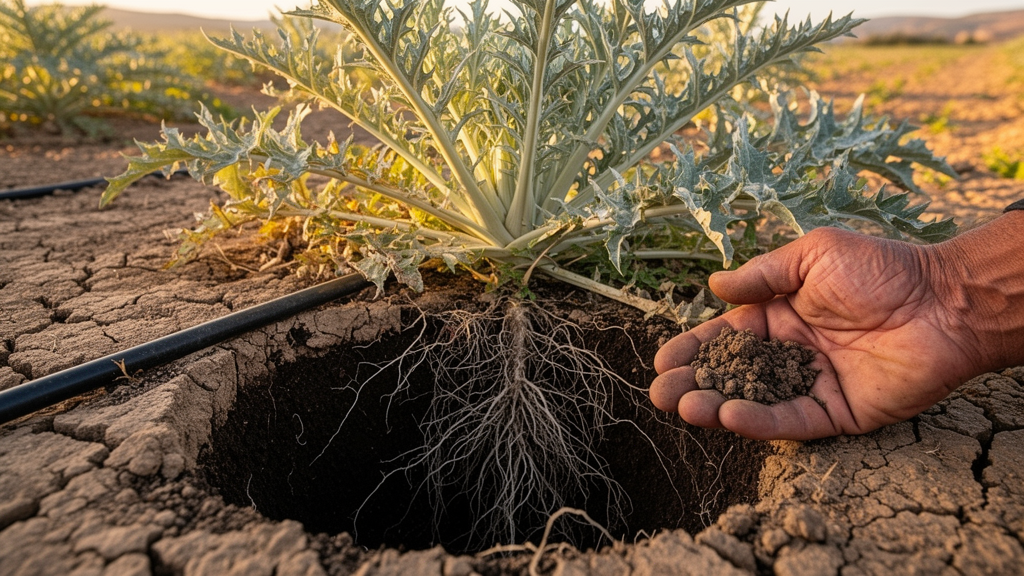
An experimental study of cardoon leaves found that arbuscular mycorrhizal fungi inoculation and deficit irrigation jointly affected leaf phytochemical composition and measured antioxidant activity. The study, summarized in an accepted-research abstract in BMC Plant Biology, tested two fungal treatments—Rhizophagus irregularis and the commercial Mykoflor consortium—against non-inoculated controls at four irrigation levels across two growing seasons. The findings concern measured plant responses, not human health effects or clinical outcomes.

Plants were maintained at 20%, 40%, 60% or 90% field capacity, with severe deficit defined in the abstract as 20% field capacity. Fungal inoculation significantly increased root colonization at every irrigation level, reaching as much as 83% at 90% field capacity. Moderate-to-optimal irrigation supported the highest colonization rates, while the lowest rate, 54%, occurred at 20% field capacity. The two inocula did not differ significantly in colonization frequency. This comparison was limited to the fungal treatments, irrigation treatments and two-season cardoon experiment described in the abstract; the abstract does not provide details such as sample size, effect-size uncertainty or whether the treatments were evaluated under field conditions.

Inoculated plants accumulated higher concentrations of total phenolic acids, total flavonoids, chlorogenic acid, cynarin, caffeic acid, protocatechuic acid and apigenin-7-O-glucoside than the controls. Mykoflor consistently produced higher values than R. irregularis for most of the measured compounds. Irrigation also altered leaf chemistry. Treatment at 20–40% field capacity significantly increased total phenolic acids, total flavonoids and antioxidant activity, while severe deficit at 20% field capacity produced the highest measured accumulation of chlorogenic acid, cynarin, luteolin-7-O-glucoside and total flavonoids.

Statistical associations linked total phenolic acids with caffeic acid, antioxidant activity and chlorogenic acid, with Pearson correlation coefficients of 0.98, 0.89 and 0.89, respectively. Total flavonoids correlated strongly with protocatechuic acid, apigenin-7-O-glucoside, luteolin-7-O-glucoside and cynarin, with coefficients of at least 0.91. The interaction between fungal inoculation and irrigation was the most influential factor in the analysis, affecting nine of the ten investigated compounds. These correlations describe relationships among the measurements and do not by themselves establish a mechanism. The abstract further identifies combined inoculation and moderate water stress as conditions that may support the phytochemical profile of cardoon leaves; however, the available summary does not establish performance at commercial field scale or support claims about human health benefits.

Subject of Research: Effects of fungal inoculation and deficit irrigation on cardoon leaf phytochemicals and antioxidant activity

Article Title: Arbuscular mycorrhizal fungi inoculation and deficit irrigation mediate phytochemical quality and antioxidant activity of cardoon (Cynara cardunculus var. altilis) leaves

Article References: Sałata, A., Nurzyńska-Wierdak, R., Formenti, C., Lombardo, S., Pandino, G., Mauromicale, G., & Kalisz, A. (2026). Arbuscular mycorrhizal fungi inoculation and deficit irrigation mediate phytochemical quality and antioxidant activity of cardoon (Cynara cardunculus var. altilis) leaves. BMC Plant Biology. https://doi.org/10.1186/s12870-026-09976-8

Image Credits: AI Generated

DOI: 10.1186/s12870-026-09976-8

Keywords: cardoon, arbuscular mycorrhizal fungi, deficit irrigation, phenolic acids, flavonoids, antioxidant activity, Rhizophagus irregularis, Cynara cardunculus, Arbuscular, mycorrhizal, fungi, inoculation

News Source: Roger Howard. (October 20, 2026). Arbuscular mycorrhizal fungi inoculation and deficit irrigation mediate phytochemical quality and antioxidant activity of cardoon (Cynara cardunculus var. altilis) leaves. Scienmag.

Tags: Antioxidant activityArbuscularArbuscular mycorrhizal fungicardoonCynara cardunculusdeficit irrigationflavonoidsfungiinoculationmycorrhizalphenolic acidsRhizophagus irregularis
Share12Tweet7Share2ShareShareShare1

Related Posts

Aromatic amino acids show context-dependent biostimulant effects in horticulture

Aromatic amino acids show context-dependent biostimulant effects in horticulture

October 20, 2026
Phytohormone and transcriptome analyses reveal the mechanisms underlying branch inclination angle formation in narrow-crowned Chamaecyparis hodginsii

Phytohormone and transcriptome analyses reveal the mechanisms underlying branch inclination angle formation in narrow-crowned Chamaecyparis hodginsii

October 20, 2026

Experimental sucrose treatment linked to mucilage-like root exudates in bentgrass

October 20, 2026

Simulated vertical-farm controller cuts costs by co-optimizing light and climate

October 20, 2026

POPULAR NEWS

  • Combination therapy improves heart failure measures in retrospective Chinese cohort

    Combination therapy improves heart failure measures in retrospective Chinese cohort

    29 shares
    Share 12 Tweet 7
  • First observation of antennal cleaning behaviour in Archaeognatha

    29 shares
    Share 12 Tweet 7
  • Taxonomic study describes Charon’s pygmygoby from two Red Sea specimens

    29 shares
    Share 12 Tweet 7
  • Taxonomic study describes nine new Panamanian microcaddisfly species

    29 shares
    Share 12 Tweet 7

About

We bring you the latest biotechnology news from best research centers and universities around the world. Check our website.

Follow us

Recent News

Combination therapy improves heart failure measures in retrospective Chinese cohort

First observation of antennal cleaning behaviour in Archaeognatha

Taxonomic study describes Charon’s pygmygoby from two Red Sea specimens

Subscribe to Blog via Email

Enter your email address to subscribe to this blog and receive notifications of new posts by email.

Join 85 other subscribers
  • Contact Us

Bioengineer.org © Copyright 2023 All Rights Reserved.

Welcome Back!

Login to your account below

Forgotten Password?

Retrieve your password

Please enter your username or email address to reset your password.

Log In
No Result
View All Result
  • Homepages
    • Home Page 1
    • Home Page 2
  • News
  • National
  • Business
  • Health
  • Lifestyle
  • Science

Bioengineer.org © Copyright 2023 All Rights Reserved.