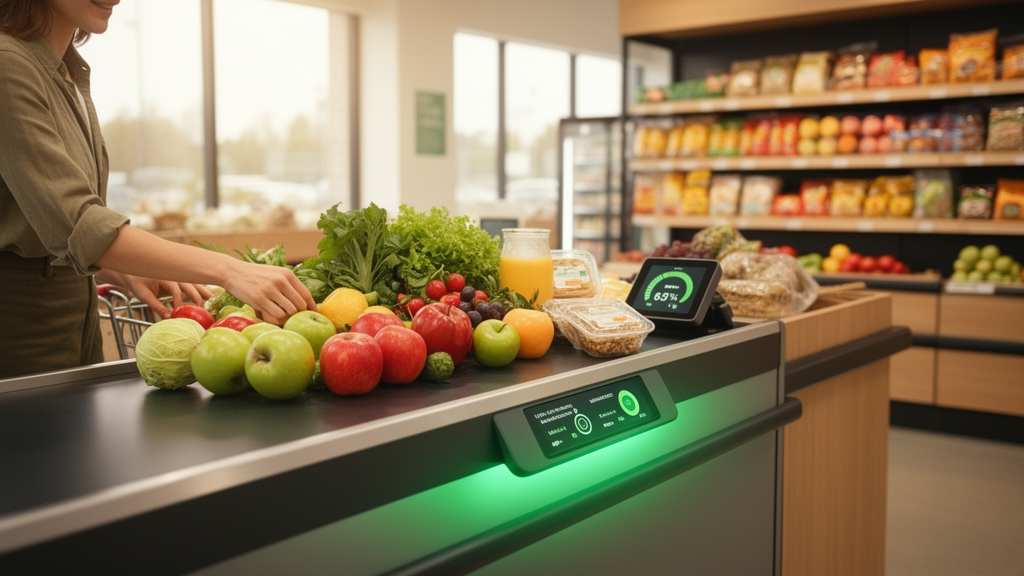
A simulation-based study of the Carbon-Aware Checkout system estimated a median 23.4% reduction in grocery-basket emissions across 227,596 test baskets, while its predicted consumer-acceptance and explanation effects require validation with real shoppers. The system combines life-cycle assessment data, machine learning, uncertainty modeling, multi-objective optimization and large language model explanations. At checkout, it estimates the emissions associated with a shopper’s complete basket and searches for alternative products while imposing price, dietary, allergen, nutritional and user-preference constraints.
Deterministic functions exposed through the Model Context Protocol perform the numerical calculations, with the language model interpreting structured outputs rather than independently generating carbon values. The researchers merged the public Instacart Online Grocery Shopping Dataset, which contains approximately 3.1 million orders from more than 200,000 users and around 50,000 products, with product-footprint information from the Poore and Nemecek meta-analysis, SU-EATABLE LIFE, Open Food Facts and Eco-Score across 43 food categories. After filtering for food and non-alcoholic beverages and requiring sufficient footprint coverage, they sampled 500,000 baskets for the main experiments; 227,596 formed the test set used to evaluate optimization performance.
The framework introduces six basket-level measures. The Carbon Opportunity Gap compares current emissions with those of an optimized basket. Behavior-Adjusted Emissions weights potential reductions by model-predicted acceptance probabilities.
The Risk-Adjusted Carbon Score incorporates uncertainty in life-cycle data, while Basket Marginal Abatement Cost reports the price paid per tonne of carbon dioxide equivalent avoided. Recurring Purchase Emissions estimates effects from repeated buying, and the Composite Carbon-Health Score combines normalized emissions with a nutritional measure. Under the balanced configuration, the optimization produced a median technical reduction of 23.4% and a mean of 22.8%, with an interquartile range of 17.2% to 28.6%.
The average basket cost increased by $1.83, equivalent to 1.9% of baseline value, and 82% of baskets remained within a ±3% price change. Applying the synthetic model’s predicted 71% acceptance rate yielded an expected reduction of 16.2%. An ablation with no behavioral constraint produced a reduction of 28.7%, but this represented an upper bound based on assuming universal acceptance rather than a measured retail outcome.
The explanation results also came from comparisons within the synthetic model. In its comparison of explanation types, the behavioral model predicted approximately 52% acceptance for numeric-only disclosures and 71% for conversational explanations, a difference of 19 percentage points. These were simulated acceptance rates, not measurements from real consumer experiments.
Any reported statistical significance applies only within the simulation and not to real consumers. Price change was the strongest acceptance feature, followed by explanation clarity, carbon reduction and brand consistency.
On the synthetic test set, the classifier achieved an AUC of 0.74, accuracy of 69.2% and F1 score of 0.71. These metrics indicate internal performance within the simulation but do not establish predictive validity among live shoppers. Data-quality checks also identified limitations.
In a manually annotated sample of 500 products, 73.4% were assigned to the exact emissions category and 19.6% to a related parent category, yielding 93.0% exact-or-partial mapping accuracy. Emissions data were available for 85.7% of the 49,688 products analyzed. A cross-database check of 150 products produced a mean coefficient of variation of 4.2%.
When random noise of up to 20% was applied to unit conversions, the median estimated reduction changed from 23.4% to 23.1%. The authors estimated overall basket-level emissions uncertainty at approximately 5% to 10%, indicating that the data were more suitable for relative product comparisons than production-grade absolute carbon accounting. Before deployment, the paper proposes a randomized controlled trial comparing standard checkout with Carbon-Aware Checkout recommendations, with additional evaluation of numeric labels versus generated explanations.
Planned outcomes include observed swap acceptance, basket emissions, expenditure, satisfaction and repeat purchasing. This was a proof-of-concept computational evaluation: all consumer acceptance rates, explanation effects and real-world reduction estimates remain model predictions, and the grocery-shopping findings should not be generalized to other retail categories without new data and recalibration.
Subject of Research: Simulation-based evaluation of a carbon-aware grocery checkout system for basket-level emissions optimization
Article Title: Carbon aware checkout for real time basket emissions optimization in online grocery shopping
Article References: Poreddy, K. K. R., Sahu, A. K., Mukherjee, S., & Basavaraju, B. K. (2026). Carbon aware checkout for real time basket emissions optimization in online grocery shopping. Discover Artificial Intelligence, 6(1), Article 1279. https://doi.org/10.1007/s44163-026-02254-4
Image Credits: AI Generated
DOI: 10.1007/s44163-026-02254-4
Keywords: carbon-aware checkout, online grocery shopping, basket emissions, life-cycle assessment, multi-objective optimization, synthetic behavior, consumer acceptance, large language models, uncertainty modeling, Carbon, aware, checkout
News Source: Sloane Callahan. (October 20, 2026). Simulated grocery checkout system estimates 23.4% median emissions reduction, but consumer effects remain unvalidated. Scienmag.