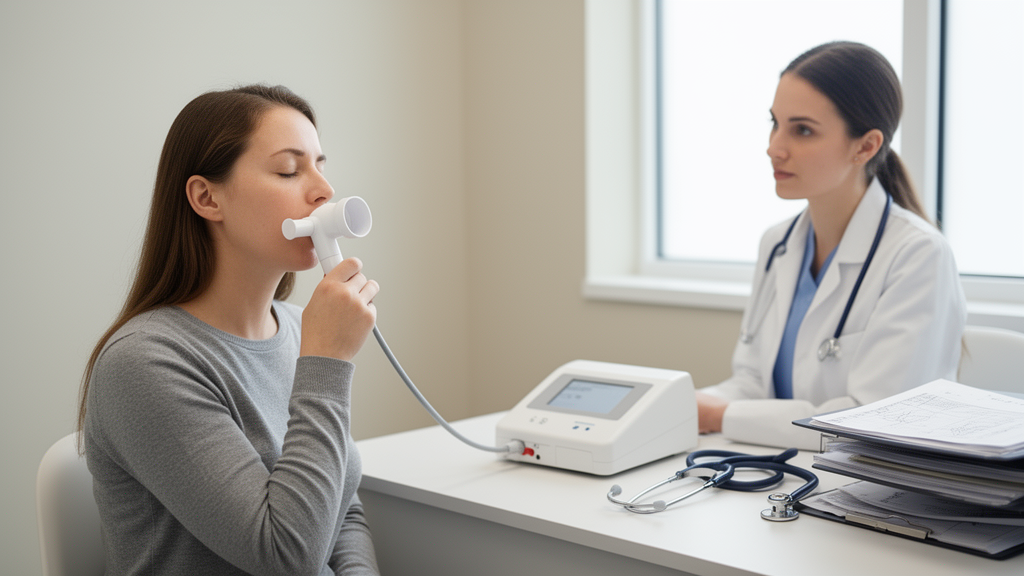
Upper airway obstructions such as subglottic stenosis can masquerade as asthma, delaying diagnosis and worsening outcomes. A new retrospective cohort study published in BMC Pulmonary Medicine reports that a single index calculated from routine spirometry, the expiratory disproportion index (EDI), can be applied in the outpatient pulmonary clinic to screen for these obstructions among adults referred for lung function testing.
Researchers analysed 244 consecutive patients referred for spirometry, calculating the EDI from their standard breathing measurements and then following the subsequent clinical course of each patient. The index is derived entirely from spirometry, meaning no additional equipment or invasive procedures are needed to compute it.
Of the 244 patients screened, three patients with an upper airway obstruction were identified by the EDI and subsequently confirmed with endoscopy. The authors report that applying the screening step had a limited impact on the number of referrals generated, an important practical consideration for busy clinics weighing the benefits of additional testing against the burden of unnecessary follow-up.
According to the study team, the findings support the use of the EDI as a standard screening tool for earlier detection of upper airway obstruction, describing it as a simple and effective approach. The study also strengthens the validation of the EDI parameter as a non-invasive screening method for patients with upper airway obstructions presenting at the outpatient pulmonary clinic.
The clinical problem the index addresses is well recognised: obstructions such as subglottic stenosis often go unrecognised early because their symptoms resemble asthma, and this diagnostic delay may result in high morbidity and mortality. A screening measure embedded in a test many of these patients already undergo could therefore shorten the path to diagnosis.
The study was retrospective in design, based on a single cohort of patients referred for spirometry, and the number of obstruction cases detected was small. As an observational analysis of clinical practice, it evaluated how the index performed when implemented in a real clinic setting rather than testing it prospectively against a predefined diagnostic gold standard in all patients.
The work was carried out by researchers including Juliëtta H.C. Schuering, Sofie Vugts, Maarten K. Ninaber, Luuk N.A. Willems, Peter Paul G. van Benthem, Elisabeth V. Sjögren and Antonius P.M. Langeveld, and was published as an open-access article on 27 October 2026. The published version is an early-release, peer-reviewed accepted manuscript subject to further editorial edits.
For clinicians, the appeal of the approach lies in its economy: the EDI requires no extra testing beyond spirometry that is already being performed, and it flags patients whose breathing pattern suggests an obstruction above the lungs rather than within them. Those flagged can then be directed toward endoscopic confirmation, as occurred in the three cases identified in this cohort.
The authors conclude that the study supports adopting the EDI as a standard screening tool in the pulmonary outpatient clinic, representing a simple and effective approach with limited impact on referral numbers, and that it strengthens the evidence base for the index as a non-invasive screening parameter for upper airway obstruction in adults.
Subject of Research: Use of a spirometry-derived expiratory disproportion index to screen adults in a pulmonary clinic for upper airway obstruction
Article Title: Applying the ‘expiratory disproportion index’ in the pulmonary clinic as a spirometry-derived screening tool for upper airway obstruction in adults
Article References: Schuering, J. H. C., Vugts, S., Ninaber, M. K., Willems, L. N. A., van Benthem, P. P. G., Sjögren, E. V., & Langeveld, A. P. M. (2026). Applying the ‘expiratory disproportion index’ in the pulmonary clinic as a spirometry-derived screening tool for upper airway obstruction in adults. BMC Pulmonary Medicine. https://doi.org/10.1186/s12890-026-04830-x
Image Credits: AI Generated
DOI: 10.1186/s12890-026-04830-x
Keywords: spirometry, expiratory disproportion index, upper airway obstruction, subglottic stenosis, pulmonary clinic, screening, endoscopy, retrospective cohort study, asthma-like symptoms, BMC Pulmonary Medicine, Applying, expiratory
News Source: Ophelia Keating. (October 28, 2026). Simple spirometry index flags hidden upper airway obstruction in lung clinic patients. Scienmag.