• HOME
  • NEWS
  • EXPLORE
    • CAREER
      • Companies
      • Jobs
    • EVENTS
    • iGEM
      • News
      • Team
    • PHOTOS
    • VIDEO
    • WIKI
  • BLOG
  • COMMUNITY
    • FACEBOOK
    • INSTAGRAM
    • TWITTER
Sunday, August 16, 2026
BIOENGINEER.ORG
No Result
View All Result
  • Login
  • HOME
  • NEWS
  • EXPLORE
    • CAREER
      • Companies
      • Jobs
        • Lecturer
        • PhD Studentship
        • Postdoc
        • Research Assistant
    • EVENTS
    • iGEM
      • News
      • Team
    • PHOTOS
    • VIDEO
    • WIKI
  • BLOG
  • COMMUNITY
    • FACEBOOK
    • INSTAGRAM
    • TWITTER
  • HOME
  • NEWS
  • EXPLORE
    • CAREER
      • Companies
      • Jobs
        • Lecturer
        • PhD Studentship
        • Postdoc
        • Research Assistant
    • EVENTS
    • iGEM
      • News
      • Team
    • PHOTOS
    • VIDEO
    • WIKI
  • BLOG
  • COMMUNITY
    • FACEBOOK
    • INSTAGRAM
    • TWITTER
No Result
View All Result
Bioengineer.org
No Result
View All Result
Home NEWS Science News Biology

Significant differences exist among neurons expressing dopamine receptors

Bioengineer by Bioengineer
May 13, 2020
in Biology
Reading Time: 3 mins read
0
IMAGE
Share on FacebookShare on TwitterShare on LinkedinShare on RedditShare on Telegram

IMAGE

Credit: INC-UAB

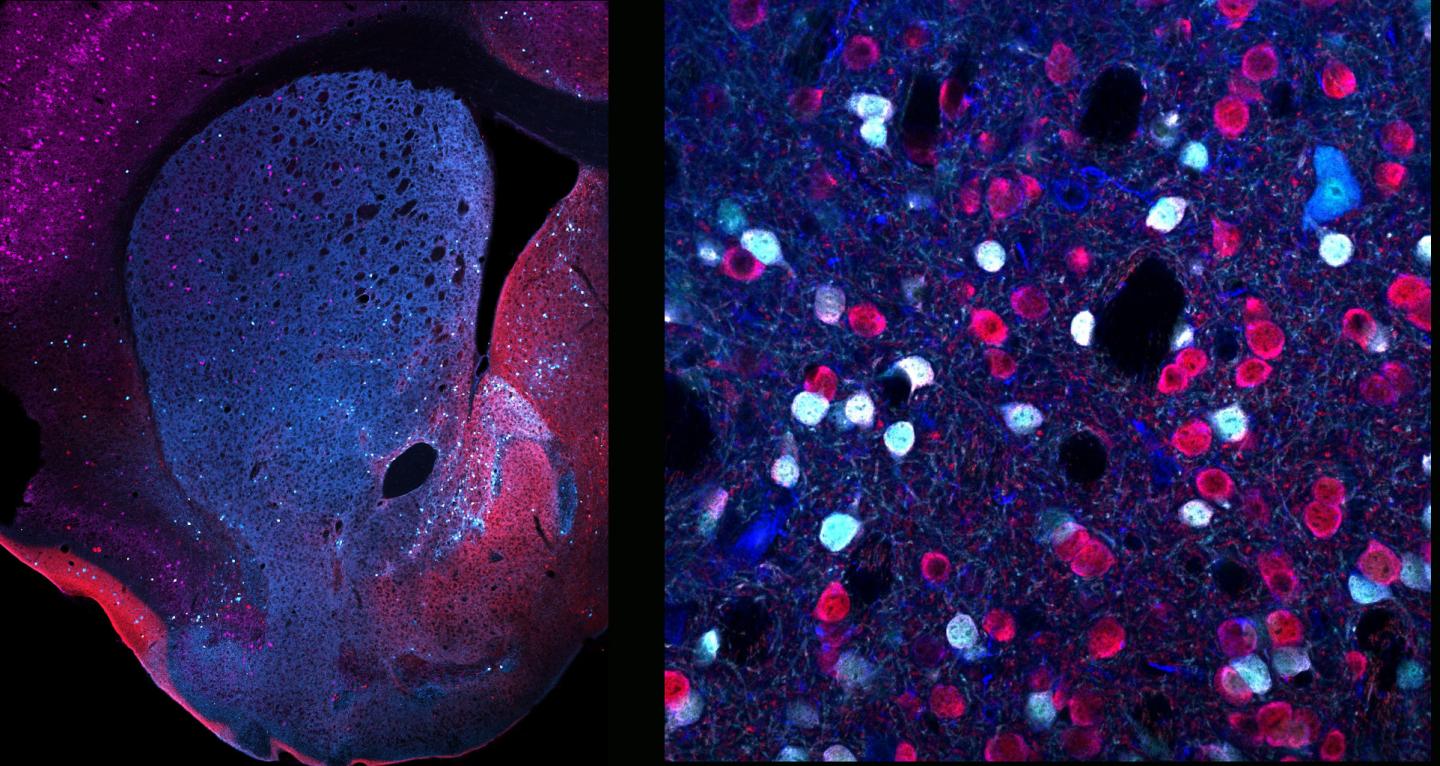
An international collaboration, which included the involvement of the research team from the Institut de Neurociències of the UAB (INC-UAB), has shown that neurons expressing dopamine D2 receptors have different molecular features and functions, depending on their anatomical localization within the striatum. This research, conducted with mouse models and published in Nature Communications, opens the door to develop better treatments for diseases in which dopamine is altered, such as schizophrenia, addictions and Parkinson’s disease.

The striatum is a brain region involved in motor control, habit formation, decision-making, motivation and reinforcement, among other aspects, and its disfunction has been associated with many neurological and psychiatric disorders. One of the most important neurotransmitters in the striatum is dopamine, which exerts different functions depending on the kind of receptor it binds to.

This study has focused on D2 receptors, and has shown that, contrary to paradigm, not all D2 neurons within the striatum have the same molecular identify or function, but that their neuro-anatomical localization is key. Researchers identified hundreds of novel region-specific molecular markers, which may serve as tools to target selective subpopulations.

“These results show that there is significant molecular and functional heterogeneity of neuronal populations in the striatum. If we know them better, we will be able to be more selective in the design of treatments for diseases in which dopamine levels are altered, such as in schizophrenia or Parkinson’s disease”, says Emma Puighermanal-Puigvert, first author of the article. “The more specific we are with our therapeutic target, the less secondary effects will appear”. The work was conducted by an international collaboration of researchers in which Albert Quintana and Elisenda Sanz, from the INC-UAB, also participated.

Using cutting-edge technologies, they analyzed mouse models to see what genes are expressed in D2 neurons from the two main areas of the striatum: the ventral striatum, consisting mainly of the nucleus accumbens, and the dorsal striatum, and revealed overwhelming differences among them. Thus, depending on their precise anatomical location, they express different kinds of proteins, changing neurons’ features and functions.

In this research, scientists also focused on a group of neurons mainly located in the accumbens, which express the protein WFS1, and studied the effects of deleting their D2 receptors. What they observed was a significant reduction in digging, an innate behavior used in many species to seek or hoard food, as shelter, or to hide away from predators, whose underlying neuronal mechanisms were still unknown. Additionally, the authors found that these animals present an exacerbated hyperlocomotor response when their dopamine levels are increased through amphetamine administration, suggesting a key role of D2 receptors from WFS1 neurons in the response to psychostimulants.

Overall, this study demonstrates that there is a huge complexity and functional specificity among D2 neuron subpopulations, and reveals the possibility to manipulate them specifically to better understand their functions, in both physiological and pathological contexts.

###

Media Contact
María Jesús Delgado
[email protected]

Original Source

https://www.uab.cat/web/newsroom/news-detail/x-1345668003610.html?noticiaid=1345812868276

Related Journal Article

http://dx.doi.org/10.1038/s41467-020-15716-9

Tags: AlzheimerBiologyGeneticsMedicine/Healthneurobiology
Share12Tweet8Share2ShareShareShare2

Related Posts

Strubbelig–NHL3 Receptor Complex Helps Arabidopsis Respond to Cellulose Deficiency

Strubbelig–NHL3 Receptor Complex Helps Arabidopsis Respond to Cellulose Deficiency

August 15, 2026
Bombyx mori Satellitome Analysis Reveals Evolutionary Stability, Dispersed Chromosomal Organization, Transposon Origins

Bombyx mori Satellitome Analysis Reveals Evolutionary Stability, Dispersed Chromosomal Organization, Transposon Origins

August 15, 2026

Synthetic pyrenoid reconstruction reveals EPYC1-driven carbon concentration mechanisms and evolution

August 15, 2026

Endophytic Flavobacterium boosts root hairs and drought tolerance through ERF–CEP5 signaling

August 15, 2026
Please login to join discussion

POPULAR NEWS

  • KAIST develops semiconductor neuron that harnesses noise to selectively process signals

    29 shares
    Share 12 Tweet 7
  • Imagining natural and extra robotic thumbs together strengthens kinesthetic sensorimotor networks

    29 shares
    Share 12 Tweet 7
  • PARP1 Drives Neuropathic Pain Through GPX4-Dependent Ferroptosis in Injured Mice’s Sensory Neurons

    29 shares
    Share 12 Tweet 7
  • Strubbelig–NHL3 Receptor Complex Helps Arabidopsis Respond to Cellulose Deficiency

    29 shares
    Share 12 Tweet 7

About

We bring you the latest biotechnology news from best research centers and universities around the world. Check our website.

Follow us

Recent News

KAIST develops semiconductor neuron that harnesses noise to selectively process signals

Imagining natural and extra robotic thumbs together strengthens kinesthetic sensorimotor networks

PARP1 Drives Neuropathic Pain Through GPX4-Dependent Ferroptosis in Injured Mice’s Sensory Neurons

Subscribe to Blog via Email

Success! An email was just sent to confirm your subscription. Please find the email now and click 'Confirm' to start subscribing.

Join 85 other subscribers
  • Contact Us

Bioengineer.org © Copyright 2023 All Rights Reserved.

Welcome Back!

Login to your account below

Forgotten Password?

Retrieve your password

Please enter your username or email address to reset your password.

Log In
No Result
View All Result
  • Homepages
    • Home Page 1
    • Home Page 2
  • News
  • National
  • Business
  • Health
  • Lifestyle
  • Science

Bioengineer.org © Copyright 2023 All Rights Reserved.