• HOME
  • NEWS
  • EXPLORE
    • CAREER
      • Companies
      • Jobs
    • EVENTS
    • iGEM
      • News
      • Team
    • PHOTOS
    • VIDEO
    • WIKI
  • BLOG
  • COMMUNITY
    • FACEBOOK
    • INSTAGRAM
    • TWITTER
Tuesday, September 15, 2026
BIOENGINEER.ORG
No Result
View All Result
  • Login
  • HOME
  • NEWS
  • EXPLORE
    • CAREER
      • Companies
      • Jobs
        • Lecturer
        • PhD Studentship
        • Postdoc
        • Research Assistant
    • EVENTS
    • iGEM
      • News
      • Team
    • PHOTOS
    • VIDEO
    • WIKI
  • BLOG
  • COMMUNITY
    • FACEBOOK
    • INSTAGRAM
    • TWITTER
  • HOME
  • NEWS
  • EXPLORE
    • CAREER
      • Companies
      • Jobs
        • Lecturer
        • PhD Studentship
        • Postdoc
        • Research Assistant
    • EVENTS
    • iGEM
      • News
      • Team
    • PHOTOS
    • VIDEO
    • WIKI
  • BLOG
  • COMMUNITY
    • FACEBOOK
    • INSTAGRAM
    • TWITTER
No Result
View All Result
Bioengineer.org
No Result
View All Result
Home NEWS Science News Chemistry

Shrink films get a grip (video)

Bioengineer by Bioengineer
May 1, 2019
in Chemistry
Reading Time: 2 mins read
0
IMAGE
Share on FacebookShare on TwitterShare on LinkedinShare on RedditShare on Telegram

IMAGE

Credit: American Chemical Society

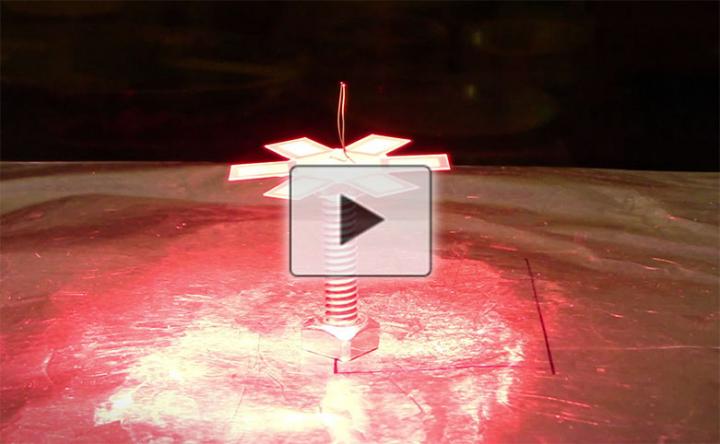
Many people fondly remember playing with toys known as Shrinky Dinks® — sheets of polystyrene plastic with shapes that kids can color, cut out and heat in an oven, where they shrink into thicker pieces of plastic. Now, researchers have repurposed shrink films for an unexpected use: making strong, durable grippers that could someday encapsulate materials or be incorporated into soft robotics. They report their results in ACS Applied Polymer Materials. Watch it in action here.

Shrinky Dinks® undergo their dramatic transformation because they are shape-memory polymers. Manufacturers pre-stretch the sheets of polystyrene so that when heated above 217 F, they shrink back to their former size. Michael Dickey, Jan Genzer and colleagues wondered if they could exploit these properties to make inexpensive grippers that would be stronger and retain their shape better than other soft materials used for this purpose, such as hydrogels and elastomers.

To find out, the researchers used an inkjet printer to pattern black ink in various shapes onto the surface of polystyrene sheets. When the researchers shone an infrared light on the cut-out shapes, the inked regions warmed faster than the blank areas, causing the polystyrene to wrap around the object to be gripped, such as a hex bolt. Removing the light locked the gripper’s shape in place. The team showed that grippers optimized for ink pattern, geometry and number of panels could suspend objects more than 24,000 times their own mass for several minutes before mechanical failure, or 5,000 times their own mass for months.

###

The authors acknowledge funding from the National Science Foundation.

Shrinky Dinks® is the registered trademark of K&B Innovations Inc. USA

The abstract that accompanies this study is available here.

The American Chemical Society, the world’s largest scientific society, is a not-for-profit organization chartered by the U.S. Congress. ACS is a global leader in providing access to chemistry-related information and research through its multiple databases, peer-reviewed journals and scientific conferences. ACS does not conduct research, but publishes and publicizes peer-reviewed scientific studies. Its main offices are in Washington, D.C., and Columbus, Ohio.

To automatically receive news releases from the American Chemical Society, contact [email protected].

Follow us on Twitter | Facebook

Media Contact
Katie Cottingham
[email protected]

Tags: Chemistry/Physics/Materials SciencesMaterialsNanotechnology/MicromachinesParenting/Child Care/FamilyPolymer ChemistryRobotry/Artificial IntelligenceTechnology/Engineering/Computer Science
Share12Tweet8Share2ShareShareShare2

Related Posts

Fast Combustion Recipe Yields Praseodymium-Doped Ceria With Tunable Oxygen Vacancies

Fast Combustion Recipe Yields Praseodymium-Doped Ceria With Tunable Oxygen Vacancies

September 14, 2026
Phosphate-Tuned Acidity Turns Niobium Catalyst Into a CO2-to-Fuel Powerhouse

Phosphate-Tuned Acidity Turns Niobium Catalyst Into a CO2-to-Fuel Powerhouse

September 13, 2026

Recycling PFAS Waste Into Silver Fluoride for Cleaner Chemistry

September 13, 2026

Cobalt-Based MOF Sensor Detects Anthrax Biomarker in Water in One Minute

September 13, 2026
Please login to join discussion

POPULAR NEWS

  • Ancient Chinese Herbal Formula Decoded: How Danggui Buxue Decoction Fights Chronic Kidney Disease

    29 shares
    Share 12 Tweet 7
  • Polariton OLEDs Combine Narrowband Color, Angle Stability and High Efficiency Through TADF

    29 shares
    Share 12 Tweet 7
  • Falls Are Rising Sharply Among Older Adults in Ireland, Landmark 15-Year Study Finds

    29 shares
    Share 12 Tweet 7
  • Sintering Rewritten: New Review Maps How Aluminum Powders Shed Their Oxide Skin and Gain Strength

    29 shares
    Share 12 Tweet 7

About

We bring you the latest biotechnology news from best research centers and universities around the world. Check our website.

Follow us

Recent News

Ancient Chinese Herbal Formula Decoded: How Danggui Buxue Decoction Fights Chronic Kidney Disease

Polariton OLEDs Combine Narrowband Color, Angle Stability and High Efficiency Through TADF

Falls Are Rising Sharply Among Older Adults in Ireland, Landmark 15-Year Study Finds

Subscribe to Blog via Email

Enter your email address to subscribe to this blog and receive notifications of new posts by email.

Join 85 other subscribers
  • Contact Us

Bioengineer.org © Copyright 2023 All Rights Reserved.

Welcome Back!

Login to your account below

Forgotten Password?

Retrieve your password

Please enter your username or email address to reset your password.

Log In
No Result
View All Result
  • Homepages
    • Home Page 1
    • Home Page 2
  • News
  • National
  • Business
  • Health
  • Lifestyle
  • Science

Bioengineer.org © Copyright 2023 All Rights Reserved.