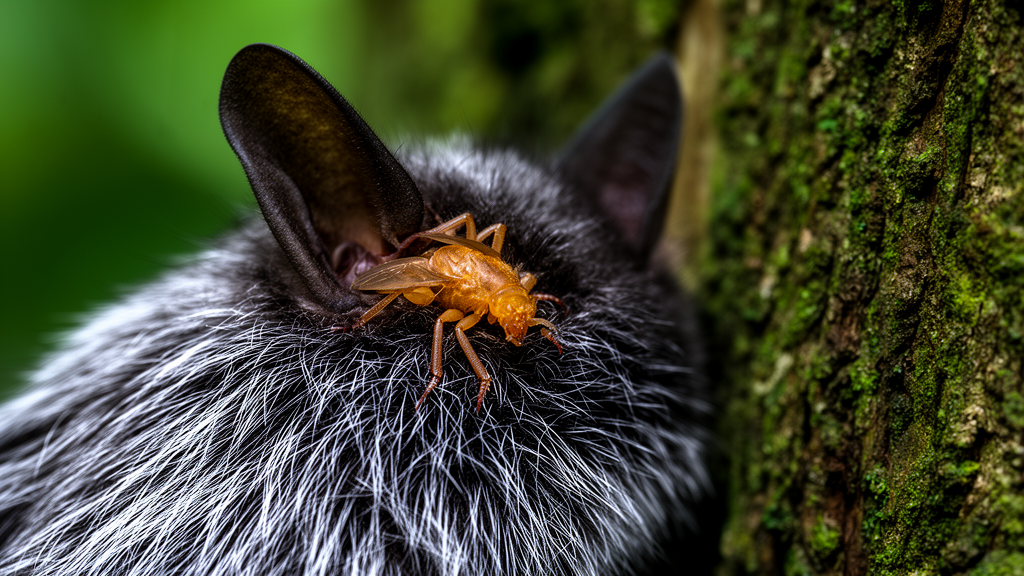
Researchers have documented the first verified record of the bat fly Basilia anceps parasitizing the silver-tipped bat Myotis albescens in the Central Amazon region of northern Brazil. This discovery, reported in the journal Evolutionary Systematics, expands the known geographic distribution of the fly to the state of Amazonas and provides the first formal, verifiable documentation of its association with this specific bat host. The study highlights a significant gap in the understanding of host-parasite interactions within the Neotropical region, where records of these obligate ectoparasites have historically been sporadic and often concentrated in other parts of Brazil.
The family Nycteribiidae comprises obligate hematophagous flies, meaning both sexes are exclusive ectoparasites of bats. While the family has a worldwide distribution, excluding Antarctica, it includes 12 genera and 285 species. In Brazil, 28 species belonging to two genera have been reported: Basilia, which is the most diverse with 24 species, and Hershkovitzia, with four species. The genus Basilia is one of the most diverse within the family, comprising approximately 117 described species globally and occurring in the Palearctic, Afrotropical, Indomalayan, Nearctic, and Neotropical regions. In the Americas, the genus includes approximately 50 described species, showing a particular association with bats of the family Vespertilionidae.
Basilia anceps was originally described from Caquetá, Colombia, and had previously been recorded in Brazil in the states of Amapá, Paraíba, Sergipe, Distrito Federal, and Goiás. The species appears to be specialized in bats of the genus Myotis, with prior records documenting its presence on M. riparius and M. nigricans. However, the new record from Amazonas represents the second occurrence of this species in northern Brazil and the first in that specific state, where only Basilia dubia had been previously recorded. This finding fills an important biogeographic gap, particularly given that previous studies in the Amazon have documented various ectoparasitic flies but with incomplete knowledge of their specific host associations.
The specimens were collected from a single female individual of Myotis albescens found at the Adolpho Ducke Forest Reserve, a 10,000-hectare tropical rainforest remnant on the outskirts of Manaus. The bat was discovered over a concrete pole and exhibited signs of poor health, including apathetic behavior, severely limited mobility, and a large number of visible ectoparasites on its dorsal pelage. The individual died a few hours after being found, confirming the clinical signs of its compromised condition. Researchers subsequently removed 13 bat fly specimens, consisting of 10 females and 3 males, from the bat’s back and deposited the bat carcass in the mammals’ collection at the National Institute for Amazonian Research.
The identification of the bat fly species was conducted in the laboratory using the taxonomic work of Guimarães and d’Andretta (1956). The bat species was identified using the taxonomic key by Díaz et al. (2021). The study provides an updated diagnosis, redescription, and high-resolution photographs of the fly, along with illustrations of the male genitalia. These detailed morphological descriptions are crucial because males of different Basilia species may share similar traits, and a more clearly illustrated description of the male of B. anceps facilitates species identification, especially when specimens are collected without associated females. The male genitalia and abdominal chaetotaxy are informative characteristics for species-level identification within the juquiensis species group, which also includes Basilia juquiensis and Basilia manu.
Morphological distinctions between B. anceps and related species are subtle but significant. For instance, B. anceps can be distinguished from B. juquiensis by the length of the pustulate setae on the lateral connexivum. In B. juquiensis, these setae are long and relatively uniform, whereas in B. anceps, only those extending to spiracle IV are predominantly long, with the setae beyond this point being very short. Additionally, the shape of the second visible tergite differs; in B. anceps, the lateral and posterior margins are rounded and continuous, while in B. juquiensis, they are nearly straight. These diagnostic features, documented through modern imaging techniques, improve the characterization of the species and aid in future taxonomic studies.
The association between B. anceps and M. albescens had been previously mentioned in secondary literature, including a record by Miller and Tschapka (2001) for the La Selva region of Costa Rica. However, this information was not formally published with the necessary documentation of examined material and voucher information to allow for verification. The online source for that record is currently unavailable, making it impossible to confirm the original data. Thus, the material examined in this study represents the first formal and verifiable documentation of this specific host-parasite association, accompanied by reference specimens that enable its confirmation. This distinction is important for the scientific record, as it provides a tangible basis for studying the ecological dynamics between these organisms.
The interaction between B. anceps and M. albescens may be related to the ecological plasticity of the host, which is frequently found in riparian environments and anthropogenically modified areas. Myotis albescens has one of the broadest geographic ranges in the genus, occurring from southern Mexico to Argentina, and occupies various low-elevation habitats including riparian forests, open areas, and grasslands. Its foraging ecology, particularly over water or in flooded areas, may be favored in these environments. However, species of the genus Myotis are often underrepresented in mist-net surveys of tropical areas due to their high-frequency echolocation and agile flight behavior, which enable them to avoid nets. This underrepresentation can lead to an underestimation of the diversity of Vespertilionidae and their parasitic interactions, as conventional capture methods tend to favor herbivorous bat groups such as Phyllostomidae.
Although the limited sample size of this study does not allow for a reliable assessment of host preference, published records provide context for interpreting the association. B. anceps has been collected parasitizing at least seven bat species throughout its geographic range, suggesting a frequent association with bats of the genus Myotis. The type host of B. anceps is M. nigricans, and subsequent records in Brazil have documented the fly on M. nigricans, M. riparius, and unidentified Myotis species in various states. The available data are insufficient to determine whether the association with Myotis reflects a genuine host preference or differences in host availability, sampling effort, and geographic coverage. The new record may reflect not only an ecological host-parasite association but also a historical sampling gap associated with the low capture rates of these aerial insectivorous bats.
Bats in lower latitudes, such as those in the Amazon region, exhibit higher rates of parasite infestation, which corroborates the record of a large number of flies on the single M. albescens specimen. The abundance of parasites may also increase the likelihood of disease transmission, as the genus Basilia is known to harbor pathogenic microparasites, including bacteria and fungi. Together, these factors may help explain the poor health status and subsequent death of the sampled bat specimen. The study underscores the importance of continued sampling efforts in the Amazon to better understand the biogeography and host specificity patterns of these specialized ectoparasites, which play a significant role in the ecology of bat populations.
The thirteen fly specimens, collected on September 15, 2023, by F. F. Xavier F° and M. M. M. Soares, were distributed across three institutional repositories to facilitate future taxonomic study. Five females and one male remained at the National Institute for Amazonian Research in Manaus alongside the host bat voucher specimen, while three females and one male were deposited at the Federal University of Mato Grosso do Sul, and two females and one male were housed at the Museu Paraense Emílio Goeldi in Belém. To document diagnostic anatomy, researchers paired traditional microscopy with modern digital workflows. Morphological images were captured using a digital camera mounted on a stereomicroscope and assembled through multi-focus image stacking software, while structural drawings of the male terminalia were rendered by hand using a compound microscope before being vectorized in graphics software. Geographic coordinates compiled from specimen records across Belize, Colombia, Costa Rica, Panama, Venezuela, Peru, and Brazil were mapped to delineate the broader continental range.
The updated redescription clarifies several fine structural characteristics across both sexes. At rest, the dorsoventrally compressed, oval-shaped head folds backward over the anterior mesonotum, bearing two-faceted eyes, three pairs of vertex setae, and modified antennae featuring reduced pedicels, reduced flagella, and straight aristae. On the flattened thorax, the pleurae and mesonotum remain membranous without an exposed scutellum or thoracic spiracles, bordered by six to eight notopleural setae and a comb-like thoracic ctenidium composed of 17 to 18 spines. The ventral sternal plate displays an arched anterior margin, a triangular posterior edge, and an obtuse median suture, while the laterally compressed legs feature distal tibial dilation and three transverse rows of ventral setae.
Examination of the male terminalia provides critical characters separating species within the genus. The male abdomen possesses a basal sternite bearing a comb of 48 to 50 spines and a fifth sternite lined posteriorly with six to nine median spines. Its surstylus is elongate and straight, terminating in a darkened, decurved apex and bearing two prominent upper setae alongside two ventral rows of six smaller setae. The narrow, nearly parallel-sided aedeagus features minute dorsal teeth and a blunt apex, supported by distally bifurcated parameres and an elongated apodeme. These features contrast sharply with related taxa; for example, Basilia manu displays 11 to 13 spines on sternite five, whereas species in the speiseri group carry 20 to 25 spiniform setae in two rows, and Basilia ferruginea bears 30 to 40 spiniform setae with aedeagal serrations along both dorsal and ventral margins.
Subject of Research: First verified record of Bat fly Basilia anceps parasitizing Myotis albescens in Central Amazon
Article Title: First record of the bat fly Basilia anceps Guimarães & d’Andretta, 1956 ( Diptera , Nycteribiidae ) parasitizing the silver-tipped bat Myotis albescens (Geoffroy, 1806) ( Chiroptera , Vespertilionidae ) in Central Amazon, northern Brazil
Article References: Castro, H. A., Soares, M. M. M., Bôlla, D., Carvalho-Filho, F. S., & Rafael, J. A. (2026). First record of the bat fly Basilia anceps Guimarães & d’Andretta, 1956 (Diptera, Nycteribiidae) parasitizing the silver-tipped bat Myotis albescens (Geoffroy, 1806) (Chiroptera, Vespertilionidae) in Central Amazon, northern Brazil. Evolutionary Systematics, 10(2), 475-484. https://doi.org/10.3897/evolsyst.10.212480
Image Credits: AI Generated
DOI: 10.3897/evolsyst.10.212480
Keywords: Basilia anceps, Myotis albescens, Nycteribiidae, Central Amazon, Bat ectoparasites, Vespertilionidae, Host-parasite association, Adolpho Ducke Forest Reserve, Taxonomic redescription, Neotropical distribution, Mammal parasitology, Amazonas state, Diptera, Ectoparasite diversity, Biogeographic gap, Silver-tipped bat, Obligate hematophagous flies, INPA collection, Mist-net bias, Riparian habitats
News Source: Drew Townsend. (November 21, 2026). Bat Fly Found on Silver-Tipped Bat in Central Amazon. Scienmag.