• HOME
  • NEWS
  • EXPLORE
    • CAREER
      • Companies
      • Jobs
    • EVENTS
    • iGEM
      • News
      • Team
    • PHOTOS
    • VIDEO
    • WIKI
  • BLOG
  • COMMUNITY
    • FACEBOOK
    • INSTAGRAM
    • TWITTER
Wednesday, May 27, 2026
BIOENGINEER.ORG
No Result
View All Result
  • Login
  • HOME
  • NEWS
  • EXPLORE
    • CAREER
      • Companies
      • Jobs
        • Lecturer
        • PhD Studentship
        • Postdoc
        • Research Assistant
    • EVENTS
    • iGEM
      • News
      • Team
    • PHOTOS
    • VIDEO
    • WIKI
  • BLOG
  • COMMUNITY
    • FACEBOOK
    • INSTAGRAM
    • TWITTER
  • HOME
  • NEWS
  • EXPLORE
    • CAREER
      • Companies
      • Jobs
        • Lecturer
        • PhD Studentship
        • Postdoc
        • Research Assistant
    • EVENTS
    • iGEM
      • News
      • Team
    • PHOTOS
    • VIDEO
    • WIKI
  • BLOG
  • COMMUNITY
    • FACEBOOK
    • INSTAGRAM
    • TWITTER
No Result
View All Result
Bioengineer.org
No Result
View All Result
Home NEWS Science News Health

Short and fragmented sleep linked to hardened arteries

Bioengineer by Bioengineer
August 26, 2018
in Health
Reading Time: 2 mins read
0
Share on FacebookShare on TwitterShare on LinkedinShare on RedditShare on Telegram
IMAGE

Credit: European Society of Cardiology

Munich, Germany – Aug 26, 2018: Sleeping less than six hours or waking up several times in the night is associated with an increased risk of asymptomatic atherosclerosis, which silently hardens and narrows the arteries, according to results of the PESA study1 presented today at ESC Congress 2018.2

Dr Fernando Dominguez, study author, of the Spanish National Centre for Cardiovascular Research (CNIC) in Madrid, said: "Bad sleeping habits are very common in Western societies and previous studies have suggested that both short and long sleep are associated with an increased risk of cardiovascular disease. However, there is a lack of large studies that have objectively measured both sleep and subclinical atherosclerosis."

The PESA study enrolled 3,974 healthy middle-aged adults who wore a waistband activity monitor for seven days to record sleep quality and quantity. They were divided into five groups according to the proportion of fragmented sleep, and four groups designating average hours slept a night: less than six (very short), six to seven (short), seven to eight (the reference), and more than eight (long). Atherosclerosis was assessed in leg and neck arteries using three-dimensional ultrasound.

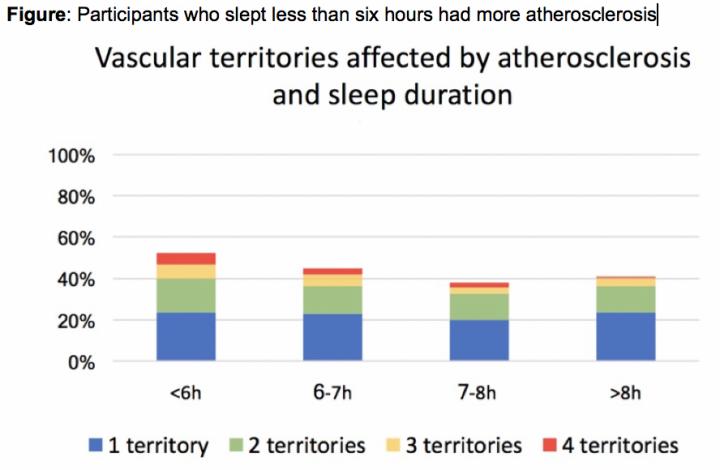
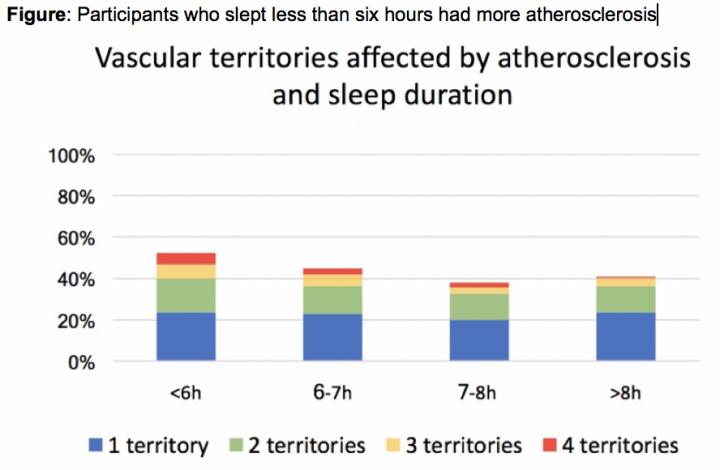
The average age of participants was 46 years and 63% were men. After adjusting for conventional cardiovascular risk factors and potential confounding factors, including age, gender, moderate to vigorous physical activity, body mass index, smoking status, alcohol consumption, blood pressure, education level, blood glucose levels, total cholesterol, total calorie consumption per day, marital status, stress and depression questionnaire scores and obstructive sleep apnoea risk (STOP-BANG score), very short sleepers had significantly more atherosclerosis than those who got seven to eight hours (odds ratio [OR] 1.27, 95% confidence interval [CI] 1.06-1.52, p=0.008) (see figure).

Those in the highest quintile of fragmented sleep were more likely to have multiple sections of arteries with atherosclerosis compared to those in the lowest quintile (OR 1.34, 95% CI 1.09-1.64, p=0.006) (figure).

Dr Dominguez said: "People who had short or disrupted sleep were also more likely to have metabolic syndrome, which refers to the combination of diabetes, high blood pressure, and obesity, and depicts an unhealthy lifestyle."

He concluded: "Failure to get enough sleep and restlessness during the night should be considered risk factors for blocking or narrowing of the arteries. Studies are needed to find out if sleeping well and long enough can prevent or reverse this effect on the arteries. In the meantime it seems sensible to take steps to get a good night's sleep – such as having a physically active lifestyle and avoiding coffee and fatty foods before bedtime."

###

Figure: Participants who slept less than six hours had more atherosclerosis

Media Contact

ESC Press Office
[email protected]
@escardio

http://www.escardio.org

Share12Tweet8Share2ShareShareShare2

Related Posts

Low-Carb Keto Diet Aids Overweight Women with Endometrial Cancer

May 27, 2026

Enhancing Pitching Technique: How Baseball Players Can Safeguard Elbow Health Through Smarter Throws

May 27, 2026

Personalized Brain Circuit Dysfunction Drives Parkinson’s Motor Symptoms

May 27, 2026

Hypertension’s Hidden Impact on Obesity-Linked Atherosclerosis

May 27, 2026
Please login to join discussion

POPULAR NEWS

  • ESMO 2025: mRNA COVID Vaccines Enhance Efficacy of Cancer Immunotherapy

    317 shares
    Share 127 Tweet 79
  • New Study Reveals Plants Can Detect the Sound of Rain

    735 shares
    Share 293 Tweet 183
  • Common Food Preservatives Associated with Elevated Blood Pressure and Increased Heart Disease Risk

    56 shares
    Share 22 Tweet 14
  • AI-Powered Atlas Uncovers Extensive Whole-Body Damage Linked to Obesity

    53 shares
    Share 21 Tweet 13

About

We bring you the latest biotechnology news from best research centers and universities around the world. Check our website.

Follow us

Recent News

Skyrmions Enable Optical Anisotropy for Topological Encoding

Metal Electrode Potential Shifts with Ion Additions

Low-Carb Keto Diet Aids Overweight Women with Endometrial Cancer

Subscribe to Blog via Email

Enter your email address to subscribe to this blog and receive notifications of new posts by email.

Join 82 other subscribers
  • Contact Us

Bioengineer.org © Copyright 2023 All Rights Reserved.

Welcome Back!

Login to your account below

Forgotten Password?

Retrieve your password

Please enter your username or email address to reset your password.

Log In
No Result
View All Result
  • Homepages
    • Home Page 1
    • Home Page 2
  • News
  • National
  • Business
  • Health
  • Lifestyle
  • Science

Bioengineer.org © Copyright 2023 All Rights Reserved.