As Major League Baseball continues to grapple with the persistent challenge of elbow injuries among pitchers, recent research emerging from the University of Waterloo could hold the key to safer pitching mechanics without compromising performance. The spotlight on Toronto Blue Jays’ right-hander José Berríos, who recently underwent surgery for an ulnar collateral ligament (UCL) injury, underscores the urgency in understanding the biomechanical factors behind these debilitating injuries. Through cutting-edge computer modeling, Waterloo researchers have revealed that adjustments in pitching mechanics can significantly reduce the stress imposed on the UCL, the fragile ligament that stabilizes the inside of the elbow.
The innovative study, led by graduate student Cedric Attias, employed a sophisticated digital skeleton model integrated with muscles, ligaments, and joints to simulate the complex forces acting on pitchers’ elbows during their throwing motions. This approach marks the first of its kind, capturing the intricate dynamics of pitching that conventional motion capture or observational studies alone cannot fully elucidate. By leveraging forward dynamics and optimal control theories, the team was able to predict and analyze how various mechanical parameters influence both the velocity of the pitch and the strain on the UCL.
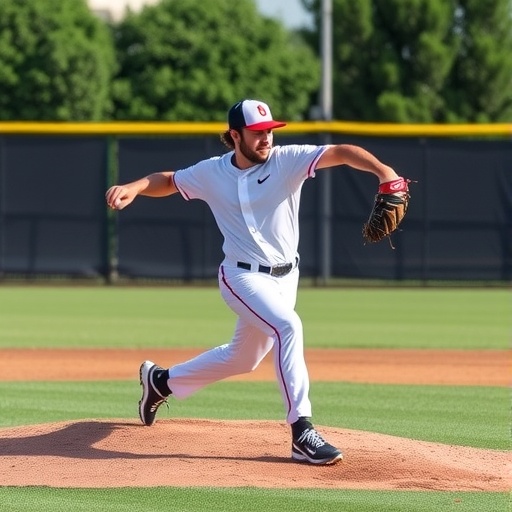
One of the pivotal insights from this research is the identification of two primary biomechanical variables that exacerbate UCL loading: a high arm slot—referring to the angle at which the arm is raised during delivery—and the tilting of the torso away from the throwing arm. These factors tend to amplify twisting forces on the medial elbow, which, combined with the repetitive, explosive nature of pitching, accelerates ligament degeneration. The findings suggest that slight modifications to arm angle and torso orientation could markedly mitigate injury risk.
The clinical significance of this discovery cannot be overstated, given that UCL injuries frequently necessitate Tommy John surgery—a reconstructive procedure that entails replacing the damaged ligament and entails a lengthy and uncertain rehabilitation period. Many pitchers struggle to regain their pre-injury performance levels, and some never return to elite competition at all. By focusing on targeted mechanical alterations rather than merely reducing pitch velocity, the study offers a promising pathway to prolong careers and preserve athletic prowess.
As Attias explains, “Our goal is not to tell pitchers to throw softer, but to help them throw smarter.” This philosophy is grounded in the modeling data, which demonstrates that pitchers maintaining a controlled, upright delivery at around 93 miles per hour exert significantly less stress on their UCLs compared to peers relying on more extreme mechanics to achieve the same velocity. The digital skeleton simulation thus serves as a virtual testing ground to explore these subtleties without subjecting actual athletes to injury risks.
The elaborate digital model incorporates comprehensive musculoskeletal elements, capturing tendon elasticity, ligament constraints, and muscular activations to replicate the biomechanical environment of professional pitching. Such granularity allowed the researchers to explore not only upper-body kinematics but also how lower-body mechanics and torso movements influence elbow stress. The interconnectedness of these factors highlights the importance of holistic biomechanical training regimens for pitchers.
Interestingly, the simulation results aligned closely with real-world footage of Toronto Blue Jays reliever Tyler Rogers, whose submarine pitching style involves a low arm slot and distinctive torso positioning. Rogers’ delivery, which tends to minimize elbow torque, corresponds closely with the model’s prediction for injury-avoidant mechanics, albeit producing slightly lower pitch velocities. This serves as a compelling validation of the model’s applicability in practical coaching and injury prevention contexts.
At the opposite end of the mechanical spectrum, the model predicted that hypothetical pitchers capable of throwing at extraordinary speeds—up to 110 miles per hour, surpassing current major league records—would adopt a form more reminiscent of cricket bowlers than traditional pitchers. This style would involve extreme trunk tilting and an almost vertical arm angle, emphasizing that performance optimization and injury avoidance are intricately linked and may require sport-specific biomechanical adaptations.
The researchers emphasize that while some degree of UCL strain is unavoidable given the velocity demands of professional baseball, optimizing delivery mechanics offers a promising avenue to balance performance with injury prevention. They hope that their findings will inform tailored coaching strategies that not only improve longevity in elite athletes but also embed safer pitching habits in youth players, reducing the incidence of overuse injuries early in their careers.
This pioneering work exemplifies the growing impact of biomechanical simulation and optimal control applied to sports science, enabling detailed exploration of dynamic loading scenarios previously inaccessible to empirical testing. The University of Waterloo’s Motion Research Group (MoRG), under the guidance of Dr. John McPhee, continues to push the boundaries of sport biomechanics, blending engineering principles with athletic performance metrics.
Cedric Attias, now a biomechanist with the Seattle Mariners organization, and his colleague Dr. Keaton Inkol, another University of Waterloo alumnus, are spearheading the translation of these computational insights into practical tools and training protocols that can be integrated into Major League Baseball programs. Their collaborative work foreshadows a future where data-driven mechanical optimization may become standard practice for injury mitigation and performance enhancement in baseball pitching.
The full research paper titled “Musculoskeletal modelling and predictive simulation of baseball pitching to improve performance and mitigate injury using forward dynamics and optimal control” is published in the journal Multibody System Dynamics. This study signals a transformative shift in how baseball pitching mechanics are analyzed, understood, and refined, with vast implications for athletes, coaches, and medical professionals alike.
Subject of Research: Biomechanical modeling and injury mitigation in professional baseball pitching.
Article Title: Musculoskeletal modelling and predictive simulation of baseball pitching to improve performance and mitigate injury using forward dynamics and optimal control.
News Publication Date: Not specified (source article date needed).
Web References:
https://link.springer.com/article/10.1007/s11044-026-10143-y
University of Waterloo Motion Research Group: https://uwaterloo.ca/systems-design-engineering/profile/mcphee
References:
Attias C., McPhee J., et al. (2026). Musculoskeletal modelling and predictive simulation of baseball pitching to improve performance and mitigate injury using forward dynamics and optimal control. Multibody System Dynamics.
Image Credits: University of Waterloo
Keywords: Ulnar collateral ligament, Tommy John surgery, pitching mechanics, biomechanical modeling, musculoskeletal simulation, optimal control, elbow injury, baseball pitching, injury prevention, sports medicine, performance optimization, baseball biomechanics.
Tags: baseball pitching elbow injury preventionbaseball pitching technique optimizationbiomechanics of pitching mechanicscomputer modeling of pitching motionsdigital skeleton model for sports injuryforward dynamics in sports scienceJosé Berríos elbow injury case studyoptimal control theory in biomechanicspitching mechanics and injury riskreducing elbow stress in baseball playersulnar collateral ligament injury in pitchersUniversity of Waterloo pitching research