Scientists probe how excited states of matter behave in phosphorene — a two-dimensional material with unusual properties
Credit: OIST
Since its discovery in 2014, phosphorene – a sheet of phosphorus atoms only a single atom thick – has intrigued scientists, due to its unique optoelectronic anisotropy. In other words, electrons interact with light and move in one direction only. This anisotropy means that despite being two dimensional (2D), phosphorene shows a mix of properties found in both one-dimensional (1D) and 2D materials. Scientists believe that the distinct quasi-1D nature of phosphorene could be exploited to develop new, innovative optoelectronic devices, from LEDs to solar cells.
Now, scientists from the Femtosecond Spectroscopy Unit at the Okinawa Institute of Science and Technology Graduate University (OIST) have shed light on how excitons – an excited state of matter at the core of optoelectronics – move and interact within phosphorene.
“Because of the anisotropy, excitons behave in a really unique way in phosphorene compared to other 2D materials, which we are only just beginning to understand,” said Vivek Pareek, PhD student and first author of the study, published in Physical Review Letters.
Excitons are formed when a material absorbs a photon of light, causing an electron to be excited to a higher energy state. This leaves a positively charged “hole” where the electron used to reside in its initial energy state, which is attracted to the negatively charged excited electron. The resultant bound electron-hole pair – the exciton – can then move through the material and interact with other excitons.
But excitons are short-lived and in time, the excited electrons “fall” back into the holes. To do so, excitons can either emit a photon – a process called radiative recombination – or they can collide with each other, transferring heat to the material – a non-radiative recombination called exciton-exciton annihilation.
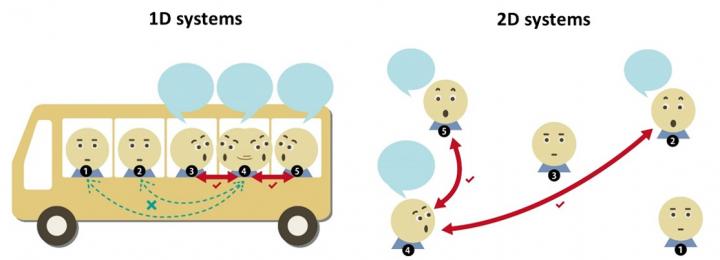
“Exciton-exciton interaction, or annihilation, is very different in 1D and 2D systems,” explained Pareek. “We can therefore use exciton-exciton annihilation as a tool to probe the nature of interactions in quasi-1D phosphorene.”
Probing phosphorene
The scientists used a laser to send two pulses of light at phosphorene – a pump pulse to excite the electrons to form excitons, and a probe pulse to capture how exciton-exciton annihilation occurred during the first hundred picoseconds, which are trillionths of a second. By changing the power of the pump pulse, the researchers altered the initial density of excitons formed.
The team found that as exciton density increased, exciton-exciton annihilation changed in dimension, shifting from 1D to 2D. The researchers show that this dimensional shift occurred due to phosphorene’s anisotropic properties, which arise due to the unusual structure of the material. This anisotropy causes excitons to move more rapidly in one specific direction along the lattice and move more slowly in the other direction. Therefore, at low exciton densities, interactions between excitons predominantly occurred only in one dimension – along the more favorable direction. But when the exciton density was increased, resulting in smaller distances between excitons, interactions started to occur in both dimensions.
The scientists also explored the effect of temperature on exciton-exciton annihilation. When the team cooled down the phosphorene flakes, exciton-exciton annihilation reverted from 2D to 1D, even at high exciton densities.
“This study shows that we can control whether exciton-exciton annihilation occurs in one or two dimensions, depending on conditions we set,” said Dr. Julien Madéo, OIST staff scientist and co-author of the study. “This reveals a new interesting property of phosphorene, enhancing its prospects as a new material in optoelectronic devices.”
###
Media Contact
Tomomi Okubo
[email protected]
Original Source
https:/
Related Journal Article
http://dx.