UNC-Chapel Hill biologists examine the links between microbial mats and a type of coral disease that has become an urgent conservation concern, and they suggest mitigation strategies to help reduce its spread. Coral reefs are valuable to marine ecosystems and the global economy. We talked with Sophie McCoy, assistant professor of biology in the College of Arts and Sciences, and Ph.D. candidate Ethan Cissell about their research published in the journal Ecological Applications.
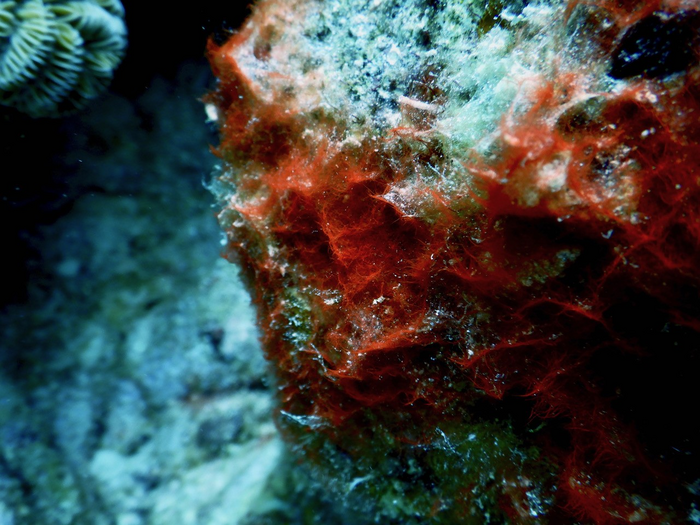
Credit: Photo by Ethan Cissell
UNC-Chapel Hill biologists examine the links between microbial mats and a type of coral disease that has become an urgent conservation concern, and they suggest mitigation strategies to help reduce its spread. Coral reefs are valuable to marine ecosystems and the global economy. We talked with Sophie McCoy, assistant professor of biology in the College of Arts and Sciences, and Ph.D. candidate Ethan Cissell about their research published in the journal Ecological Applications.
Q: What’s the overall value of coral reefs to marine ecosystems and to the economy?
A: It is easy to care about corals, which are such beautiful and charismatic animals. However, corals also play a truly outsized role in the provision of concrete ecosystem services across the world. Corals provide the skeleton or underwater skyline of reefs that are home to many other sedentary organisms, like sponges and octocorals that are valuable for water filtration and natural products, and that are also used by fish — including fisheries species. Physically, coral structures attenuate waves and flooding from storms, protecting shorelines from flooding and erosion. Finally, healthy reefs are the backbone of lucrative tourism industries around the world, including in the United States.
Q: The increasing prevalence of coral diseases is an urgent conservation concern. What did you find?
A: Coral diseases are becoming more common on coral reefs globally. Coral disease outbreaks can devastate entire populations of critically endangered corals. This threatens the physical and economic services that reefs provide, including shoreline protection and food security. To work toward disease prevention, we also need to understand what aspects of coral reefs promote the survival and spread of disease-causing pathogens.
In this study, we identified benthic cyanobacterial mats as a possible refuge for Black Band Disease pathogens on coral reefs. Benthic cyanobacterial mats are microbial mats that grow on the sea floor in association with photosynthetic cyanobacteria, which are also called blue-green algae. Similar mats are also found in freshwater systems. On coral reefs, benthic cyanobacterial mats have been spreading globally, and they are related to water column cyanobacterial blooms that have become problematic along many coastlines.
This paper identifies and describes priority research areas to specify links between cyanobacterial mats and coral Black Band Disease. We also discuss next steps toward developing mitigation strategies to help reduce the spread of Black Band Disease.
Q: Why focus on coral Black Bland Disease?
A: Black Band Disease, known as BBD, was one of the earliest coral diseases to be described, and it remains one of the easiest to identify by a black ring separating healthy coral tissue from dead white skeleton. This black ring is actually caused by a microbial mat. This disease is described by the presence of a “microbial fingerprint” of multiple organisms, including cyanobacteria, sulfide-oxidizing and sulfate-reducing bacteria. While BBD is still an active management challenge across the world, many other coral diseases contribute to coral conservation challenges.
Q: Where are the coral reefs you analyzed in this study?
A: Our study focused on reefs in Bonaire, Netherlands. My research group has chosen to study Bonaire’s reefs because they are well conserved due to long-standing conservation policies, and they rank among the most pristine in the Caribbean region. By studying processes in pristine ecosystems that function as they should, we can gain insights for conservation and management of other coral reefs.
Q: What are implications for decision-makers with these findings?
A: We teamed up with Caren Eckrich, a natural resources manager for STINAPA, the national park in Bonaire, Netherlands, for this study. Benthic cyanobacterial mats are normal components of all coral reefs but are getting more common with warming water temperatures and other runoff impacts to reefs. However, knowing that coral disease pathogens are associated with cyanobacterial mats may make them easier to manage due to the visibility of the mats. For example, ongoing reef monitoring efforts should start to include reef cover of cyanobacterial mats, which would add a low-cost tool for management.
Other suggestions we make in this study will help managers decide how best to allocate often limited management and restoration resources. Managing fisheries, regulating coastal development, controlling runoff and wastewater treatment are all local management strategies actively pursued to combat and control disease drivers. A better understanding of coral disease transmission is critical for tailoring specific and effective coral monitoring, management and restoration strategies, and creating evidence-based policies governing sustainable coastal development.
Learn more and read the paper.
Journal
Ecological Applications
Method of Research
Observational study
Subject of Research
Not applicable
Article Title
Cyanobacterial mats as benthic reservoirs and vectors for coral black band disease pathogens
Article Publication Date
16-Jun-2022