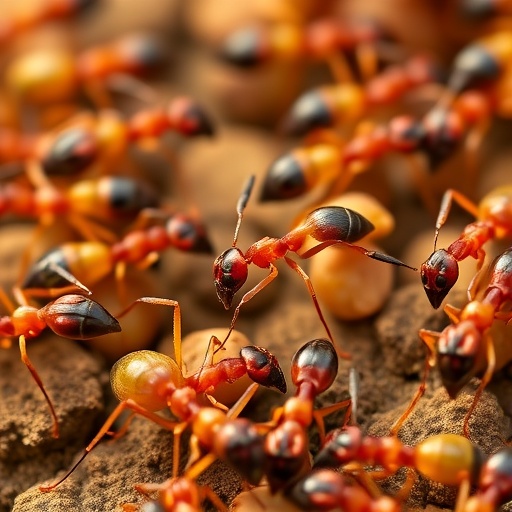
A single ant can trigger a synchronized wave of activity across an entire colony, sending hundreds or even thousands of nestmates into motion, according to a new computational study from the New Jersey Institute of Technology. The finding challenges the common assumption that large-scale collective behavior requires a critical mass of already-active individuals. In the modeled ant colonies, one “first mover” was sometimes enough to initiate a cascade that spread rapidly through the nest before subsiding into a period of relative calm.
The research focuses on acorn ants in the genus Temnothorax, including species such as Temnothorax allardycei, T. rugatulus and T. rudis, as well as the closely related Leptothorax acervorum. Biologists have observed that these ants periodically erupt into brief, synchronized bursts of movement. The colony may remain quiet for a time, then suddenly surge into collective activity, with many workers moving simultaneously before the wave fades. These episodes appear irregular, yet their underlying dynamics resemble coordinated bursts seen in schooling fish, firefly signaling, chemical reactions and networks of firing neurons.
To investigate how such bursts begin, Simon Garnier, a professor of biological sciences at NJIT, worked with Michael Napoli and Maurizio Porfiri of New York University’s Tandon School of Engineering. The researchers constructed a mathematical model in which every ant moved independently through a virtual nest while interacting with nearby nestmates. Each simulated insect could occupy one of three functional states: active, inactive or temporarily unresponsive. Ants could change state spontaneously, but encounters with active individuals could also influence whether a previously inactive ant began moving.
The model allowed the scientists to vary several factors that determine how information travels through a colony. These included the density of ants within the nest, their movement speed and the distance over which they could detect or interact with one another. The researchers used observations from earlier studies of real colonies to select biologically realistic ranges for these parameters. By adjusting the values, they could examine when an ant’s activity remained isolated and when it became powerful enough to spread through the population as a self-sustaining wave.
The simulations revealed a narrow but important regime in which colony-wide coordination emerged from a single initiating ant. When density, speed and interaction distance were balanced correctly, the first mover encountered enough nearby nestmates, and those nestmates encountered others, creating a chain reaction. Activity propagated through the virtual nest much like a wave moving through a responsive medium. The result was not merely an increase in random motion, but a synchronized burst involving a substantial fraction of the colony.
This behavior represents a form of collective phase transition. In statistical physics, a phase transition occurs when small changes in system conditions produce a sharp shift in behavior, such as water changing from liquid to vapor. In the ant model, the colony could shift from a largely quiescent state to a highly active one when its interaction parameters crossed a critical threshold. Below that threshold, individual movements died out quickly. Near the transition, however, one ant could initiate a cascade that expanded dramatically before eventually collapsing.
A key feature of the model was the inclusion of deactivation. Without a mechanism to stop the cascade, the colony would remain active indefinitely once a wave began. Instead, ants could become temporarily unresponsive, and excessive activity could suppress further activation. This produced a natural rhythm: rapid mobilization followed by collective rest. Garnier and his colleagues describe the balance as essential to synchronized bursts because it allows information to spread efficiently while preventing the colony from wasting energy in continuous motion.
The ability to mobilize quickly may provide an evolutionary advantage. Ant colonies must respond to disturbances, changes in their nest environment and possible threats, and a wave of activity could allow information to reach many workers almost immediately. At the same time, a colony-wide response carries a cost. If the first ant reacts to an ambiguous or misleading cue, thousands of workers could become active unnecessarily. Earlier work by Garnier and collaborators suggests that ant colonies possess regulatory mechanisms that limit this risk. When too many individuals are active, they can inhibit one another, rapidly returning the group to a quieter state.
The findings also offer a possible blueprint for engineered systems composed of autonomous agents. Fleets of self-driving taxis, robotic swarms or distributed sensor networks may need to respond collectively to rapidly changing conditions without activating every available unit. A communication strategy inspired by ants could allow one agent to initiate a coordinated response, while built-in suppression mechanisms would prevent excessive deployment. The study, published in PRX Life, therefore connects the behavior of tiny social insects with a broader question in science and engineering: how can a system react with the speed of a crowd while retaining the energy efficiency of an individual?
Subject of Research: Animals
Article Title: Nest-Level Phase Transition Drives Synchronized Activity Bursts in Ant Colonies
News Publication Date: 5-Aug-2026
Web References: https://journals.aps.org/prxlife/abstract/10.1103/ghnl-p5c1; https://people.njit.edu/profile/garnier; https://www.nsf.gov/awardsearch/show-award/?AWD_ID=2222418
References: PRX Life, DOI: 10.1103/ghnl-p5c1
Image Credits: Gilles San Martin
Keywords: Ant colonies, Temnothorax affinis, synchronized activity, collective behavior, biological models, computer modeling, computational biology, phase transitions, swarm intelligence, autonomous systems
Tags: Ant colony collective behaviorant-triggered activity cascadecollective decision-making in ant coloniescomputational ant behavior simulationemergence of collective motion in antsinfluence of single ant on colony dynamicsmodeling ant foraging and movement patternsneural network-inspired ant activityrole of individual ants in colony coordinationsocial synchronization in insect nestssynchronized movement in insect coloniesTemnothorax ant colony dynamics