• HOME
  • NEWS
  • EXPLORE
    • CAREER
      • Companies
      • Jobs
    • EVENTS
    • iGEM
      • News
      • Team
    • PHOTOS
    • VIDEO
    • WIKI
  • BLOG
  • COMMUNITY
    • FACEBOOK
    • INSTAGRAM
    • TWITTER
Saturday, January 17, 2026
BIOENGINEER.ORG
No Result
View All Result
  • Login
  • HOME
  • NEWS
  • EXPLORE
    • CAREER
      • Companies
      • Jobs
        • Lecturer
        • PhD Studentship
        • Postdoc
        • Research Assistant
    • EVENTS
    • iGEM
      • News
      • Team
    • PHOTOS
    • VIDEO
    • WIKI
  • BLOG
  • COMMUNITY
    • FACEBOOK
    • INSTAGRAM
    • TWITTER
  • HOME
  • NEWS
  • EXPLORE
    • CAREER
      • Companies
      • Jobs
        • Lecturer
        • PhD Studentship
        • Postdoc
        • Research Assistant
    • EVENTS
    • iGEM
      • News
      • Team
    • PHOTOS
    • VIDEO
    • WIKI
  • BLOG
  • COMMUNITY
    • FACEBOOK
    • INSTAGRAM
    • TWITTER
No Result
View All Result
Bioengineer.org
No Result
View All Result
Home NEWS Science News Biology

SFU students are helping develop heat and drought tolerant rice and wheat

Bioengineer by Bioengineer
March 15, 2018
in Biology
Reading Time: 2 mins read
0
Share on FacebookShare on TwitterShare on LinkedinShare on RedditShare on Telegram
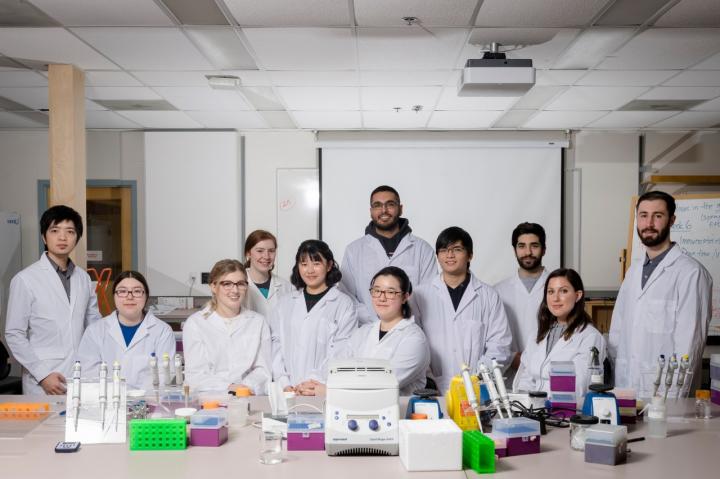
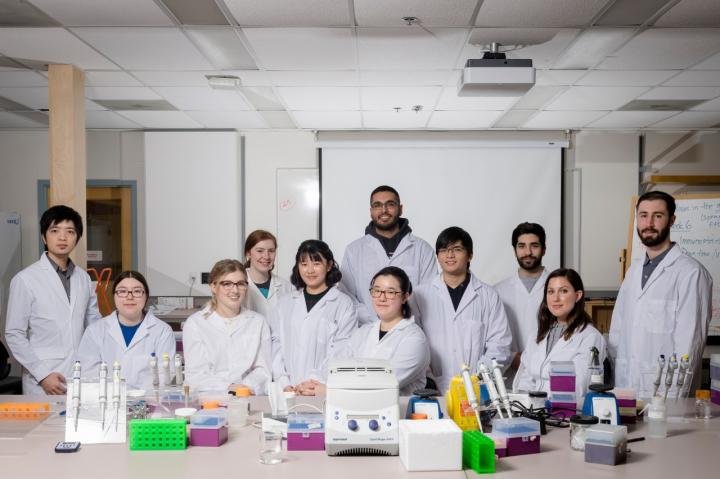
IMAGE

Credit: SFU

The United Nations predicts that by 2050 our growing global population will require 70 per cent more food than is available today. Compounding this enormous shortfall is a loss of agricultural land to urbanization, and the effects of global warming–particularly high temperatures–on crop growth.

SFU biological sciences faculty Jim Mattsson and Kathleen FitzPatrick, together with students in their Genetic Engineering (BISC 357) course, are working towards a solution using CRISPR genome-editing technology.

"Rice and wheat are essential to diets around the world," says Matsson. "That's why there is a worldwide effort to improve rice and, eventually, wheat so they can be productive at higher temperatures."

His students are using the cutting-edge CRISPR technology to decipher which rice and wheat genes need to be modified to improve growth.

Plant species such as sugarcane and millet, for example, have naturally evolved to produce at higher temperatures, but that hasn't happened in their relatives, rice and wheat.

Mattsson figures that by identifying the genes responsible for forming veins in millet leaves (more veins permit greater photosynthesis and therefore growth), it should be possible to reverse engineer more veins in rice and wheat plants.

So during the fall 2017 term, Mattsson and FitzPatrick challenged their students to learn how to use CRISPR to identify the genes behind the evolution of heat stress tolerance in millet.

With this successfully accomplished, future classes will compare these millet genes to their cousin genes in rice to see how the rice genes need to be changed or reverse engineered to gain heat tolerance.

"The students were thrilled to discover that they had successfully put together DNA fragments capable of inactivating, one by one, over 30 individual genes in living millet plants," says Matsson. "They knew the theory behind CRISPR, but to get a chance to actually splice genes was pretty exciting for them."

Student Serina Li says, "I found that the course provided me with a really good foundation for the molecular cloning techniques and applications that are currently used in labs. "We were working on specific projects while learning the techniques involved, so that we were able to apply what we learned right away. This was one of my favourite aspects of the course, as it made the material easier to learn and also was more relevant to how one would conduct these types of experiments as a real scientist."

Around the world, scientists have high expectations of CRISPR technology, mainly for treating human disease.

Mattsson is equally delighted with CRISPR's prospects for plant engineering.

He says, "In my class alone, students are discovering what genes are doing with a precision and scale that was unheard of just a few years ago."

###

Media Contact

Justin Wong
[email protected]
778-782-3035
@SFU_Media

http://www.sfu.ca

Share12Tweet8Share2ShareShareShare2

Related Posts

Exploring BAHD Genes in Pecan Development and Stress

January 17, 2026
Gender Differences in Obesity and Stroke Outcomes

Gender Differences in Obesity and Stroke Outcomes

January 17, 2026

Genome Assembly of Helan Shan Pika Aids Conservation

January 17, 2026

New Genetic Insights into Strobilanthes cusia Cultivation

January 16, 2026
Please login to join discussion

POPULAR NEWS

  • Enhancing Spiritual Care Education in Nursing Programs

    155 shares
    Share 62 Tweet 39
  • PTSD, Depression, Anxiety in Childhood Cancer Survivors, Parents

    147 shares
    Share 59 Tweet 37
  • Robotic Ureteral Reconstruction: A Novel Approach

    77 shares
    Share 31 Tweet 19
  • Study Reveals Lipid Accumulation in ME/CFS Cells

    54 shares
    Share 22 Tweet 14

About

We bring you the latest biotechnology news from best research centers and universities around the world. Check our website.

Follow us

Recent News

Studying Tumor Stem Cell Role in Oral Cancer

HR020602 and Propofol: Safety in Pediatric Anesthesia

Exploring BAHD Genes in Pecan Development and Stress

Subscribe to Blog via Email

Enter your email address to subscribe to this blog and receive notifications of new posts by email.

Join 71 other subscribers
  • Contact Us

Bioengineer.org © Copyright 2023 All Rights Reserved.

Welcome Back!

Login to your account below

Forgotten Password?

Retrieve your password

Please enter your username or email address to reset your password.

Log In
No Result
View All Result
  • Homepages
    • Home Page 1
    • Home Page 2
  • News
  • National
  • Business
  • Health
  • Lifestyle
  • Science

Bioengineer.org © Copyright 2023 All Rights Reserved.