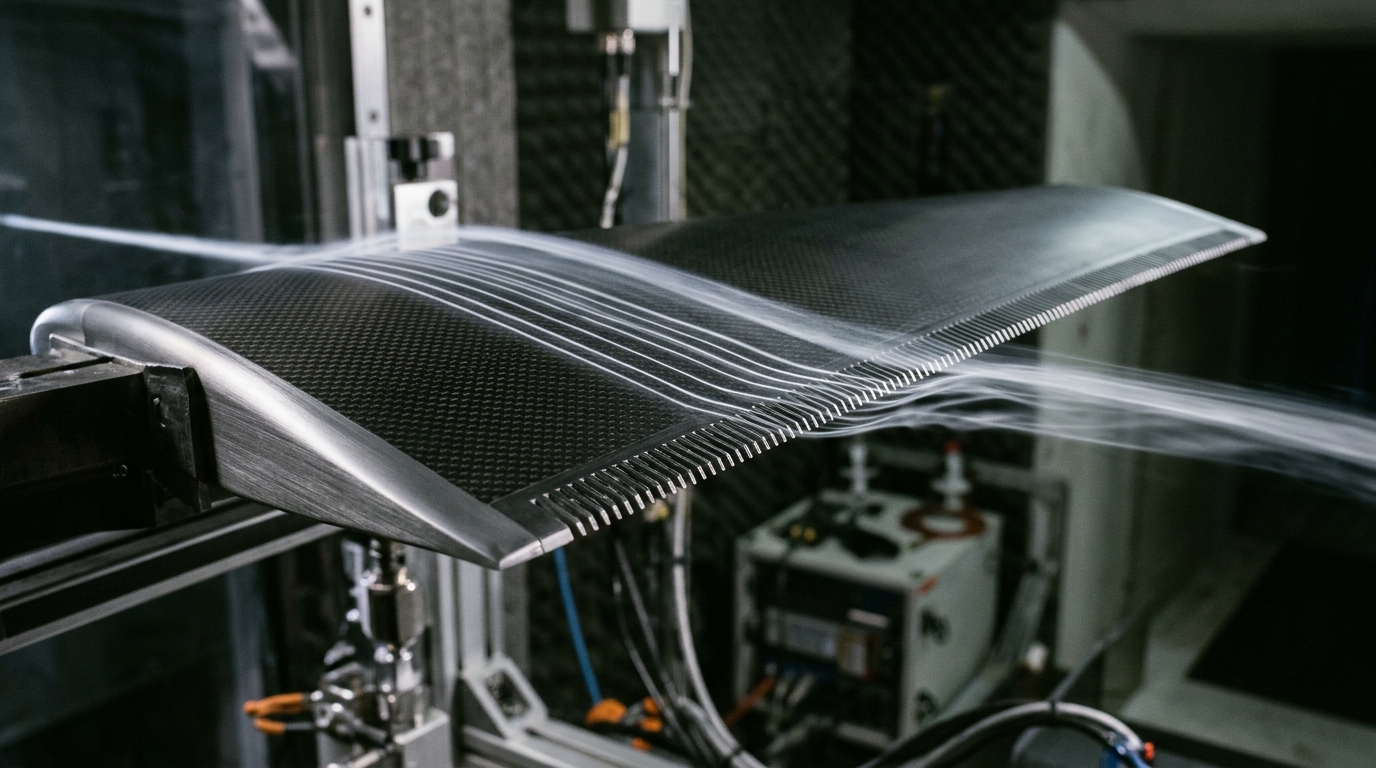
Published in Advances in Aerodynamics, the study utilizes large eddy simulations to analyze a symmetric Joukowski airfoil with a 12% thickness ratio. The investigation focuses on the initial acceleration phase, a period analogous to aircraft takeoff, where unsteady flow phenomena pose significant challenges for aerodynamic performance and noise control. By comparing a conventional trailing edge with a serrated configuration, the team provides detailed insights into how passive flow control devices interact with unsteady aerodynamic forces.
The computational study employed high-resolution implicit large eddy simulations to model the flow around the airfoil at a Mach number of 0.25 and a 5-degree angle of attack. The simulations were conducted at four distinct Reynolds numbers: 100,000, 250,000, 400,000, and 500,000. These parameters were selected to reflect conditions relevant to smaller aircraft and unmanned aerial vehicles. The flow was accelerated from zero to the target freestream velocity using a Gaussian distribution over eight non-dimensional time units, followed by a constant velocity phase.
For the conventional trailing edge airfoil, the simulations revealed the formation of a laminar separation bubble on the suction side during the post-acceleration phase. This bubble, a region of recirculating flow, formed between 13.2 and 16.7 time units. The study identified that trailing edge sound waves played a causal role in the breakdown of this separation bubble. As the sound waves propagated upstream and interacted with the boundary layer, they triggered the bursting of the bubble, leading to increased flow instability and volatility in the aerodynamic forces.
In contrast, the airfoil equipped with serrated trailing edges exhibited markedly different flow behavior. The serrations, which accounted for 10% of the chord length, promoted an earlier transition from a laminar to a turbulent boundary layer. This earlier transition prevented the formation of the laminar separation bubble entirely. By inducing turbulence closer to the leading edge, the serrations effectively stabilized the boundary layer, resulting in smoother aerodynamic force distributions. The absence of the separation bubble contributed to a more predictable and stable lift force, particularly during the latter half of the simulation.
The aeroacoustic analysis indicated that the serrated trailing edge reduced the intensity of trailing edge noise. The serrations break down larger vortical structures into smaller ones, which reduces the amplitude of the pressure fluctuations that generate sound. While the study did not provide a detailed quantification of the decibel reduction, it confirmed that the noise source intensity was lower for the serrated case. The earlier onset of trailing edge noise in the serrated case, occurring around 11.5 time units compared to 13.4 for the conventional case, was attributed to the earlier transition to turbulence.
When comparing the aerodynamic forces, the non-dimensional force in the x-direction, analogous to drag, showed a slight increase for the serrated airfoil during the initial post-acceleration phase. This increase is due to the additional surface area and the earlier onset of turbulent skin friction. However, this penalty diminished over time, and by the end of the simulation, the drag values for both configurations converged. The non-dimensional force in the y-direction, analogous to lift, showed improved stability for the serrated airfoil. The serrated case exhibited a smoother curve with less volatility, indicating better control over the aerodynamic forces.
The study further examined the effects of varying Reynolds numbers on the performance of the serrated trailing edge. At higher Reynolds numbers, the transition to turbulence occurred even earlier, leading to a more pronounced initial drag penalty. However, the benefits in terms of stability and noise reduction persisted across all tested Reynolds numbers. At the lowest Reynolds number of 100,000, the benefits of the serrations were most significant, with a 5.51% improvement in the non-dimensional force in the x-direction during the final 25% of the simulation.
The grid validation process ensured the accuracy of the simulation results. Three different mesh configurations were tested, and the results showed close agreement, particularly between the medium and fine meshes. The root mean square error between the medium and fine mesh for the non-dimensional force in the x-direction was 9.04e-07, indicating high numerical precision. The near-wall mesh resolution was carefully designed to capture the boundary layer accurately, with wall units within the recommended range for large eddy simulations.
The implications of this study extend to the design of quieter and more stable airfoils for various applications.
The research team, comprising Andro Rak, Lado Kranjcevic, and Jae Wook Kim, utilized a structured multi-block grid system consisting of six blocks to perform the simulations. The numerical solver employed wavenumber-optimized fourth-order pentadiagonal compact finite difference schemes with seven-point stencils to calculate flux derivatives. To maintain numerical stability, a sixth-order pentadiagonal compact filter was applied with a cutoff wavenumber of 0.88π. The time advancement of the solution used a classical fourth-order Runge-Kutta scheme with a Courant-Friedrichs-Lewy number of 0.99. Characteristic non-reflecting boundary conditions were coupled with a sponge layer at the far-field boundaries to create perfectly anechoic conditions, suppressing numerical reflections of pressure waves. Periodic boundary conditions were applied across the spanwise boundary planes, while no-slip wall boundary conditions were enforced on the airfoil surface. The calculations were carried out on the IRIDIS-5 cluster at the University of Southampton, utilizing 1,200 processor cores for the distributed solution of pentadiagonal matrix systems.
Grid validation was performed using three distinct mesh configurations: coarse, medium, and fine. The grid was refined by a factor of 1.25 in all three directions from the coarsest to the finest mesh, resulting in the finest mesh containing nearly twice the number of grid cells as the coarsest. The near-wall mesh resolution was analyzed using wall units, with streamwise spacing remaining within the large eddy simulation range below 150. In the spanwise direction, values stayed below the limit of 40, except for 2% near the leading edge. In the normal direction, approximately 30% of the airfoil exceeded the recommended value of 1, primarily near the leading edge where the laminar boundary layer dominates. The medium mesh was selected for further analysis due to its superior alignment with the fine mesh in capturing oscillations accurately.
The pressure coefficient distribution for the conventional trailing edge airfoil was compared with XFoil predictions for a 12% thick Joukowski airfoil. The simulation exhibited noticeable oscillatory behavior over the turbulent region of the flow, while both the simulation and XFoil lines followed a similar general downward trend. During the laminar flow stage, XFoil overpredicted the maximum pressure coefficient value, a phenomenon well-documented in the literature for thick trailing edges. The time-averaged solution from the simulation matched the XFoil prediction very well over the turbulent region. The study noted that the simulation focused on initial acceleration and short post-acceleration phases rather than the fully converged state, suggesting that extended simulations would improve laminar flow correlation.
The introduction of serrations altered the aerodynamic force components in specific ways. The pressure force component was slightly improved in the serrated case, attributed to the absence of a laminar separation bubble. Conversely, the skin friction force increased significantly due to the additional surface area exposed to the fluid and the earlier onset of turbulence. This increase in skin friction negatively impacted the overall force in the x-direction initially. However, the rapid transition from a laminar to a turbulent boundary layer, which began closer to the trailing edge in the serrated case, contributed to performance gains over time. The relative error in the mean non-dimensional force in the x-direction between the conventional and serrated airfoils was calculated to be 1.15% for the Re = 100,000 case.
The study highlights that trailing edge noise is predominant for airfoils, resulting from surface pressure fluctuations in the turbulent boundary layer scattering off the trailing edge. Serrated trailing edges are a popular modification inspired by owl wings, with the first analytical solution formulated in 1991. This solution showed that noise reduction effectiveness depends on serration length and wavelength. Recent studies have utilized various techniques, including transient compressible lattice Boltzmann methods and direct numerical simulation, to examine these effects. Experimental measurements and computational fluid dynamics simulations have deepened the understanding of serrated trailing edges in the past five years. The current study contributes to this body of knowledge by investigating the behavior during both flow acceleration and post-acceleration phases, providing insights into boundary layer instabilities and sound wave-fluid flow interactions.
Subject of Research: Aerodynamic and aeroacoustic performance of serrated trailing edge airfoils during flow acceleration
Article Title: Aerodynamic and aeroacoustic analysis of airfoils with a serrated trailing edge during flow acceleration
Article References: Rak, A., Kranjcevic, L., & Kim, J. W. (2025). Aerodynamic and aeroacoustic analysis of airfoils with a serrated trailing edge during flow acceleration. Advances in Aerodynamics, 7(1), Article 18. https://doi.org/10.1186/s42774-025-00220-9
Image Credits: AI Generated
DOI: 10.1186/s42774-025-00220-9
Keywords: aerodynamics, aeroacoustics, serrated trailing edge, large eddy simulation, boundary layer, noise reduction, Joukowski airfoil, flow acceleration, Reynolds number, laminar separation bubble, Aerodynamic, aeroacoustic
News Source: Denise Maddox. (November 11, 2026). Serrated Airfoils Stabilize Flow and Cut Noise During Acceleration. Scienmag.