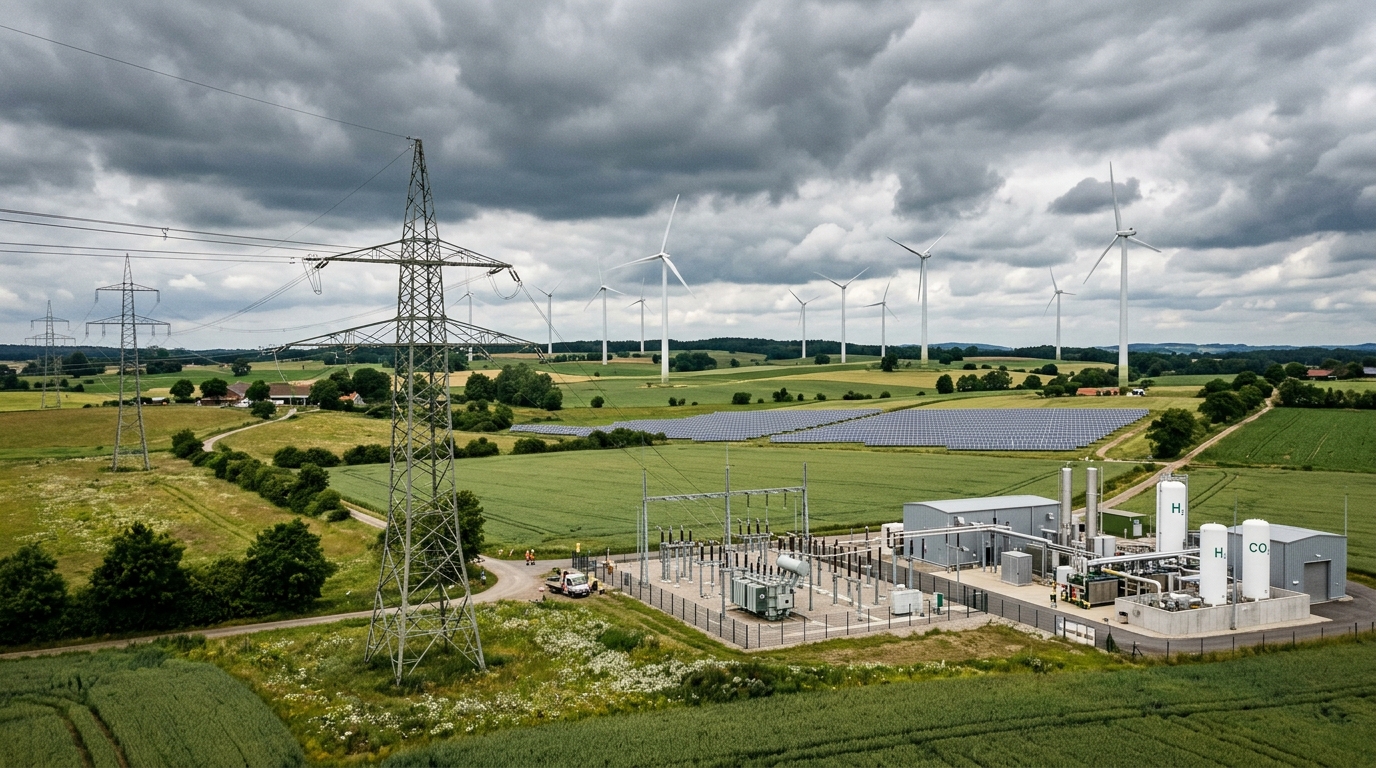
A systematic review and bibliometric analysis of 1,755 academic publications shows that Germany’s energy transition has reached a critical structural turning point in the post-nuclear and coal phase-out era. Published in Carbon Neutral Systems by researchers Hans-Peter Beck, Michael Z. Hou, and colleagues, the study synthesizes literature from 2010 through 2024 across five core pillars: policy frameworks, sustainable energy foundations, renewable and storage technologies, smart grids, and sector coupling. Utilizing data from the Web of Science Core Collection and the Bibliometrix tool in R, the authors identified three dominant research clusters concentrating on system design, optimization modeling, and governance. The findings demonstrate that while Germany has successfully expanded green electricity, achieving climate neutrality requires integrating disparate energy networks into an adaptive socio-technical system. The researchers emphasize that systemic coherence across physical infrastructure, legal structures, and digital markets is essential to overcome persistent bottlenecks and transform variable renewable generation into a fully synchronized national energy architecture.
National energy accounting reveals that fossil fuels continued to dominate Germany’s overall primary energy supply through 2023, despite significant additions in solar and wind capacity. Total primary energy supply records indicate that oil accounted for 34.44 percent of primary supply, generating 3.44 times ten to the sixth terajoules in total final consumption across industry and transport. Natural gas represented 26.16 percent of primary supply with 2.22 times ten to the sixth terajoules, predominantly supplying residential heating, while coal contributed 17.80 percent. Overall electricity consumption stood at 1.72 times ten to the sixth terajoules. Meanwhile, domestic fossil fuel extraction dropped sharply between 2008 and 2023, with coal production falling over 55 percent to 9.3 times ten to the fifth terajoules, crude oil extraction dropping to 1.15 times ten to the fifth terajoules, and nuclear generation dropping to 78,720 terajoules before full decommissioning in 2023. Nevertheless, energy self-sufficiency remained steady at approximately 34 to 40 percent due to domestic biomass and renewable expansion.
In 2024, renewable sources produced a record 62.7 percent of public net electricity generation, led by wind turbines at 136.4 terawatt-hours and solar photovoltaics at 72.2 terawatt-hours. Grid-scale battery storage capacity expanded from 8.6 gigawatts to 12.1 gigawatts, while lignite and hard coal electricity generation contracted by 8.4 percent and 27.6 percent, respectively. However, installing 2.44 gigawatts of new onshore wind fell short of trajectories required for Germany’s 2030 target of 115 gigawatts of onshore wind and 215 gigawatts of solar capacity. Furthermore, renewable variability generated acute market anomalies, causing negative wholesale electricity prices across 468 hours in 2024, a 60 percent increase over the prior year. During an extreme midday surplus on May 11, 2025, day-ahead auction prices collapsed to negative 250.32 euros per megawatt-hour. Even amidst this excess renewable electricity, grid stability rules required operating 5.6 gigawatts of conventional must-run capacity to maintain crucial system inertia and voltage support.
To absorb fluctuating power surpluses and decarbonize thermal demand, German system foundations increasingly rely on sector coupling through direct electrification and Power-to-X technologies. In municipal and residential heating, heat pumps provide a core linkage by upgrading ambient or waste heat using renewable electricity. Large-scale heat pumps achieve seasonal performance factors of 3.0 to 3.5, providing effective operating efficiencies of 300 to 350 percent compared to 55 to 60 percent for coal-based combined heat and power systems. Modeling frameworks demonstrate that heat pumps absorb excess wind and solar generation to mitigate curtailment. Urban demonstration projects prove the viability of this integrated strategy, notably in Hamburg’s HafenCity, where municipal planners are replacing coal heat by harvesting industrial waste heat from a copper smelter to cut 100,000 tons of carbon dioxide annually. This facility operates alongside a large electrode boiler Power-to-Heat plant, thermal storage tanks, and planned river-source heat pumps.
Road transport electrification provides critical demand-side flexibility, allowing battery electric vehicles to mitigate power fluctuations through smart charging and vehicle-to-grid bidirectional energy delivery. Modeling indicates that one million managed electric vehicles could reduce grid fluctuations by 16 percent, generating daily revenues of up to 68 euro cents per vehicle. However, transport transformation slowed after the abrupt cancellation of federal purchase subsidies in late 2023. By January 1, 2025, Germany’s 1.65 million battery electric vehicles and 970,000 plug-in hybrids constituted roughly 5.3 percent of the total vehicle fleet, lagging behind the national target of 15 million electric vehicles by 2030. For hard-to-electrify transport sectors like heavy freight, aviation, and shipping, Germany’s National Hydrogen Strategy established a 10-gigawatt electrolyzer capacity target by 2030. Projections indicate transport hydrogen demand will reach 25 to 100 terawatt-hours annually by 2045, alongside 85 to 150 terawatt-hours required for synthetic e-fuel synthesis.
Managing complex multi-sector interactions requires sophisticated artificial intelligence tools capable of processing energy big data, which exhibits standard volume, velocity, variety, and value properties alongside energy-specific attributes. Because German smart meter deployments operate under strict data privacy regulations under the General Data Protection Regulation, gathering granular household consumption data remains challenging. To overcome data scarcity without compromising privacy, the SyLas-KI project developed synthetic load profiles using Wasserstein Generative Adversarial Networks trained on OpenMeter measurements. These generative models produce artificial consumption time series that statistically mirror electric vehicle charging, heat pump cycling, and rooftop solar generation while eliminating traceability to individuals. When tested in grid state estimation, synthetic curves significantly outperformed coarse standard profiles. Open energy platforms like Fraunhofer ISE’s Energy-Charts and integration with the German Weather Service further support predictive models by combining hourly power flows with deep learning weather ensembles to forecast local loads under climate shifts.
Machine learning architectures are replacing traditional statistical methods in sectoral demand forecasting, with deep learning models, recurrent networks, and transformers achieving error margins below 3 percent in power load predictions. In the heating sector, artificial intelligence applications enhance district network operations and building-level management. A pilot implementation by the Norderstedt municipal utility showed that machine learning reduced 24-hour heat demand forecast errors by 25 percent, preventing unnecessary startup cycles and auxiliary boiler firing. In urban modeling, convolutional neural networks extracting building footprints from remote sensing imagery achieved 96 percent classification accuracy and an R-squared of 0.82, showing that retrofitting multifamily buildings built between 1950 and 1970 could address 47 percent of residential heat demand. In the transport sector, route-level LightGBM models predicted electric bus energy consumption with a mean absolute percentage error of 3.92 percent, while federal rail projects utilize artificial intelligence to optimize freight timetables, locomotive dispatching, and battery manufacturing traceability.
Institutional and market designs provide the commercial foundation for balancing renewable generation. Following the 1998 Energy Industry Act reform that unbundled generation, transmission, and retail, Germany ended monopolistic utility control. The Renewable Energy Act of 2000 fostered decentralized generation through guaranteed feed-in tariffs, but reforms in 2014 and 2017 transitioned larger projects to competitive auction tenders and capacity corridors, while retaining feed-in tariffs for solar systems below 750 kilowatts and biomass under 150 kilowatts. Electricity trading centers on EPEX SPOT, where day-ahead uniform-price auctions handle roughly half of total power volumes, complemented by rolling 15-minute intraday trading closing five minutes before physical delivery. Cross-border integration via European single day-ahead and intraday market coupling smooths regional wind fluctuations with neighboring countries. Meanwhile, grid reliability is maintained through a three-tier frequency reserve market comprising primary frequency containment, secondary automated restoration, and manual tertiary restoration, providing commercial access for flexible battery storage and demand response assets.
Geographic mismatch between northern renewable generation and southern industrial load centers creates severe grid congestion, shifting network operations from top-down distribution to bottom-up power flows. Conventional 380-kilovolt alternating current transmission lines suffer heavy reactive power limitations over long distances, with transmittable capacity dropping steeply beyond 200 kilometers. Consequently, Germany is constructing four major high-voltage direct current corridors, designated Corridors A through D, to establish 24 gigawatts of transmission capacity by 2034. Because direct current avoids reactive power losses, these systems sustain efficient transmission across 2,000 to 3,000 kilometers, linking offshore wind farms directly to industrial hubs. Modeling indicates that managing strong-wind imbalances requires 33.5 gigawatts of corridor capacity, but integrating large-scale energy storage can reduce this requirement to 13 gigawatts. Additionally, hybrid regional schemes like the Okertalsperre-Huneberg pumped-storage project in the Harz region provide 719 megawatt-hours of localized storage capacity while simultaneously delivering regional flood control and drinking water protection.
Sustaining the transition requires maintaining social participation while addressing material circularity in clean energy technologies. Public engagement remains a defining feature of German energy policy, with roughly 900 cooperatives and 2,000 citizen groups encompassing 500,000 members who co-own 25,000 wind turbines and 1.4 million solar systems. Representative surveys reveal that 81 percent of German citizens support renewable expansion, with local acceptance highest for rooftop solar at 76 to 84 percent, though dropping to 33 percent for transmission towers. Simultaneously, the Circular Economy Act is driving a shift toward lifecycle resource recovery. While Germany achieves a 70 percent municipal waste recycling rate, its circular material use rate was only 13 percent in 2022, trailing European leaders. Research at Clausthal University of Technology, including the CircularLIB battery recycling and BioICEP projects, is pioneering digital tracking to reclaim critical materials from wind turbines and batteries, demonstrating that long-term decarbonization requires harmonizing technical, market, social, and ecological dimensions.
Subject of Research: Systematic review of the German energy transition, sector coupling, and grid foundations
Article Title: A comprehensive review of sustainable energy systems in the context of the German energy transition—part 1: development status and system foundations
Article References: Beck, H.-P., Hou, M. Z., Wang, Q., Shi, T., Guo, Y., Huang, L., Zhang, T., Cai, N., Yue, Y., & Xie, Y. (2025). A comprehensive review of sustainable energy systems in the context of the German energy transition—part 1: development status and system foundations. Carbon Neutral Systems, 1(1), Article 12. https://doi.org/10.1007/s44438-025-00012-0
Image Credits: AI Generated
DOI: 10.1007/s44438-025-00012-0
Keywords: German energy transition, Energiewende, sector coupling, renewable electricity, Power-to-X, heat pumps, electric vehicles, high-voltage direct current, energy forecasting, synthetic load profiles, electricity market design, EPEX SPOT, battery storage, circular economy, citizen energy cooperatives, grid congestion, negative electricity prices, green hydrogen
News Source: Sloane Callahan. (November 14, 2026). German Clean Power Reaches Record Output While Sector Coupling Faces Systemic Hurdles. Scienmag.