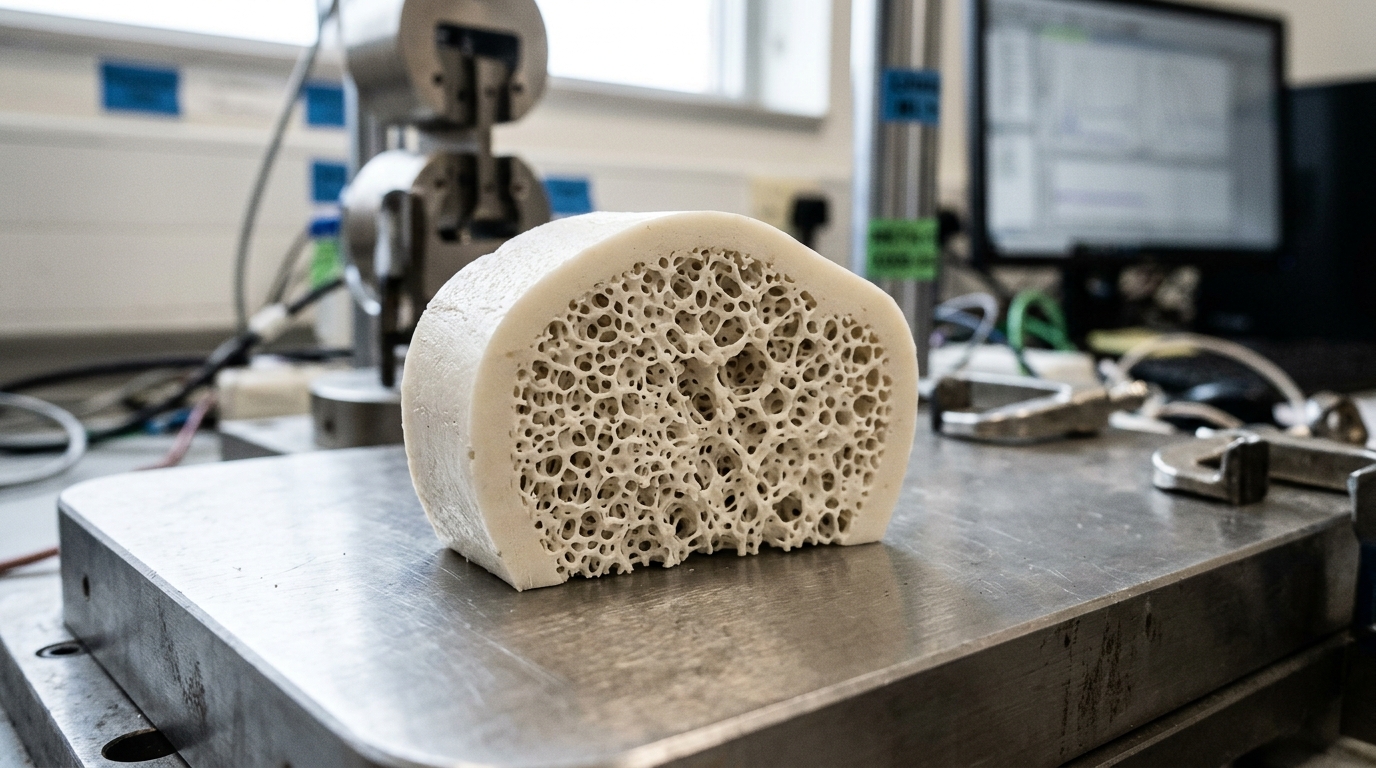
A comprehensive systematic review synthesising three decades of published research has revealed extensive disparities across the mechanical characterisation methods used to evaluate artificial bone surrogates, highlighting a critical absence of standardized benchmarks in preclinical orthopaedic testing. Evaluating new orthopaedic devices has historically depended on human cadaveric tissue because it provides the most authentic mechanical match to skeletal structures in living patients; however, high donor variability stemming from physiological differences, low commercial availability, ethical restrictions, disease transmission hazards, and degradation over storage make cadaveric material difficult to implement reliably. Consequently, synthetic surrogates have emerged as non-biological alternatives intended to deliver repeatable baseline performance during early device assessments. Yet, after evaluating eighty-eight studies published over thirty years in accordance with PRISMA-2020 guidelines, researchers found that substantial methodological divergence across experimental designs severely restricts valid inter-study comparisons. Strikingly, only twenty-three of the eighty-eight reviewed investigations evaluated human cadaveric specimens alongside synthetic constructs, with the remaining majority relying on inconsistent historical literature data obtained under disparate loading configurations.
To map the complete landscape of synthetic skeletal research, the authors conducted comprehensive database searches across Web of Science and MEDLINE, retrieving an initial total of 3,252 records, consisting of 1,393 and 1,859 entries respectively, alongside 869 duplicate publications. Following the removal of 231 records that failed date, format, or language criteria, 2,152 entries underwent two sequential screening phases governed by explicit inclusion and exclusion boundaries. Title screening eliminated fully irrelevant entries, after which abstract evaluations by paired reviewers, with third-party resolution of disputed records, produced eighty-four eligible search entries supplemented by four studies identified through author knowledge and bibliographies, yielding eighty-eight final publications. The reviewers subsequently conducted a systematic quality assessment using an adapted RoBDEMAT framework originating from dental materials research, addressing potential biases across planning, sample preparation, outcome measurements, and data reporting without using these scores to exclude or weight papers. Analysis confirmed that research was heavily skewed toward specific anatomical locations, with long bones such as femurs, tibias, and humeri, alongside vertebrae and crania, dominating structural assessments, while isolated trabecular and cortical constituents represented the remainder of investigated models.
Commercially produced constructs represent the primary source of synthetic bone models in preclinical testing, led predominantly by Sawbones models manufactured by Pacific Research Laboratories, which appeared in fifty of the eighty-eight reviewed studies. First introduced in 1987, original composite bones paired polyurethane foam trabecular cores with outer cortical shells formed from epoxy resin reinforced with long glass fibres. Progressive design revisions culminated in fourth-generation composites released in 2007, incorporating short-glass-fibre-reinforced epoxy cortical layers that exhibit reduced cortical densities alongside improved fracture toughness, fatigue resistance, tensile strength, and compressive modulus. However, because commercial geometries reflect standardized anatomical archetypes based on European male morphology, they cannot replicate diverse patient demographics or disease-induced variations. Meanwhile, medical training models produced by Synbone since 1987 strive to emulate the tactile feedback of real surgery rather than provide biomechanically validated performance metrics, leading the manufacturer to omit published mechanical properties. Additional commercial materials examined in literature include Orthobone whole-bone models from 3B Scientific as well as specialized cellular polyurethane and polyvinyl chloride foams developed by AIREX and General Plastics to emulate porous cancellous architecture under static mechanical loads.
To mimic cancellous bone architecture surrounding orthopaedic hardware, twenty-one reviewed investigations manufactured custom cured foam models, focusing primarily on solid polyurethane systems that provide lower cost and reduced inter-specimen variability compared to cadaveric tissue. Despite widespread application by researchers such as Hollensteiner and colleagues, cured synthetic foams exhibit inherent structural shortcomings because isotropic, closed-cell polymer networks cannot reproduce the intricate porosity, directional anisotropy, and microarchitectural complexity found in natural trabecular networks. This fundamental microstructural divergence alters localized stress transfer and fracture modes, prompting some groups to formulate metallic cellular foams to attain higher mechanical strength or cast polyurethane cores inside precision-moulded cortical shells. Additionally, hybrid fabrication approaches explored by Kakarala and co-workers combined additive manufacturing techniques for outer cortical boundaries with cast polyurethane cores. Nevertheless, these bonded composite boundaries fail to recreate the continuous anatomical gradient characteristic of natural skeletal structures, maintaining an abrupt junction between trabecular interiors and cortical boundaries that compromises physiological fidelity.
Recent progress in additive manufacturing has expanded the ability to fabricate porous lattices with tailored internal architectures, prompting seventeen studies to assess 3D printed surrogates manufactured using material extrusion, stereolithography, or photopolymer PolyJet jetting systems. Material extrusion methods proved most common across eleven studies, with eight relying on polylactic acid filament, one utilizing acrylonitrile butadiene styrene, and two applying composite combinations. Stereolithography was examined across five studies, providing higher dimensional resolution that permitted the fabrication of porous trabecular lattices in three studies and cortical shell geometries in two. Only one study utilized advanced PolyJet jetting via the Stratasys J850 Digital Anatomy platform, which can deposit up to seven distinct photopolymer resins simultaneously to replicate varied tissue properties; however, high printer expenses and proprietary resin restrictions currently limit its adoption. Compared to fixed-density commercial foams, additive manufacturing allows the creation of triply periodic minimal surface gyroids and stochastic Voronoi lattices whose spatial densities can theoretically be tailored to specific clinical pathologies; however, limitations in dimensional printing resolution, anisotropy control, and post-processing protocols still impede consistent mechanical equivalence.
Static compressive testing was performed in twenty-five investigations to evaluate trabecular constituents, applying displacement rates spanning 0.5 to 30 millimetres per minute to examine cancellous surrogates. Seventeen of these studies tested cellular polyurethane foams, with fourteen reporting paired values for structural density and compressive elastic modulus that permitted mathematical regression against the classical Gibson-Ashby scaling laws. When fitted to polynomial formulations where open-cell modulus scales with density squared and closed-cell modulus scales with density cubed, open-cell trends showed an adjusted coefficient of determination of 0.933, whereas closed-cell models achieved an adjusted coefficient of only 0.637, reflecting wide property dispersion across identical densities. For example, closed-cell foams of 0.32 grams per cubic centimetre exhibited compressive moduli ranging from 41 to 230 megapascals across different papers. Furthermore, although ASTM F1839 establishes target properties for testing rigid polyurethane foams and references the ISO 844 loading rate of ten percent sample height per minute, only three of seventeen polyurethane foam studies complied with ISO 844, with non-standard loading protocols routinely producing sub-standard stiffness values.
Mechanical evaluation of constituent specimens extended beyond static compression into cyclic fatigue, tensile, flexural, fracture, and local indentation characterisations across diverse test configurations. Dynamic compression was conducted across five studies operating between one and two hertz, where open-cell polyurethane foams reproduced realistic stiffness degradation, localized crush-band development, and strain damage accumulation mirroring cadaveric trabecular behaviour, whereas closed-cell PVC foams exhibited markedly reduced modulus degradation. Tensile testing across four studies demonstrated that fourth-generation composite cortical specimens achieved ultimate tensile moduli between ten and twenty-one gigapascals, matching healthy adult human cortical ranges, while polyurethane trabecular samples proved weaker in tension than compression. Flexural investigations applying four-point bending to polyurethane-methylene diphenyl diisocyanate cortical surrogates recorded a modest flexural modulus of 795 megapascals compared to 13.69 gigapascals for bovine cortical bone tested in parallel. Fracture assessments examining notched stereolithography and composite cortical specimens measured plane-strain fracture toughness and energy absorbance, demonstrating crack-propagation resistance comparable to cadaveric cortical tissue, while indentation dowels of varied diameters recorded displacement forces that systematically diverged from matched cadaveric bone controls.
Structural testing of complete anatomical surrogate models focused heavily on whole femurs and tibias subjected to simulated physiological loading, primarily via axial compression inclined between ten and twenty degrees from vertical. Across eight investigations evaluating healthy whole femoral models, axial compressive stiffness spanned a tenfold range from 307 to 4,067 newtons per millimetre due to divergent geometry, foam core density, and loading velocity. Despite bone viscoelasticity, experimental trials evaluating loading rate variations on fourth-generation composite femurs identified no statistically significant correlation with axial stiffness, demonstrating that standard synthetic bones cannot capture time-dependent viscoelastic physiological responses. Whole-bone comparisons against biological specimens remained rare: only a single study tested healthy cadaveric femurs concurrently, measuring an axial stiffness of 757 newtons per millimetre, whereas three osteoporotic femoral studies reported lower stiffnesses between 275 and 555 newtons per millimetre that closely matched reported osteoporotic cadaveric data. Tibial whole-bone models demonstrated higher axial stiffness values spanning 7,304 to 9,589 newtons per millimetre, while vertebral, cranial, calcaneal, rib, and metatarsal constructs demonstrated marked load-bearing variability across bending, cyclic, and torsional configurations.
Because bone surrogates are intended primarily to assess surgical implants, twenty-five studies evaluated mechanical performance using clinical hardware, with twenty-two focusing on orthopaedic screw insertion and pullout testing. In accordance with ASTM F1839 guidelines, standardized polyurethane testing prescribes 6.5-millimetre cancellous screws for lower-density foams and 4.5-millimetre screws for higher-density blocks under ASTM F543 insertion protocols, where pullout resistance directly tracks core material density. Although two polyurethane foam studies achieved pullout values aligning with standardized boundaries without strictly adhering to ASTM F543 procedures, whole-bone screw pullout tests across eight femoral studies yielded ultimate loads between 0.13 and 1.52 kilonewtons in healthy models, while osteoporotic femurs withstood pullout forces between 54 and 855 newtons. Other implant evaluations included testing acetabular cups, fracture fixation plates under cyclic loading, push-in tests of femoral arthroplasty stems, and friction measurements at the bone-implant interface. In arthroplasty trials, 3D printed femoral models sustained ultimate stem insertion loads between 3.8 and 5.0 kilonewtons, notably below the 6.2 kilonewton capacity of cadaveric controls, while interfacial friction coefficients diverged substantially between synthetic models and excised femoral heads.
To address pervasive experimental heterogeneity and establish reliable translation, the systematic review emphasizes that future surrogate research must overcome widespread deficits in demographic reporting, standardized loading, and biological validation. Strikingly, only eleven of the eighty-eight reviewed studies explicitly identified the demographic profile and health status of the target human population, and only four compared surrogate data against biological controls tested under identical experimental mechanisms. The introduction of international standard ISO 22926 in 2023 represents an essential advancement by formalizing specifications for anatomical bone models; however, the authors urge regulatory bodies to mandate matched cadaveric testing under equivalent loading mechanisms to avoid selective literature comparison. Moving forward, the authors recommend that investigators explicitly define target patient demographics and physiological conditions, establish intended mechanical loading modes, select appropriate fabrication techniques and morphological parameters, conduct baseline evaluations adhering to operational standards like ISO 844 and ISO 22926, characterize scenario-specific functional responses, and validate models directly against matched cadaveric specimens tested under identical mechanical protocols.
Subject of Research: Mechanical characterisation methods and cadaveric validation of artificial bone surrogates
Article Title: Mechanical Characterisation of Bone Surrogates: A Systematic Review
Article References: Gargan, L., Gao, X., Bryant, M., & Hall, R. M. (2026). Mechanical Characterisation of Bone Surrogates: A Systematic Review. Annals of Biomedical Engineering. https://doi.org/10.1007/s10439-026-04444-8
Image Credits: AI Generated
DOI: 10.1007/s10439-026-04444-8
Keywords: Bone Surrogates, Biomechanical Characterisation, Orthopaedic Implants, Cadaveric Bone, Sawbones, Polyurethane Foam, Additive Manufacturing, ISO 844, ASTM F1839, ISO 22926, Compressive Modulus, Fracture Toughness, Screw Pullout Testing, Trabecular Bone, Cortical Bone, PRISMA-2020, Whole Bone Testing
News Source: Denise Maddox. (November 14, 2026). Review Reveals Most Bone Surrogate Studies Lack Matched Human Cadaveric Testing. Scienmag.