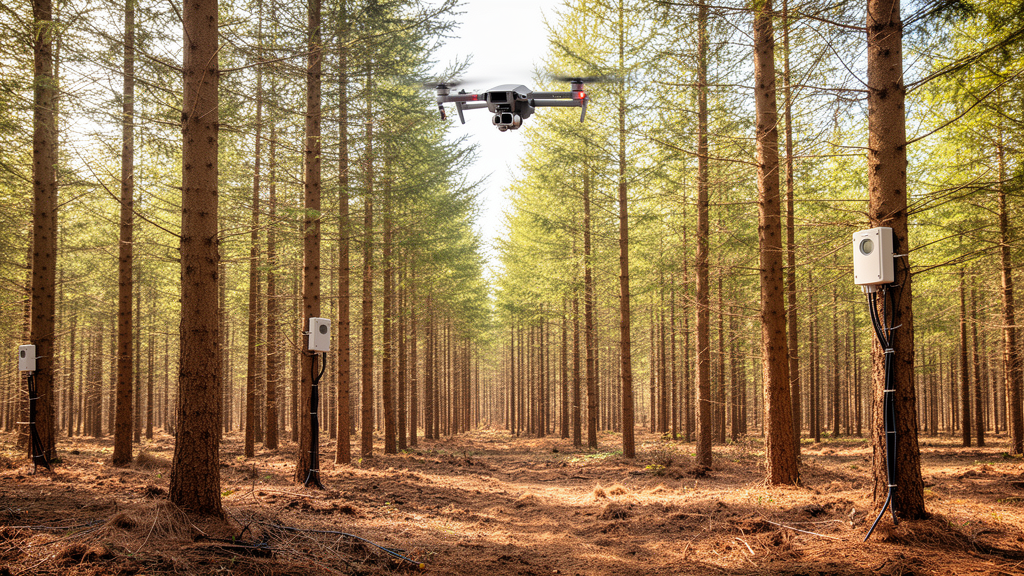
Deep in southern Finland, a managed Norway spruce forest on drained peat soil has become an unlikely laboratory for one of the most urgent questions in boreal ecology: what happens to a water-thrifty conifer forest when the climate turns hot and dry? A new study published in the journal Biogeosciences by Pavel Alekseychik of the Natural Resources Institute Finland and colleagues monitored the Ränskälänkorpi peatland forest through two contrasting summer seasons, 2020 and 2021, and found clear but complex responses to drought. The work is notable not only for its findings but for its method: for the first time, eddy-covariance flux towers, sap-flow sensors, soil and weather instrumentation, and drone-based thermal and multispectral imaging were combined in a single drought experiment on a drained boreal peatland.
The stakes are high. Nearly 80 percent of Fennoscandian forests are intensively managed, and Norway spruce is among the most productive industrial species in the region. Warming temperatures and rising carbon dioxide could, in principle, boost spruce growth in the coming decades, but only if water does not become limiting. Climate projections point in the opposite direction, forecasting more frequent droughts across the boreal zone. Norway spruce is an isohydric species, meaning it closes its stomata in response to rising vapor pressure deficit, the drying power of the air, in order to preserve leaf water potential. That strategy protects the tree’s hydraulics but comes at the cost of reduced carbon uptake, and the species’ shallow roots and generally low drought resilience on mineral soils have long worried foresters. Far less has been known about how spruce fares on peat soil, where water tables are managed by drainage ditches.
The study site offered a natural experiment. In March 2021, the stand was divided into two blocks: an untreated control and a block that was selectively harvested according to the principles of continuous cover forestry, a management approach gaining traction in the boreal region. The harvest removed 55 percent of the trees taller than 15 meters, cutting projected canopy cover from 60 percent to 22 percent and reducing leaf-area index from roughly 3 to 2 square meters per square meter. The researchers hypothesized that the thinned block, with less inter-tree competition for soil water, would weather drought better than the dense control stand, and that is largely what the data showed, though with instructive complications.
Meteorologically, the two years could hardly have been more different. The summer of 2020 was warm but drought-free by the Standardized Precipitation-Evapotranspiration Index, while June and July 2021 brought a severe drought, with monthly SPEI values as low as minus 1.87, a rainless spell lasting until late July, a steep drop in the water table, and surface soil moisture falling below the 0.2 cubic meters per cubic meter threshold the team used to define soil drought. Crucially, atmospheric drought, defined as a daily mean vapor pressure deficit above 1 kilopascal, was frequent in both years, and the hottest days saw median daytime temperatures approaching 30 degrees Celsius. The forest was thus exposed to the full spectrum of atmospheric and soil drought, separately and in combination.
The eddy-covariance tower, standing 29 meters tall on the boundary between the two blocks, revealed the ecosystem-scale signature of that stress. Net ecosystem exchange peaked at a vapor pressure deficit of about 1 kilopascal and fell toward zero as the air dried further, reaching essentially zero exchange at roughly 2 kilopascals in both blocks and both years. Light-saturated photosynthesis, ecosystem respiration, and light-use efficiency all dropped markedly in 2021 compared with 2020, and the Bowen ratio, the ratio of sensible to latent heat flux, roughly doubled during the dry summer, a classic indicator that the forest was diverting energy away from evapotranspiration. Yet the picture was not uniformly grim: drought days are typically sunnier, and the extra sunlight at least partly compensated for the reduced photosynthetic efficiency, keeping daily carbon gains comparable to those of milder days.
The most direct evidence of tree-level stress came from the sap-flow sensors installed on 16 spruce trees, eight per block. In the control stand, sap flow rose linearly with vapor pressure deficit up to about 1 kilopascal and then saturated, a sign that stomata were constricting. More striking was a progressive afternoon dip in control-tree sap flow that deepened from June through July 2021, coinciding with the daily peak in atmospheric demand, and then largely vanished in August when rains returned. Most harvest-block trees, by contrast, maintained higher sap flow across the entire vapor pressure deficit range, consistent with the idea that fewer trees sharing the same soil water reservoir face less competition. When the team upscaled tree-level sap flow to the stand using tree height relationships derived from drone imagery, the thinned block transpired roughly half as much water as the control, echoing earlier findings that thinning raises per-tree water use while lowering stand-level totals.
The drone surveys added a spatial dimension that ground sensors cannot provide. Flying a DJI Matrice 210 with thermal and multispectral cameras on four clear days, the team produced orthomosaics of canopy temperature and the Normalized Difference Vegetation Index, then segmented individual tree crowns and corrected temperatures for differences in canopy brightness. Under non-drought conditions, the two blocks were nearly indistinguishable. During peak drought, however, trees in the harvested block tended to run hotter and show lower NDVI than control trees, implying greater susceptibility to extreme drought in the open stand, possibly because thinned crowns receive more solar radiation. Rows of stressed trees also appeared along forest tracks and ditches, a spatial pattern invisible to the tower. A novel touch was the use of wet and dry reference piles of spruce branches, sprayed with the equivalent of 15 millimeters of rainfall, to convert canopy temperatures into estimates of stomatal conductance for every mapped tree.
Perhaps the study’s most valuable contribution is its honest cross-examination of the monitoring tools themselves. The sap-flow data flagged stress in the denser control stand, exactly where competition for water was fiercest, while the drone data highlighted stress in the thinned stand, where exposed crowns heated up. The eddy-covariance system, which averages fluxes over hectares, smoothed over much of this tree-to-tree variation and could not reliably detect a minority of vulnerable individuals. Each technique, the authors conclude, occupies a different niche: sap flow offers continuity and directness but covers only a handful of trees; drones offer stand-wide spatial coverage but only snapshot temporal resolution; eddy covariance offers continuous ecosystem totals but little spatial discrimination. No single method currently combines directness, continuity, coverage, and low uncertainty.
For forest management, the practical implications are tangible. The evidence that selection-harvested trees maintained higher photosynthetic uptake, sap flow, and stem growth during drought supports continuous cover forestry as a strategy for buffering spruce stands against the hotter, drier summers projected for the boreal zone. The authors also propose a deceptively simple early-warning tactic: equip the least resilient trees in a stand, those most disadvantaged by competition or exposure, with sap-flow and stem-diameter sensors, and let them act as sentinels for the onset of drought stress. As boreal summers like that of 2021 become the norm rather than the exception, such sentinel trees, watched from the ground and the air alike, may become an essential part of keeping northern forests productive and climate-friendly.
Subject of Research: Drought ecophysiology of a managed Norway spruce forest on drained boreal peatland
Article Title: Drought responses of a Norway spruce forest on drained peat soil: combining sap-flow sensors, eddy-covariance, meteorological, soil and UAV data
Article References: Alekseychik, P. K., Peltoniemi, M., Mäkipää, R., Tuominen, V., Laurila, T., Jones, H., Müller, M., Lopatin, E., Rautakoski, H., Vesala, T., & Launiainen, S. (2026). Drought responses of a Norway spruce forest on drained peat soil: combining sap-flow sensors, eddy-covariance, meteorological, soil and UAV data. Biogeosciences, 23(19), 7091-7127. https://doi.org/10.5194/bg-23-7091-2026
Image Credits: AI Generated
Keywords: Norway spruce, drought, boreal forest, peatland, sap flow, eddy covariance, UAV remote sensing, continuous cover forestry, vapor pressure deficit, evapotranspiration, NDVI, forest management
News Source: Sloane Callahan. (October 9, 2026). Sensors and Drones Reveal How Thinned Spruce Forests Weather Drought. Scienmag.