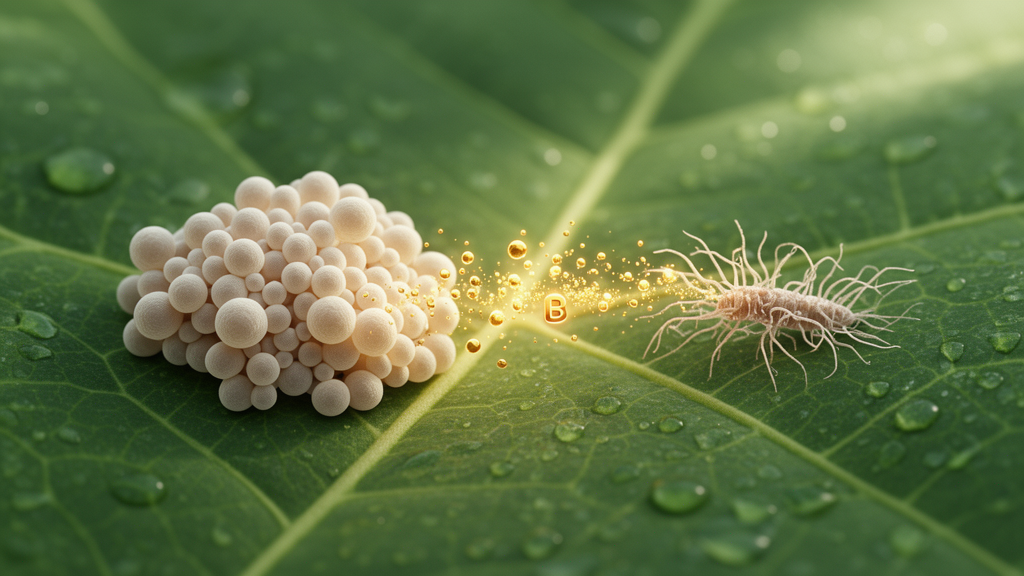
Deep in the microscopic world that coats every green leaf, two organisms have been quietly striking a bargain that scientists have now caught in the act. A team of researchers surveying wild populations of the plant Arabidopsis thaliana across Europe has discovered that a common yeast and an obligate plant pathogen depend on each other for survival through an exchange of vitamin B1, also known as thiamine. The finding, published in Nature Microbiology, offers one of the clearest molecular explanations yet for how microbial communities assemble and remain stable in one of the harshest habitats on Earth: the surface of a living leaf.
The phyllosphere, as the leaf environment is called, is a notoriously difficult place to make a living. It is exposed to ultraviolet radiation, fluctuating humidity, temperature swings and scarce nutrients, and it changes dramatically with the seasons. Yet despite these pressures, leaf surfaces host complex communities of bacteria, fungi, oomycetes and other eukaryotes that influence plant health, disease resistance and even ecosystem function. Understanding which interactions hold these communities together has been a long-standing puzzle, because most studies rely on computational predictions of who interacts with whom rather than direct experimental proof of the underlying mechanisms.
To crack the problem, the researchers launched a continental-scale field survey, collecting 347 wild Arabidopsis plants from 15 natural populations spanning Spain, France, Germany and Sweden. They sequenced bacterial, fungal, oomycete and broader eukaryotic marker genes from both whole-leaf samples and surface-sterilized endophytic samples, building a multikingdom picture of who lives where. Network analysis of the resulting data revealed that certain taxa, so-called hub microbes, occupied disproportionately central positions in the microbial community. Among the most prominent were the oomycete genus Albugo and the basidiomycete yeast Dioszegia, both of which scored highly on measures of closeness and betweenness centrality, indicating that they act as connective tissue within the leaf microbiome.
Albugo laibachii is an obligate biotrophic pathogen, meaning it can only survive on living host tissue. Such pathogens typically lose essential metabolic pathways during evolution because they can steal the missing nutrients from their hosts. Albugo’s genome, for example, lacks the entire pathway for making thiamine. But there is a catch: during the earliest stages of infection, before the pathogen has penetrated the plant, the leaf surface offers almost no resources. The researchers hypothesized that other leaf-dwelling microbes might be filling this gap, and that a positive interaction between Albugo and a co-occurring microbe could explain how the pathogen manages to establish itself in nature.
Testing this idea required moving from correlation to causation. The team adapted a gnotobiotic system in which sterile Arabidopsis seedlings are grown in plates and inoculated with defined microbes, allowing them to measure how individual strains affect Albugo colonization. Of twelve candidate interactors predicted from the network analysis, most either inhibited the pathogen or had no effect. One result was particularly instructive: two strains of the yeast Leucosporidium, predicted to interact positively with Albugo, actually suppressed infection, a reminder that computational associations do not always translate into direct functional outcomes. But one strain, a Dioszegia hungarica isolate designated EY, consistently and strongly promoted Albugo infection, exactly as the network had predicted.
The molecular culprit turned out to be a gene called DhPER1, which encodes a membrane permease for thiamine. Comparing the genomes of the Albugo-promoting EY strain and a non-promoting strain from Portugal, the researchers found that DhPER1 carried the highest density of single-nucleotide polymorphisms among all thiamine-related genes, and that its expression was more than twentyfold higher in EY than in the non-promoting strain. Using a newly developed CRISPR-based transformation system for Dioszegia, they knocked out DhPER1 in the EY strain and found that the mutant lost its ability to promote Albugo infection. Complementing the mutant with the EY version of the gene restored the phenotype, confirming that this single permease is the key to the interaction.
Enzyme-linked immunosorbent assays showed that strains expressing DhPER1 secreted thiamine into their surroundings, and adding purified thiamine to the gnotobiotic system boosted Albugo infection by up to 500 percent at low concentrations. Under the microscope, the researchers observed something remarkable: Albugo zoospores, the motile spores that initiate infection, actively swam toward Dioszegia EY cells rather than drifting freely in water, suggesting that the yeast both attracts and feeds the pathogen. Transcriptomic analysis two days after infection revealed that Albugo’s overall gene expression tripled in the presence of the EY strain, with 316 genes upregulated, many involved in metabolism and membrane transport, indicating that the yeast jump-starts the pathogen’s metabolic machinery during the critical early phase of colonization.
Evolutionary analyses added a deeper layer to the story. The DhPER1 gene shows signatures of strong purifying selection in Dioszegia, with a ratio of nonsynonymous to synonymous substitutions among the most conserved of all genes, and the RELAX algorithm revealed intensified selection specifically along the D. hungarica lineage. The EY strain also carries more than twice as many tRNA genes as other D. hungarica strains, and its thiamine-related genes show significantly higher predicted translation efficiency, suggesting that natural selection has optimized the yeast’s protein-production machinery to support the cross-feeding lifestyle. These findings echo the Black Queen Hypothesis, which proposes that leaky production of costly public goods drives stable metabolic dependencies between microbes.
What does the yeast get out of the deal? In long-term co-cultivation experiments lasting 32 days, roughly the span of Arabidopsis’s vegetative growth, Dioszegia populations gradually died out on non-sterile plants when Albugo was absent, overwhelmed by the native microbiome. But when Albugo was present, the yeast populations were rescued, increasing more than a hundredfold, and strains expressing DhPER1 fared significantly better than those without it. The benefit appears to be indirect: Albugo, known from earlier work to suppress plant immunity and inhibit certain competitors, effectively engineers the leaf environment, sheltering its metabolic partner from competitive exclusion. The result is an asymmetric mutualism in which the yeast supplies a vitamin and the pathogen supplies a niche.
The implications reach well beyond Arabidopsis. Vitamin auxotrophy is widespread among bacteria in oceans, soils and the human gut, and obligate plant pathogens such as downy mildews, rusts and arbuscular mycorrhizal fungi all depend on nutrients they cannot make themselves. If the colonization of such organisms depends on nutrient supplies from the microbiome rather than solely from the host, as this study suggests, then manipulating microbial nutrient flows could become a powerful tool. Researchers envision strategies that either starve harmful obligate pathogens by disrupting their microbial supply lines or bolster beneficial symbionts by engineering cross-feeding partners, opening a new frontier in microbiome engineering for agriculture and ecosystem management.
Subject of Research: Thiamine cross-feeding between a leaf yeast and an oomycete pathogen in the Arabidopsis phyllosphere microbiome
Article Title: Thiamine cross-feeding drives microbial coexistence in the leaf microbiome
Article References: Hu, Y., Bode, J., Gómez-Pérez, D., Guerreiro, M. A., Mari, A., Wang, K., Niemann, S., Mahmoudi, M., Kemen, A., Duran, P., Wacker, O., Straub, D., Nahnsen, S., Schwessinger, B., Roux, F., Alonso-Blanco, C., Ågren, J., Hacquard, S., Stukenbrock, E. H., & Kemen, E. (2026). Thiamine cross-feeding drives microbial coexistence in the leaf microbiome. Nature Microbiology. https://doi.org/10.1038/s41564-026-02499-w
Image Credits: AI Generated
DOI: 10.1038/s41564-026-02499-w
Keywords: thiamine, cross-feeding, phyllosphere, microbiome, Arabidopsis thaliana, Albugo laibachii, Dioszegia hungarica, mutualism, keystone taxa, oomycete, plant pathology, microbial ecology
News Source: Morgan Morrow. (October 9, 2026). A Leaf-Dwelling Yeast Feeds Vitamin B1 to a Pathogen, Keeping Both Alive. Scienmag.