Better detection of microwave radiation will improve thermal imaging, electronic warfare, radio communications
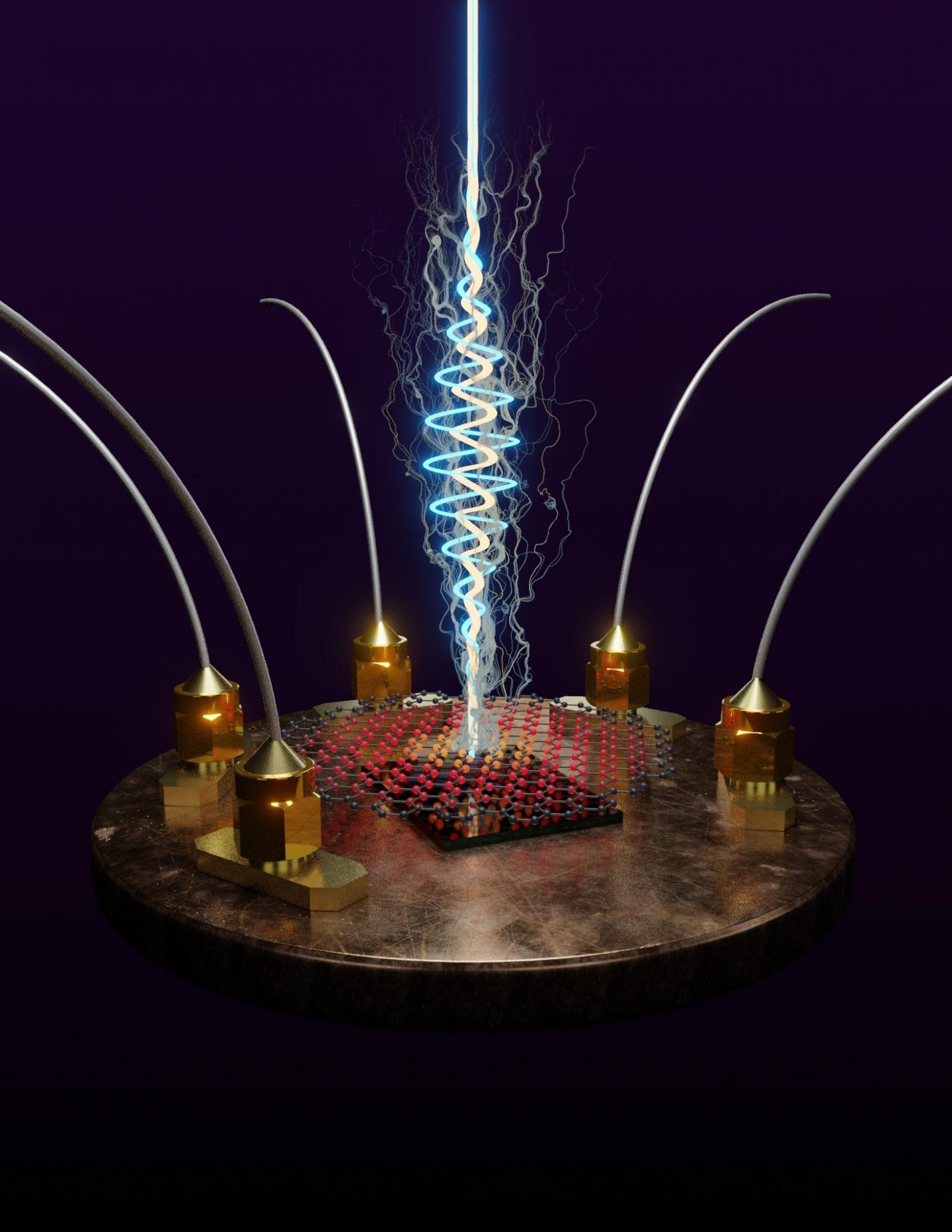
Credit: Raytheon BBN Technologies
RESEARCH TRIANGLE PARK, N.C. — Army-funded research developed a new microwave radiation sensor with 100,000 times higher sensitivity than currently available commercial sensors. Researchers said better detection of microwave radiation will enable improved thermal imaging, electronic warfare, radio communications and radar.
Researchers published their study in the peer-reviewed journal Nature. The team includes scientists from Harvard University, The Institute of Photonic Sciences, Massachusetts Institute of Technology, Pohang University of Science and Technology, and Raytheon BBN Technologies. The Army, in part, funded the work to fabricate this bolometer by exploiting the giant thermal response of graphene to microwave radiation.
“The microwave bolometer developed under this project is so sensitive that it is capable of detecting a single microwave photon, which is the smallest amount of energy in nature,” said Dr. Joe Qiu, program manager for solid-state electronics and electromagnetics, Army Research Office, an element of the U.S. Army Combat Capabilities Development Command’s Army Research Laboratory. “This technology will potentially enable new capabilities for applications such as quantum sensing and radar, and ensure the U.S. Army maintains spectral dominance in the foreseeable future.”
The graphene bolometer sensor detects electromagnetic radiation by measuring the temperature rise as the photons are absorbed into the sensor. Graphene is a two dimensional, one-atom layer thick material. The researchers achieved a high bolometer sensitivity by incorporating graphene in the microwave antenna.
A key innovation in this advancement is to measure the temperature rise by superconducting Josephson junction while maintaining a high microwave radiation coupling into the graphene through an antenna, researchers said. The coupling efficiency is essential in a high sensitivity detection because “every precious photon counts.”
A Josephson junction is a quantum mechanical device which is made of two superconducting electrodes separated by a barrier (thin insulating tunnel barrier, normal metal, semiconductor, ferromagnet, etc.)
In addition to being thin, the electrons in graphene are also in a very special band structure in which the valence and conduction bands meet at only one point, known as Dirac point.
“The density of states vanishes there so that when the electrons receive the photon energy, the temperature rise is high while the heat leakage is small,” said Dr. Kin Chung Fong, Raytheon BBN Technologies.
With increased sensitivity of bolometer detectors, this research has found a new pathway to improve the performance of systems detecting electromagnetic signal such as radar, night vision, LIDAR (Light Detection and Ranging), and communication. It could also enable new applications such as quantum information science, thermal imaging as well as the search of dark matter.
The part of the research conducted at MIT included work from the Institute for Soldier Nanotechnologies. The U.S. Army established the institute in 2002 as an interdisciplinary research center to dramatically improve protection, survivability and mission capabilities of the Soldier and of Soldier-supporting platforms and systems.
###
CCDC Army Research Laboratory is an element of the U.S. Army Combat Capabilities Development Command. As the Army’s corporate research laboratory, ARL discovers, innovates and transitions science and technology to ensure dominant strategic land power. Through collaboration across the command’s core technical competencies, CCDC leads in the discovery, development and delivery of the technology-based capabilities required to make Soldiers more lethal to win the nation’s wars and come home safely. CCDC is a major subordinate command of the U.S. Army Futures Command.
Media Contact
Lisa B Bistreich-Wolfe
[email protected]
Original Source
https:/
Related Journal Article
http://dx.