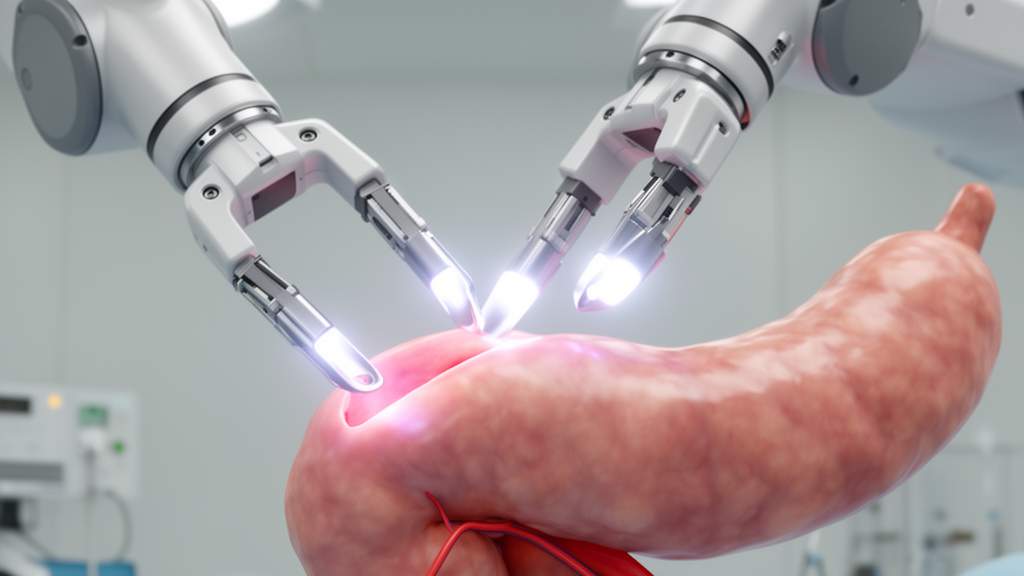
A newly evaluated surgical protocol known as the Sensor-Assisted Firing Execution, or SAFE Cut technique, successfully standardized pancreatic transection during robotic distal pancreatectomy across thirty-one consecutive patients. Robotic distal pancreatectomy presents distinct technical challenges because surgeons at the console operate without haptic feedback, while stapler firing is delegated to a bedside assistant. Consequently, tissue compression quality during transection has remained highly operator-dependent under traditional practice. The investigated technique establishes an objective, device-guided workflow designed to convert subjective wait-and-fire judgment into a standardized procedure.
The protocol utilizes a smart stapler that displays real-time tissue resistance across nine stratifications divided among three color-coded zones, labeled Zone 1–1 through Zone 3–3. Based on the observed zone reading, surgical teams implemented a mandatory pre-firing compression wait ranging from immediate firing to sixty seconds. This assigned waiting period was not applied merely once across the gland; instead, bedside operators reassessed the reading and re-applied the corresponding pre-firing wait at every incremental firing step throughout the transection.
Investigators evaluated the workflow by reviewing thirty-one consecutive patients who underwent robotic distal pancreatectomy with the SAFE Cut protocol, analyzing prospectively recorded zone observations for all firing steps. In every case, the stapler was operated by a bedside trainee. The protocol was completed in all thirty-one patients without any protocol-related conversion, repositioning, or technical failure, demonstrating that trainee bedside assistants could reliably execute the standardized, sensor-guided sequence without procedural breakdown.
Across the cohort, the median pancreatic transection time was 13.3 minutes, with observed values ranging from 8.7 to 23.0 minutes. Clinically relevant postoperative pancreatic fistula occurred in one patient, representing an incidence of 3.2 percent. The authors reported that no Grade C pancreatic fistulas developed in the study population, and there was zero 90-day mortality recorded following the procedures.
Analysis of 1,179 individual firing steps documented the distribution of tissue resistance encountered during surgery. Zone 1 readings occurred in 940 steps, accounting for 79.7 percent of all recorded events, while Zone 2 readings occurred in 239 steps, or 20.3 percent. Zone 3 resistance readings never occurred. These prospectively gathered observations enabled the surgical team to quantify mechanical variations occurring within the pancreatic tissue during division.
Because each incremental step advances the stapler to new tissue, consecutive readings sampled distinct pancreatic segments. The data revealed notable local variation across adjacent tissue regions: following a Zone 2 resistance reading, the subsequent step registered a Zone 1 reading in 136 of 239 events, or 56.9 percent. This documented transition demonstrates that tissue resistance fluctuates across adjacent areas, exposing previously unquantified tissue heterogeneity during transection.
The authors concluded that the SAFE Cut technique is feasible and successfully quantifies previously hidden variations in pancreatic resistance during robotic surgery. However, the researchers emphasized that the study was not designed to evaluate fistula prevention. While the observed rate of clinically relevant fistula was low, a thirty-one patient study cannot establish clinical efficacy or prove complication reduction. Whether this approach reduces fistula rates, and whether comparably low rates recur in other cohorts, requires prospective investigation.
Subject of Research: Standardized sensor-guided pancreatic transection during robotic distal pancreatectomy
Article Title: Sensor-assisted firing execution (SAFE) cut: a quantitatively standardized technique for pancreatic transection in robotic distal pancreatectomy
Article References: Ninomiya, R., Takemura, N., Sawano, T., Nakamura, M., Okinaga, H., Kurata, M., Beck, Y., & Seyama, Y. (2026). Sensor-assisted firing execution (SAFE) cut: a quantitatively standardized technique for pancreatic transection in robotic distal pancreatectomy. Langenbeck's Archives of Surgery. https://doi.org/10.1007/s00423-026-04332-8
Image Credits: AI Generated
DOI: 10.1007/s00423-026-04332-8
Keywords: robotic distal pancreatectomy, SAFE Cut technique, pancreatic transection, smart stapler, tissue resistance, color-coded zones, compression quality, haptic feedback, bedside trainee, pre-firing wait, clinically relevant postoperative pancreatic fistula, CR-POPF, transection time, incremental firing steps, pancreatic surgery, surgical robotics, feasibility study
News Source: Ophelia Keating. (November 20, 2026). Sensor-Guided Protocol Standardizes Robotic Pancreatic Transection in Initial Feasibility Study. Scienmag.