


Credit: Patrick Drew, Penn State
A consensus is building that air pollution can cause neurological diseases such as Alzheimer’s disease and Parkinson’s disease, but how fine, sooty particles cause problems in the brain is still an unanswered question. Now a team of Penn State researchers, using mice, have found a possible way, but more research is still needed.
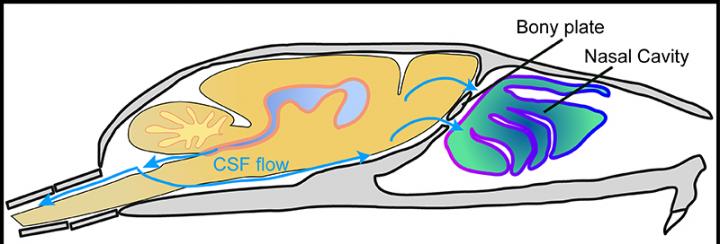
The researchers looked at how cerebrospinal fluid, the liquid that flows around the brain and spinal cord, flows out through the nose, and what happens when the flow of fluid is stopped.
“There has been a lot of interest in understanding cerebrospinal fluid movement in the last 5 years,” said Patrick Drew, Huck Distinguished Associate Professor of Engineering Science and Mechanics, Neurosurgery and Biomedical Engineering. “More and more it is realized that it does not just cushion the brain, but may also transfer stuff out of the brain and spinal column area.”
The question, however, is how does the cerebrospinal fluid — or CSF — leave the enclosed area of the brain and spinal column and where does it go? Research into old scientific papers indicated that some scientists had speculated that one exit pathway was through the nose.
“I was trying to label cerebrospinal fluid with a dye for another experiment,” said Jordan N. Norwood, graduate student in cellular and developmental biology and Drew’s student. “We started seeing this dyed cerebrospinal fluid drain out through the nose.”
More research into old scientific papers showed that not only had others suggested that the cerebrospinal fluid left through the nose, but that there was a connection to the sense of smell. The researchers also found that there is a long-held connection between loss of smell and the early beginnings of such neurological diseases as Alzheimer’s disease and Parkinson’s disease.
Using chemical ablation, the researchers destroyed the olfactory sensory nerves that come through the mouse’s hard palate. Destruction of these nerves causes loss of the sense of smell, but also caused the flow of cerebrospinal fluid to stop.
“The mice seem normal after we used zinc sulfate to ablate the nerves in the nose,” said Drew.
Because the flow of fluid from the nose stopped, the researchers checked to see if the pressure around the brain and in the spinal cord increased.
“Animals and people are constantly making CSF so if it doesn’t go out, pressure will go up,” said Drew. “But we found that the pressure did not increase after the flow from the nose stopped.”
The researchers believe that some other pathway may increase its flow or CSF to compensate for what would normally go out through the nose. These other pathways could include those around the brain that drain into the lymphatic system.
Another possibility is that the production of CSF decreases in response to stoppage of CSF flow through the nose.
The researchers suggest in a recent issue of eLife, “that damage to olfactory sensory neurons (such as from air pollution) could contribute to altered CSF turnover and flow, providing a potential mechanism for neurological disease.” They also state that “reduced CSF turnover may be a contributing factor to the buildup of toxic metabolites and proteins that cause neurodegenerative disorders.”
Both the effects of pollution and the effects of reduced CSF turnover might explain the origin of some of these diseases.
“By ablating the neurons, we were able to disrupt and disable flow in the nose,” said Norwood. “People in areas with heavy air pollution may be breathing stuff that does the same thing as our experiments.
“Next we would like to collaborate with a lab in the Materials Research Institute that is working with soot or jet fuel particles to see if we get the same effect,” she added.
###
Other researchers on this project include Qinigguang Zhang, postdoctoral fellow in engineering science and mechanics; David Card, undergraduate in physics, since graduated; Amanda Craine, undergraduate in biomedical engineering; and Timothy M. Ryan, associate professor of anthropology and interim department head.
The McKnight Endowment Fund for Neuroscience, the National Institutes of Health and the National Science Foundation supported this work.
Media Contact
A’ndrea Elyse Messer
[email protected]
Related Journal Article
http://dx.



