• HOME
  • NEWS
  • EXPLORE
    • CAREER
      • Companies
      • Jobs
    • EVENTS
    • iGEM
      • News
      • Team
    • PHOTOS
    • VIDEO
    • WIKI
  • BLOG
  • COMMUNITY
    • FACEBOOK
    • INSTAGRAM
    • TWITTER
Wednesday, December 17, 2025
BIOENGINEER.ORG
No Result
View All Result
  • Login
  • HOME
  • NEWS
  • EXPLORE
    • CAREER
      • Companies
      • Jobs
        • Lecturer
        • PhD Studentship
        • Postdoc
        • Research Assistant
    • EVENTS
    • iGEM
      • News
      • Team
    • PHOTOS
    • VIDEO
    • WIKI
  • BLOG
  • COMMUNITY
    • FACEBOOK
    • INSTAGRAM
    • TWITTER
  • HOME
  • NEWS
  • EXPLORE
    • CAREER
      • Companies
      • Jobs
        • Lecturer
        • PhD Studentship
        • Postdoc
        • Research Assistant
    • EVENTS
    • iGEM
      • News
      • Team
    • PHOTOS
    • VIDEO
    • WIKI
  • BLOG
  • COMMUNITY
    • FACEBOOK
    • INSTAGRAM
    • TWITTER
No Result
View All Result
Bioengineer.org
No Result
View All Result
Home NEWS Science News Biology

Semen miRNAs could be non-invasive biomarkers for prostate cancer

Bioengineer by Bioengineer
September 26, 2019
in Biology
Reading Time: 2 mins read
0
IMAGE
Share on FacebookShare on TwitterShare on LinkedinShare on RedditShare on Telegram

IMAGE

Credit: IDIBELL

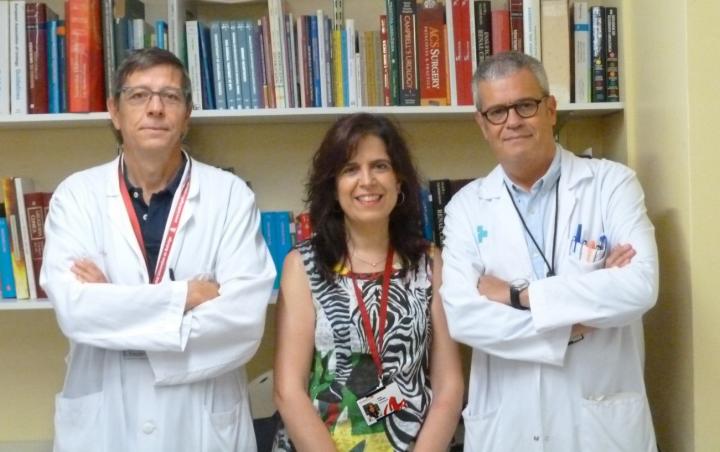
Researchers of the Human Molecular Genetics group at the Bellvitge Biomedical Research Institute (IDIBELL), led by Dr. Sara Larriba, in collaboration with Dr. Francesc Vigués and Dr. Manel Castells of the Urology Service of Bellvitge University Hospital (HUB), show the usefulness of certain molecules, the miRNAs in semen, as non-invasive biomarkers for prostate cancer. The results of this study were protected by a patent and are published in Scientific Reports this week.

Semen could be considered a liquid biopsy of the organs of male reproductive system and specifically of prostate gland: approximately 40% of semen is derived from prostatic tissue, so that its contents are most likely to contain prostate disease-specific derived molecules. Dr. Larriba’s research group, which focuses on the “Molecular Genetics of Male Infertility and Urogenital Cancer” research line, has determined that the quantification of certain molecules of ribonucleic acid, known as miRNAs, contained in extracellular vesicles from seminal plasma might be clinically useful as non-invasive biomarkers for prostate cancer.

“Our study shows semen exosome miRNA-based models as molecular biomarkers with the potential to improve prostate cancer diagnosis/prognosis efficiency. These miRNA-based tests should provide reliable information that will help physicians to take clinical decisions as well as will save unnecessary invasive biopsies to the patients, improving the efficiency of detection of prostate cancer and patient outcome”, Dr. Larriba explains.

Prostate cancer is the most prevalent type of malignant male cancer in Western countries. A significant decrease in deaths due to prostate cancer has been associated with the use of the PSA screening test. However, the deficiencies of serum PSA as a biomarker are well documented: “In many cases, having elevated PSA levels does not mean having prostate cancer. Thus, PSA screening has resulted in an over-diagnosis of prostate cancer, and in many unnecessary biopsies of benign disease” Dr Vigués explains. “Additionally, serum PSA levels do not correlate with tumor aggressiveness, survival, or response to pharmacological treatments leading to over-treatment of indolent tumors. Given this context, more accurate non-invasive biomarkers for prostate cancer with diagnostic and prognostic purposes would be very welcomed indeed” Dr. Castells adds.

“Our aim is to offer our results to the clinics as a diagnostic test. In that respect, as our next step, we should carry out further prospective studies on larger cohorts of patients before this miRNA-based biomarker could be adopted in the daily clinical practice”, Larriba concludes.

###

Media Contact
Gemma Fornons
[email protected]

Original Source

http://www.idibell.cat/en/whats-on/noticies/researchers-prove-usefulness-semen-mirnas-non-invasive-biomarkers-prostate-cancer

Related Journal Article

http://dx.doi.org/10.1038/s41598-019-50172-6

Tags: BiologycancerGeneticsMedicine/HealthProstate Cancer
Share13Tweet8Share2ShareShareShare2

Related Posts

blank

Revolutionary Transformer Boosts Microbial Protein Function Insights

December 17, 2025
DEPDC1B Boosts Colon Cancer Progress Post-EBF1 Loss

DEPDC1B Boosts Colon Cancer Progress Post-EBF1 Loss

December 17, 2025

Gender Gaps in Cognitive Decline: A Review

December 16, 2025

Correction: m6A Regulates ABA via ECT8 Condensates

December 16, 2025
Please login to join discussion

POPULAR NEWS

  • Nurses’ Views on Online Learning: Effects on Performance

    Nurses’ Views on Online Learning: Effects on Performance

    70 shares
    Share 28 Tweet 18
  • NSF funds machine-learning research at UNO and UNL to study energy requirements of walking in older adults

    70 shares
    Share 28 Tweet 18
  • MoCK2 Kinase Shapes Mitochondrial Dynamics in Rice Fungal Pathogen

    72 shares
    Share 29 Tweet 18
  • Unraveling Levofloxacin’s Impact on Brain Function

    52 shares
    Share 21 Tweet 13

About

We bring you the latest biotechnology news from best research centers and universities around the world. Check our website.

Follow us

Recent News

LBNet: Optimized CNN for Interpretable Breast Cancer Detection

Assessing the Social Communication Questionnaire in Rural Kenya

14 Epigenetic Clocks Compared Across 174 Diseases

Subscribe to Blog via Email

Enter your email address to subscribe to this blog and receive notifications of new posts by email.

Join 70 other subscribers
  • Contact Us

Bioengineer.org © Copyright 2023 All Rights Reserved.

Welcome Back!

Login to your account below

Forgotten Password?

Retrieve your password

Please enter your username or email address to reset your password.

Log In
No Result
View All Result
  • Homepages
    • Home Page 1
    • Home Page 2
  • News
  • National
  • Business
  • Health
  • Lifestyle
  • Science

Bioengineer.org © Copyright 2023 All Rights Reserved.